BASIC · EP 04 · EXERCISE — PART 2
Before You Listen
Episode Setup
- Topic in one line: the physiology of exercise prescription — VO2max as the gold-standard measure of cardiorespiratory fitness defined by the Fick equation (VO2 equals cardiac output multiplied by the arteriovenous oxygen difference), metabolic equivalents (METs) where 1 MET equals 3.5 mL of oxygen per kilogram per minute, the rate-pressure product (RPP) as a clinical surrogate for myocardial oxygen demand, the Karvonen heart rate reserve formula (target heart rate equals resting heart rate plus the intensity percent times the heart rate reserve, where heart rate reserve equals maximum heart rate minus resting heart rate and maximum heart rate is estimated as 220 minus age), the Borg rating of perceived exertion (RPE) scale (6 to 20 with target 11-14 for moderate exercise, preferred over heart rate in beta-blocker, atrial fibrillation, pacemaker, or cardiac transplant patients), the FITT principle (Frequency, Intensity, Time, Type), the ACSM aerobic targets (150 minutes per week of moderate or 75 minutes per week of vigorous exercise), the aerobic and anaerobic thresholds (approximately 2 mmol/L and 4 mmol/L lactate), the cardiovascular and skeletal muscle adaptations to aerobic and resistance training, the denervated cardiac transplant heart, special populations (diabetes, COPD), the absolute contraindications to graded exercise testing, detraining timelines, and overtraining syndrome.
- Prerequisites: Part 1 of this episode (the three energy systems and the bioenergetic continuum), familiarity with cardiac output (heart rate multiplied by stroke volume), basic muscle fiber types from BASIC-02, and the difference between aerobic and anaerobic metabolism.
- Runtime: 45 minutes.
Vignette. A 52-year-old man with controlled hypertension on metoprolol succinate 50 mg daily completes a baseline graded exercise test that stops at 8 metabolic equivalents (METs) for fatigue without ischemic changes. His resting heart rate is 60 beats per minute on the medication, his measured maximum heart rate on the test is 150 beats per minute, and his clinic blood pressure is 124/78. He is referred to a supervised cardiac fitness program and asks for a target heart rate range for moderate aerobic exercise.
Calculate his target heart rate range at 50 to 70 percent of heart rate reserve (HRR) using the Karvonen formula, and explain why the rating of perceived exertion (RPE) should also be tracked at every session.
(Answer at the end of this chapter)
Section 1: VO2max, the Fick Equation, and METs
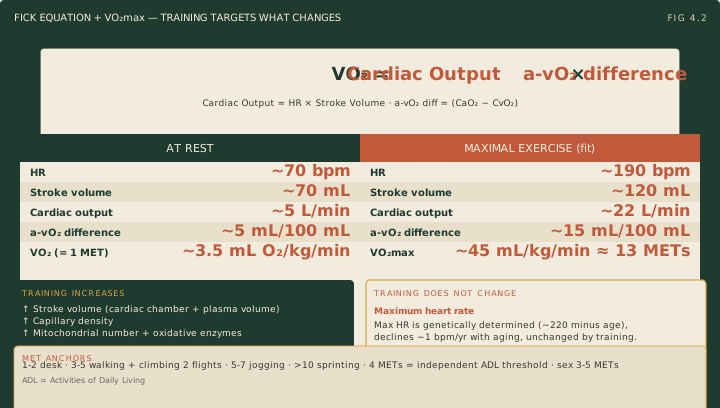
Bottom line: VO2max (maximal oxygen consumption) is the gold-standard quantitative measure of cardiorespiratory fitness, defined by the Fick equation (VO2 equals cardiac output multiplied by the arteriovenous oxygen difference, where cardiac output equals heart rate multiplied by stroke volume); training improves VO2max by raising stroke volume (eccentric cardiac hypertrophy, increased plasma volume) and the arteriovenous oxygen difference (capillary density, mitochondrial biogenesis), but maximum heart rate does not change with training and declines with age; many rehabilitation patients cannot reach a true VO2max plateau and stop at a symptom-limited peak VO2; 1 MET equals 3.5 mL of oxygen per kilogram per minute (resting metabolic rate), and 4 METs is the practical threshold for independent activities of daily living, with sexual activity at approximately 3-5 METs (equivalent to climbing two flights of stairs at a normal pace).
VO2max is the maximal oxygen consumption attainable during exhaustive exercise. It is measured during a graded exercise test on a treadmill or cycle ergometer, with intensity progressively increased until volitional exhaustion. The hallmark of a true VO2max is a plateau in oxygen consumption despite further increases in workload. VO2max is expressed in milliliters of oxygen per kilogram of body weight per minute (mL O2/kg/min) or in absolute terms as liters of oxygen per minute.
VO2max is governed by the Fick equation:
VO2 = Cardiac Output × Arteriovenous O2 difference (a-vO2 difference)
= Heart Rate × Stroke Volume × (CaO2 − CvO2)
Cardiac output is the volume of blood pumped per minute (heart rate multiplied by stroke volume; resting approximately 5 L/min, maximal in fit individuals approximately 20-25 L/min). The arteriovenous oxygen difference reflects how much oxygen the working tissues extract from each unit of blood (resting approximately 5 mL O2 per 100 mL of blood; maximal approximately 15-17 mL per 100 mL during exhaustive exercise). VO2max is improved by training-induced increases in maximal cardiac output (primarily larger stroke volume) and by training-induced increases in tissue extraction (greater capillary density, more mitochondria, more oxidative enzymes). Maximum heart rate does not change appreciably with training and declines with age.
Normal VO2max varies by age, sex, and fitness level. A young healthy male is approximately 40-50 mL O2/kg/min; a young healthy female approximately 35-45 mL O2/kg/min. Elite endurance athletes can reach 70-85 mL O2/kg/min. Sedentary individuals may be as low as 20-25 mL O2/kg/min. VO2max declines at approximately 0.5-1 percent per year after age 30 in sedentary individuals, with regular exercise substantially slowing the decline. Many rehabilitation patients cannot achieve a true VO2max plateau due to pain, fatigue, musculoskeletal limitation, or neurologic impairment; in such cases, a symptom-limited peak VO2 is reported. A true physiological VO2max requires that the engine give out before the chassis does; in a patient with chronic spinal cord injury, recent stroke, or severe knee osteoarthritis, the chassis breaks first and the test ends at a peak VO2 well below the patient’s true cardiovascular ceiling.
 ::: {.podcast-quote .stable}
Standard sexual activity generally requires an energy expenditure in the range of three to five METs. Physiologically, three to five METs is the functional equivalent of climbing two standard flights of stairs at a normal pace. Therefore, if you can observe that patient climbing two flights of stairs in the clinic without experiencing angina, excessive tachycardia, or severe dyspnea, you can objectively clear them for sexual activity.
::: {.podcast-quote .stable}
Standard sexual activity generally requires an energy expenditure in the range of three to five METs. Physiologically, three to five METs is the functional equivalent of climbing two standard flights of stairs at a normal pace. Therefore, if you can observe that patient climbing two flights of stairs in the clinic without experiencing angina, excessive tachycardia, or severe dyspnea, you can objectively clear them for sexual activity.
— BASIC-04-b podcast, ~13:50 :::
This brings us to the foundational principle of exercise physiology, which is the Fick equation. The Fick equation states that VO2 equals cardiac output multiplied by the arteriovenous oxygen difference. Cardiac output is your heart rate multiplied by your stroke volume — that is simply how much blood the pump is moving per minute.
— BASIC-04-b podcast, ~4:37