Before You Listen
Episode Setup
- Topic in one line: the impairment-versus-disability distinction (impairment is a problem in body function or structure; disability reflects health-related limitations interacting with context and applicable role or benefit criteria); the World Health Organization (WHO) International Classification of Functioning, Disability and Health (ICF) biopsychosocial framework that replaced the older linear impairment-disability-handicap model; the American Medical Association (AMA) Guides to the Evaluation of Permanent Impairment, 6th edition, diagnosis-based impairment (DBI) methodology with class assignment, three grade modifiers, and the Combined Values Chart; the Social Security Administration (SSA) 5-step sequential evaluation and the SSDI/SSI distinction; the Americans with Disabilities Act (ADA), Section 504 of the Rehabilitation Act, and the Family and Medical Leave Act (FMLA); the workers’ compensation framework including maximum medical improvement (MMI), the independent medical examination (IME), and the functional capacity evaluation (FCE); the four elements of decision-making capacity (understanding, appreciation, reasoning, communication) and the capacity-versus-competency distinction; advance directives (living will, durable power of attorney for healthcare) and portable clinician orders (POLST/MOLST); and the Daubert versus Frye expert witness standards.
- Prerequisites: familiarity with the WHO disability frameworks, the basic structure of federal benefits programs (Medicare, Medicaid, SSDI/SSI), and the standard physiatric assessment of range of motion and neurological function.
- Runtime: 53 minutes.
Vignette. A 52-year-old right-hand-dominant concert pianist sustains a crush injury to the right dominant index finger requiring distal interphalangeal (DIP) amputation. After 9 months of rehabilitation she has reached MMI. Her impairment is rated under the AMA Guides 6th edition. She also carries a 10 percent whole person impairment (WPI) from a prior left shoulder injury. She files a workers’ compensation claim and applies for SSDI; her employer terminates her position citing inability to perform the essential job functions of a concert pianist.
Distinguish her impairment from her disability, calculate her combined whole person impairment using hypothetical supplied values of 5 percent WPI for the new injury and 10 percent WPI for the prior shoulder, identify which Social Security step would address her ability to return to past relevant work, identify which federal statute requires her employer to consider reasonable accommodation, and identify the legal standard her treating physiatrist’s expert testimony must meet in federal court.
(Answer at the end of this chapter)
Section 1: Impairment vs Disability and the ICF Framework
Bottom line: impairment concerns body function or structure; disability reflects health-related limitations interacting with context and role demands. Same impairment, different disability across contexts. Cascade: radial nerve palsy = disease, wrist drop = impairment, cannot type = disability. The WHO ICF (2001) replaced the older ICIDH linear model with a biopsychosocial interactive model. ICF Part 1 pairs body functions and structures with activities and participation; disability remains an umbrella term. Part 2: environmental and personal factors.
The most fundamental concept in this domain is the impairment-versus-disability distinction, tested relentlessly.
Impairment is a problem in body structure or function, including psychological function. Physicians assess impairments and may rate permanent impairment using the applicable rating system. An impairment is not inherently a whole-person percentage: some systems rate a region or scheduled member. Physicians also document functional limitations relevant to disability decisions.
In occupational and benefit discussions, disability concerns limitations in activity or role performance under the applicable criteria. Both medical limitations and contextual factors matter: job demands, accessibility, supports and legal standards. The same rated impairment can have different occupational consequences for a concert pianist and a philosophy professor. In the ICF, disability is the broader umbrella encompassing impairments, activity limitations and participation restrictions.
Two additional terms complete the cascade. Disease/disorder is the underlying pathology (the medical diagnosis). Handicap, in older WHO terminology, referred to the social disadvantage from impairment or disability. The modern ICF replaced “handicap” with participation restrictions.
The classic cascade: radial nerve palsy (disease) leads to wrist drop (impairment), which leads to inability to write or type (disability), which leads to inability to participate in employment (participation restriction, formerly handicap).
The WHO ICF framework, adopted in 2001, replaced the older International Classification of Impairments, Disabilities, and Handicaps (ICIDH, published in 1980) with a biopsychosocial model that conceptualizes functioning and disability as interactions between health conditions and contextual factors.
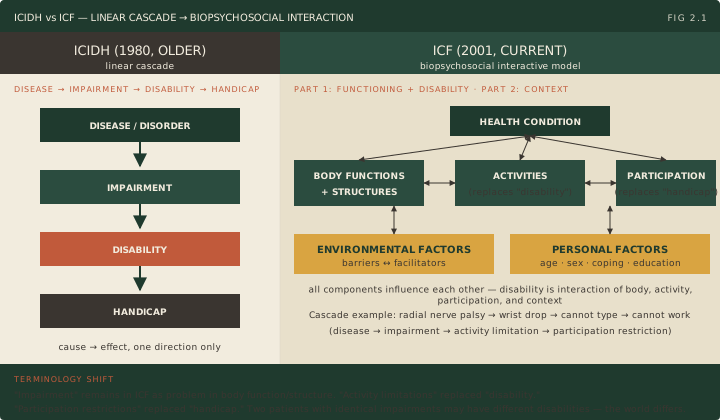
The ICF is organised in two parts. Keep four familiar concepts in view—body functions, body structures, activities and participation—while distinguishing them from the formal paired components.
Part 1 (functioning and disability):
- Body functions = physiological functions including psychological functions (muscle power, joint mobility, sensation, cognition).
- Body structures = anatomical parts (organs, limbs).
- Activities = execution of a task; activity limitations replace the older term “disability.”
- Participation = involvement in a life situation; participation restrictions replace the older term “handicap.”
Formally, Part 1 has two components: body functions and structures; activities and participation. These group the four concepts above. Impairments are problems in body function or structure. Activity limitations and participation restrictions replace the narrower older labels; the ICF still uses disability as an umbrella term.
Part 2 (contextual factors):
- Environmental factors are the physical, social, and attitudinal environment. They can be barriers (stairs without elevator) or facilitators (wheelchair-accessible building).
- Personal factors are background characteristics: gender, age, coping styles, education, profession.
The shift from ICIDH to ICF is from a linear cascade to an interactive model where all components influence each other.
High Yield — Impairment vs disability and ICF
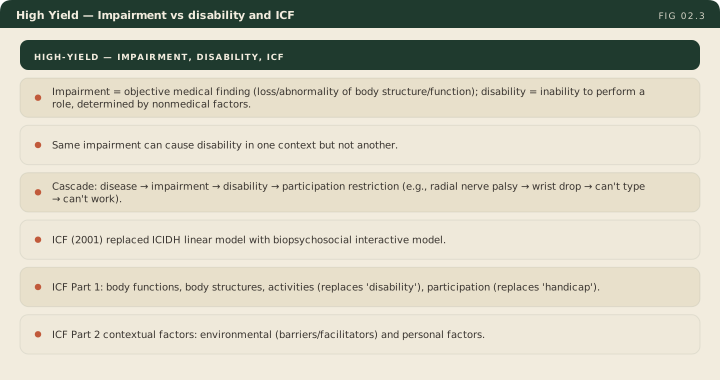
- Impairment = problem in body function or structure; disability reflects health-related limitations interacting with context. Legal benefit definitions are program-specific.
- Same impairment can produce disability in one context and not another.
- Cascade: disease (radial nerve palsy) → impairment (wrist drop) → disability (cannot type) → participation restriction (cannot work).
- ICF (2001) replaced ICIDH (linear) with biopsychosocial interactive model.
- ICF Part 1 (functioning/disability): two paired components—body functions and structures; activities and participation. Disability remains an umbrella term.
- ICF Part 2 (contextual factors): environmental factors (barriers/facilitators), personal factors.
- “Impairment” in ICF = problem in body function or structure; “activity limitation” replaces older “disability”; “participation restriction” replaces older “handicap”.
Mnemonic — “Impairment is the body, disability is the world”
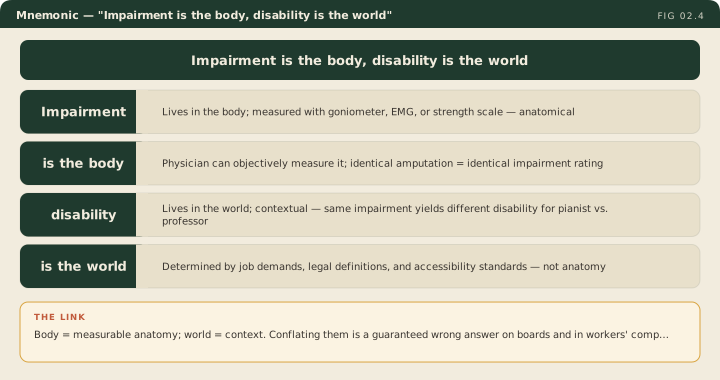
Impairment lives in the body: a physician can measure it with a goniometer, an electromyogram, or a strength scale. Disability highlights functioning in the world: job demands, legal definitions, accessibility and support affect the consequences of an impairment. Two patients with the same rated impairment may have different activity and participation limitations. This mnemonic emphasizes context; it does not remove the medical contribution to disability.
Disability on the other hand is the world. It’s completely different in kind, not just in degree. Disability is the inability to perform a specific activity or fulfill a specific role because of an impairment combined with all these non-medical factors.
— ADMIN-02 podcast, ~2:38