Before You Listen
Episode Setup
- Topic in one line: the three rehabilitation team models (interdisciplinary, multidisciplinary, transdisciplinary); the physiatrist as team leader; the core team disciplines (physical therapy, occupational therapy, speech-language pathology, rehabilitation nursing, social work, neuropsychology, case management, recreation therapy); the rehabilitation levels-of-care continuum (inpatient rehabilitation facility (IRF), skilled nursing facility (SNF), long-term care hospital (LTCH), home health agency (HHA), outpatient therapy, and hospice); SMART goals; life care planning components and the physiatrist’s role as medical expert; palliative care versus hospice and the double effect principle; structured handoff protocols (I-PASS for shift transitions, SBAR for urgent provider-to-provider communication); medication reconciliation and transitions of care; health literacy and the teach-back method; the four federal compliance laws (Stark Law, Anti-Kickback Statute, False Claims Act, Emergency Medical Treatment and Labor Act (EMTALA)); and palliative symptom management.
- Prerequisites: familiarity with the IRF admission framework from ADMIN-01 (60 percent rule, 13 conditions, 3-hour rule, IRF-PAI), the just culture and Swiss cheese frameworks from ADMIN-03, and the bioethical pillars and capacity framework from ADMIN-02 and ADMIN-03.
- Runtime: 58 minutes.
Vignette. A 67-year-old man is 12 days into an IRF stay after a left middle cerebral artery (MCA) ischemic stroke with right hemiparesis and global aphasia. The interdisciplinary team meets weekly. He has reached his short-term mobility goal (ambulating 100 feet with a hemi-walker and contact-guard assist) but plateaus on swallowing and naming tasks. The team plans discharge to home with home health services in 5 days. His daughter, a nurse, asks about long-term planning, requests a copy of his swallow study, and inquires about a Medicare-funded skilled rehabilitation hospital that her cousin’s facility recently invested in (the cousin offers your group a referral fee).
Identify which team model is described, identify which discipline leads each plateau domain (swallowing, language), name the structured handoff framework whose named steps include synthesis by the receiver, which is what this IRF-to-home-health transition asks for, identify the federal compliance law that prohibits accepting the referral fee, and identify the prognostic threshold and one care principle for hospice should the patient deteriorate.
(Answer at the end of this chapter)
Section 1: Team Models, Physiatrist Leadership, and Core Disciplines
Bottom line: three team models. Interdisciplinary (standard in inpatient rehab) features shared integrated goals, joint conferences, bidirectional communication. Multidisciplinary features parallel discipline-specific goals (acute, outpatient). Transdisciplinary features role release: a primary provider delivers strategies taught by the other disciplines, within training and legal scope and with the specialists still involved (early intervention). The physiatrist serves as medical director: prescribes therapy, coordinates medical management, leads team conferences, determines level-of-care appropriateness. Core disciplines: PT (mobility, gait, transfers, balance); OT (activities of daily living, upper extremity, splinting, adaptive equipment, home modifications); SLP (communication, dysphagia, cognitive rehab); rehab nursing (bowel/bladder, skin, medication education); social work (discharge planning, community resources); neuropsychology (cognitive testing); case management (insurance, transitions); recreation therapy (leisure, community reintegration).
Three rehabilitation team models differ in how goals are set and how roles are shared.
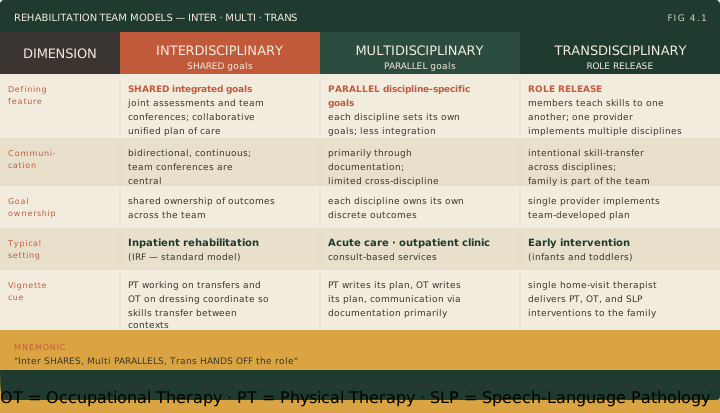
The interdisciplinary team model is the standard in inpatient rehabilitation. Team members from different disciplines work toward shared, integrated goals, conduct joint assessments, participate in regular team conferences, and collaboratively develop a unified plan of care. Communication is bidirectional and continuous. The PT working on transfers and the OT working on dressing coordinate so skills transfer between contexts. Shared ownership of outcomes across the team is the defining feature.
The multidisciplinary team model involves multiple disciplines working in parallel with less integration. Each discipline sets its own discipline-specific goals and communicates primarily through documentation rather than through joint conferences. Common in acute care and outpatient clinics.
The transdisciplinary team model involves intentional role release: team members teach their discipline-specific skills to other members so that one primary provider carries selected interventions across domains, within their own training and legal scope and with the teaching specialists still supporting the case. The classic setting is early intervention for infants and toddlers, where minimizing the number of providers interacting with the child and family is the point.
A vignette featuring shared goals and joint team conferences describes the interdisciplinary model. Parallel discipline-specific goals with limited cross-disciplinary communication describes multidisciplinary. Role release, with a primary provider carrying strategies from several disciplines, describes transdisciplinary.
The physiatrist serves as the medical director of the rehabilitation team:
- Prescribes the therapy program (type, frequency, duration).
- Coordinates medical management across all active medical conditions.
- Leads or co-leads the interdisciplinary team conference.
- Communicates with the patient and family about goals, prognosis, and discharge planning.
- Determines appropriateness for each level of rehabilitation care.
The physical therapist (PT) addresses mobility, gait training, transfer training, balance, wheelchair mobility, lower extremity strength and range of motion, and assistive device training (canes, walkers, crutches).
The occupational therapist (OT) addresses activities of daily living (ADL) (bathing, dressing, grooming, feeding, toileting), upper extremity function, fine motor coordination, splinting and orthotics, adaptive equipment, home modification assessment, cognitive retraining for functional tasks, and visual-perceptual rehabilitation. Answer the PT/OT split as mobility versus ADL and upper-extremity function. That is the exam distinction and the everyday emphasis; it is not a body-region ownership rule, and the two disciplines share overlapping skills and responsibilities.
The speech-language pathologist (SLP) addresses communication disorders (aphasia, dysarthria, apraxia of speech, cognitive-communication deficits), swallowing disorders/dysphagia (bedside assessments plus instrumental evaluations including videofluoroscopic swallow study and fiberoptic endoscopic evaluation of swallowing (FEES)), and cognitive rehabilitation (attention, memory, executive function).
Rehabilitation nursing manages bowel and bladder programs, skin care and pressure injury prevention, medication administration and education, neurological monitoring, and daily schedule coordination. Nurses have the most continuous patient contact and often first identify changes in condition.
Social work provides psychosocial support, discharge planning, community resource identification, financial assistance, family conferences, advance directive completion, and crisis counseling. Social work is the primary discipline for discharge planning.
Psychology/neuropsychology provides cognitive and behavioral assessment, mood and behavior management, and coping/family counseling. Neuropsychologists perform standardized cognitive testing to characterize cognitive deficits after brain injury or stroke.
Case management focuses on insurance authorization, utilization review, and transition planning across settings.
Recreation therapy addresses leisure skills, community reintegration, adaptive recreation and sports, and quality of life beyond medical/functional domains.
High Yield — Team models, physiatrist leadership, core disciplines
- Interdisciplinary: SHARED integrated goals, joint conferences (standard in inpatient rehab).
- Multidisciplinary: PARALLEL discipline-specific goals (common in acute and outpatient).
- Transdisciplinary: ROLE RELEASE, single provider implements across disciplines (early intervention).
- Physiatrist = medical director: prescribes therapy, coordinates medical management, leads team conferences, determines level-of-care appropriateness.
- PT: mobility, gait, transfers, balance.
- OT: ADL, upper extremity function, splinting, adaptive equipment, home modifications.
- SLP: communication, dysphagia, cognitive rehabilitation.
- Rehabilitation nursing: bowel/bladder, skin care, medication education.
- Social work: discharge planning and community resources.
- Neuropsychology: standardized cognitive testing.
- Case management: insurance authorization and transition planning.
Mnemonic — “Inter shares, Multi parallels, Trans hands off the role”
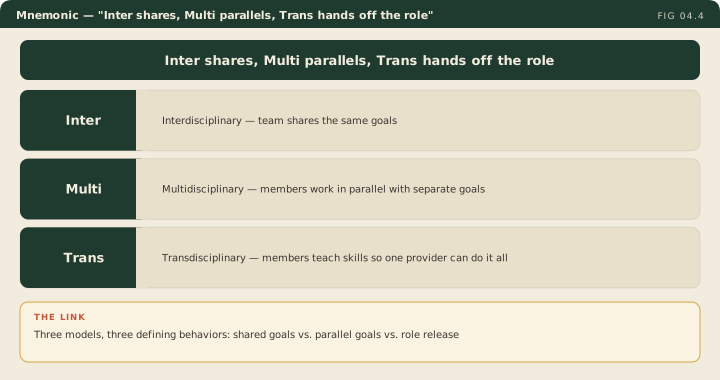
The interdisciplinary team shares the goals. The multidisciplinary team works in parallel with separate goals. The transdisciplinary team hands off the role: members teach their skills to other members so one primary provider can carry them, within scope and with specialist backup. Three models, three defining behaviors, three classic settings (inpatient rehab, acute/outpatient, early intervention).
Yeah, because you have different instruments, like a saxophone, a piano, an upright bass, and they all have their own specific, highly technical skill sets. But they are actively listening to each other. They adapt to each other’s tempo.
— ADMIN-04 podcast, ~2:54