BASIC · EP 01b · CENTRAL NEURO
Before You Listen
Episode Setup
- Topic in one line: the rest of central neuroanatomy — the cerebellum with its three functional zones and the rule that cerebellar signs are ipsilateral; the three spinal cord long tracts (lateral corticospinal, spinothalamic, dorsal column–medial lemniscal) and the crossing patterns that predict Brown-Séquard, central cord, and anterior cord syndromes; the Circle of Willis with the ACA / MCA / PCA cortical territories and spinal cord vascular supply; the blood-brain barrier and the circumventricular organs that intentionally lack it; and the cerebrospinal fluid circulation pathway with the Hakim triad of normal pressure hydrocephalus.
- Prerequisites: the cortical homunculus rule, basal ganglia circuits, thalamic relay nuclei, and brainstem cranial nerve nuclei from BASIC-01-a. Reflex root levels, ISNCSCI key muscles, dermatomes, plexus anatomy, and the autonomic nervous system live in BASIC-11.
- Runtime: 55 minutes (Part 2 of 2).
Vignette. A 52-year-old woman with a several-year history of insidiously progressive neck pain and bilateral upper-extremity numbness presents with a new pattern: she has dropped two coffee cups in the past week but has burned her hands on the stove without realizing it. On exam she has bilateral cape-like loss of pain and temperature sensation across both shoulders and the upper arms, with preserved light touch, vibration, and proprioception in the same distribution. Strength and reflexes in the legs are normal. MRI of the cervical spine shows a fluid-filled cavity expanding the central canal from C3 to C7.
Which spinal cord tract is being disrupted, where does the crossing occur, and why are proprioception, vibration, and motor strength relatively spared?
(Answer at the end of this chapter)
Section 1: Cerebellum — Anatomy and Functional Zones
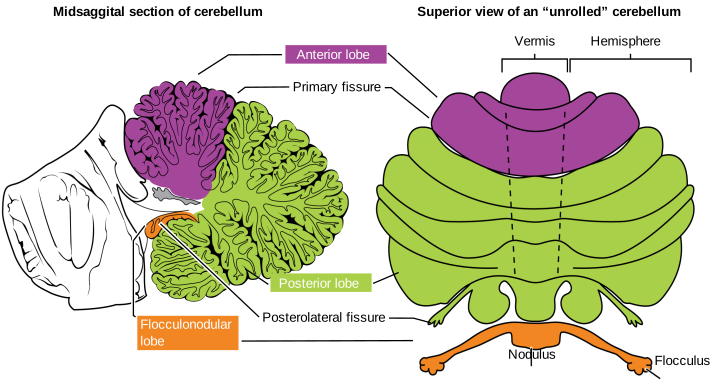
Bottom line: the cerebellum sits in the posterior cranial fossa beneath the tentorium cerebelli and connects to the brainstem through three peduncles — superior (output to red nucleus and thalamus), middle (input from contralateral pontine nuclei), and inferior (input from inferior olive and spinal cord). Functionally it has three zones. The vermis (midline) controls axial and postural muscles via output through the fastigial nucleus; lesions produce truncal ataxia and a wide-based, staggering gait. Chronic alcoholic cerebellar degeneration classically targets the anterior vermis, producing predominant gait ataxia with relatively spared limb function. The cerebellar hemispheres (lateral zones) control distal limb coordination via output through the dentate nucleus, the superior cerebellar peduncle, the red nucleus, the ventral lateral thalamus, and the contralateral motor cortex; lesions produce ipsilateral limb dysmetria, intention tremor, dysdiadochokinesia, and dysarthria. The signs are ipsilateral because cerebellar outflow crosses in the superior peduncle decussation and the corticospinal tract crosses again at the medullary pyramids — two crossings cancel. The flocculonodular lobe (vestibulocerebellum) coordinates vestibular function, balance, and eye movements; lesions produce vertigo, nystagmus, and equilibrium impairment, and medulloblastoma in children classically arises here.
The cerebellum sits in the posterior cranial fossa beneath the tentorium cerebelli, dorsal to the brainstem. It connects to the brainstem through three peduncles. The superior cerebellar peduncle carries output to the red nucleus and thalamus. The middle cerebellar peduncle carries input from the contralateral pontine nuclei. The inferior cerebellar peduncle carries input from the inferior olive and spinal cord. Functionally the cerebellum has three zones, and each has a distinct anatomic substrate and clinical syndrome.
The vermis is the midline strip that controls axial and postural muscles. Output runs through the fastigial nucleus to the vestibular nuclei and the reticular formation. Lesions of the vermis produce truncal ataxia and a wide-based, staggering gait, with relatively preserved limb coordination on finger-to-nose and heel-to-shin testing. Chronic alcoholic cerebellar degeneration classically targets the anterior vermis, which is why the classic alcoholic patient walks with a wide-based gait but can still touch finger to nose without major dysmetria.
The cerebellar hemispheres are the lateral zones, and they control distal limb coordination. Output runs through the dentate nucleus, the superior cerebellar peduncle, the red nucleus, the ventral lateral thalamus, and the contralateral motor cortex. Lesions produce ipsilateral limb dysmetria, intention tremor, dysdiadochokinesia, and dysarthria.
Why are cerebellar signs ipsilateral? The cerebellar outflow crosses at the decussation of the superior cerebellar peduncle, and the corticospinal tract then crosses again at the medullary pyramids. Two crossings cancel, so the signs appear on the same side as the lesion. This is one of the most reliably tested anatomy explanations on the exam: a right-hemisphere cerebellar stroke produces right-sided limb ataxia, not left.
The flocculonodular lobe, also called the vestibulocerebellum, coordinates vestibular function, balance, and eye movements. Lesions produce vertigo, nystagmus, and equilibrium impairment. Medulloblastoma in children classically arises in this zone, presenting with morning headache, vomiting, truncal ataxia, and eye-movement abnormalities.
Mnemonic — Two crossings cancel
Cerebellar signs are ipsilateral because the cerebellar outflow crosses once at the superior cerebellar peduncle decussation and the corticospinal tract crosses again at the medullary pyramids. Two crossings cancel. A right cerebellar hemisphere lesion → right limb ataxia. A right MCA cortical stroke → left hemiparesis. Same brain, opposite rules, one tract diagram explains both.
High Yield — Cerebellum
- Three peduncles: superior (output → red nucleus, thalamus); middle (input from contralateral pontine nuclei); inferior (input from inferior olive and spinal cord).
- Vermis (midline): axial/postural control via fastigial nucleus; lesions → truncal ataxia, wide-based gait. Chronic alcoholic cerebellar degeneration targets the anterior vermis (gait ataxia greater than limb ataxia).
- Cerebellar hemispheres (lateral): distal limb coordination via dentate nucleus → superior peduncle → red nucleus → VL thalamus → contralateral motor cortex. Lesions → ipsilateral limb dysmetria, intention tremor, dysdiadochokinesia, dysarthria.
- Why ipsilateral: cerebellar outflow crosses at the superior peduncle decussation AND the corticospinal tract crosses again at the medullary pyramids — two crossings cancel.
- Flocculonodular lobe (vestibulocerebellum): balance and eye movements; pediatric medulloblastoma classically arises here.