Before You Listen
Episode Setup
- Topic in one line: the mechanical principles that govern how the human body produces and controls movement, including the three classes of levers (first class with fulcrum between effort and load, second class with load between fulcrum and effort, third class with effort between fulcrum and load — the most common in the body), the sliding filament theory and the three muscle fiber types (Type I slow oxidative red, Type IIa fast oxidative-glycolytic intermediate, Type IIx fast glycolytic white), the Henneman size principle of motor unit recruitment from smallest to largest, the length-tension and force-velocity relationships, the four contraction types (isometric, concentric, eccentric, isokinetic) with the usual eccentric > isometric > concentric force-capacity hierarchy at comparable length and activation, the cardinal planes and axes of motion, joint kinematics with roll-glide-spin and the concave-convex rule of arthrokinematics, and Wolff law and Davis law of bone and soft tissue remodeling.
- Prerequisites: basic familiarity with skeletal anatomy, the difference between origin and insertion of a muscle, and the gross anatomy of common joints (elbow, knee, shoulder, hip).
- Runtime: 41 minutes.
Vignette. A 28-year-old recreational runner presents 48 hours after running her first downhill trail race. She reports severe bilateral quadriceps soreness that began 24 hours after the race and peaked at 48 hours. The pain is reproduced with eccentric loading (sitting down slowly into a chair, walking down stairs) but is much milder with concentric activity (cycling, ascending stairs). She has no joint swelling, no acute injury history, and her urinalysis shows trace blood with positive heme on dipstick.
Which contraction type predominantly caused her muscle damage and delayed-onset muscle soreness (DOMS), and what is the underlying force-velocity rationale?
(Answer at the end of this chapter)
Section 1: Lever Systems and Mechanical Advantage
Bottom line: every musculoskeletal lever in the body is one of three classes defined by the relative position of the fulcrum (joint), effort (muscle force), and load (resistance), and the board expects rapid identification of each: a first-class lever has the fulcrum between the effort and load (atlanto-occipital head extension is the classic body example, like a seesaw), a second-class lever has the load between the fulcrum and effort (heel raise on the toes is the classic example, like a wheelbarrow, and always provides mechanical advantage because the effort arm is longer than the load arm), and a third-class lever has the effort between the fulcrum and load (biceps curl is the classic example, the most common arrangement in the body, and always operates at a mechanical disadvantage but trades force for speed and range of motion).
A lever is a rigid bar that pivots about a fixed point (the fulcrum) with two opposing forces acting at different distances from that fulcrum: the effort (the applied force) and the load (the resistance). In musculoskeletal levers, the bone is the bar, the joint is the fulcrum, the muscle force is the effort, and the body weight or external resistance is the load. The classification depends entirely on the arrangement of these three elements. Mechanical advantage equals the effort moment arm divided by the load moment arm. Moment arms are perpendicular distances from the joint axis to each force’s line of action, rather than simply distances to attachment sites. In the idealized lever comparison, a mechanical advantage greater than 1 means less effort force is needed than the load weight; a mechanical advantage less than 1 means more effort force is needed than the load weight, but the trade-off is amplified speed and range of motion at the load.
A first-class lever has the fulcrum positioned between the effort and the load, like a seesaw. The classic anatomical example is the atlanto-occipital joint during head extension: the fulcrum is the atlanto-occipital joint, the effort is provided by the posterior neck extensor muscles, and the load is the weight of the face and anterior skull. First-class levers can amplify either force or speed depending on the relative distances of the effort and load from the fulcrum.
A second-class lever has the load positioned between the fulcrum and the effort, like a wheelbarrow. The anatomical example is ankle plantarflexion during a toe raise: the fulcrum is the metatarsophalangeal joints where the toes contact the ground, the load is the body weight transmitted through the tibia to the ankle joint, and the effort is the gastrocnemius-soleus pulling on the calcaneus through the Achilles tendon. Second-class levers always produce a mechanical advantage because the effort arm is longer than the load arm, so less force is needed to move the load.
A third-class lever has the effort positioned between the fulcrum and the load. This is the most common lever arrangement in the human body. The classic example is the biceps curl: the fulcrum is the elbow joint, the effort is the biceps inserting on the radial tuberosity close to the fulcrum, and the load is the weight held in the hand far from the fulcrum. Third-class levers always have a mechanical disadvantage; the effort arm is shorter than the load arm, meaning the muscle must generate a force much greater than the weight of the load. In exchange, third-class levers amplify speed and range of motion: a small contraction of the biceps produces a large arc of motion at the hand.
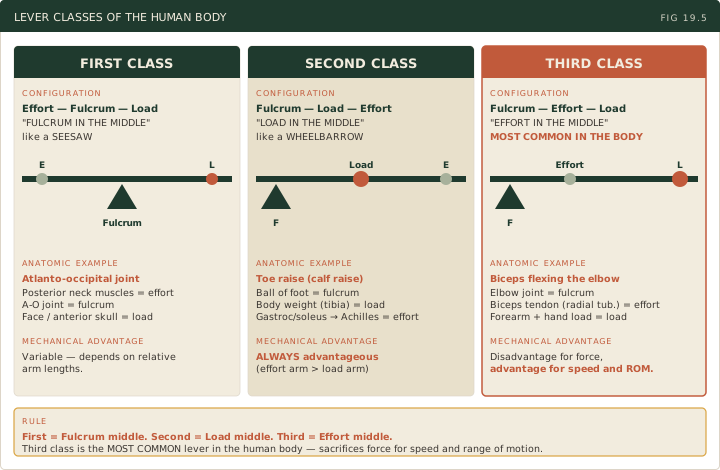
High Yield — Lever classes
- First class: fulcrum between effort and load (seesaw); example atlanto-occipital head extension.
- Second class: load between fulcrum and effort (wheelbarrow); example heel raise on toes; always mechanical advantage.
- Third class: effort between fulcrum and load; example biceps curl; most common in the body; mechanical disadvantage, speed and range-of-motion (ROM) advantage.
- Mechanical advantage (MA) equals effort arm divided by load arm.
Mnemonic — “1-F, 2-L, 3-E”
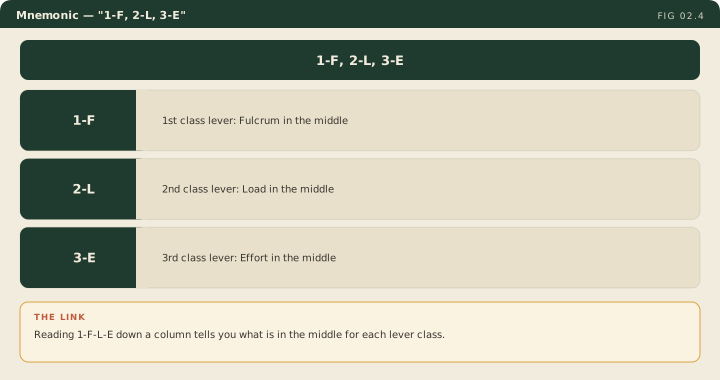
The middle component identifies the class. 1st class = Fulcrum in the middle. 2nd class = Load in the middle. 3rd class = Effort in the middle. “1-F-L-E reading down a column tells you what is in the middle for each class,” and the body relies overwhelmingly on third-class levers because we trade muscle force for speed at the limbs.
Because the muscle insertion is so incredibly close to the joint, a tiny one-inch shortening of the biceps muscle belly rapidly sweeps the hand through an arc of over 100 degrees.
— BASIC-02 podcast, ~7:26
Geometry clarification. The quote illustrates a lever’s excursion advantage; one inch of biceps shortening does not specify a universal joint angle. Moment arms vary with joint position and activation. Lever class still depends on the relative fulcrum, effort and load positions.