Normal Gait Analysis — Muscle Activation, Three Rockers, Saunders Determinants, Pathological Patterns, and Energy Cost — Part 2
BASIC · EP 03 · GAIT
Before You Listen
Episode Setup
- Topic in one line: the second half of normal gait analysis, covering the muscle activation pattern across the gait cycle (eccentric tibialis anterior, eccentric quadriceps, hip abductors, eccentric soleus, concentric gastrocnemius-soleus, and eccentric hamstrings), the three rockers of stance phase (heel, ankle, and forefoot rockers), the ground reaction force (GRF) vector and its relationship to joint moments, the standard quantitative parameters (cadence 110-120 steps per minute, walking velocity 1.2-1.4 m/s, stride length 1.4-1.6 m, step width 7-9 cm, toe-out angle ~7 degrees), the Saunders six determinants of gait that reduce vertical center-of-mass excursion from 10 cm to 5 cm, the major pathological gait patterns (Trendelenburg, gluteus maximus, steppage, antalgic, circumduction, vaulting, quadriceps avoidance, scissoring, waddling, ataxic, Parkinsonian), and the energy cost of normal walking (~12 mL O2/kg/min) which rises predictably with amputation level and stroke.
- Prerequisites: Part 1 of BASIC-03 (the gait cycle and the eight Rancho Los Amigos subphases), familiarity with lower extremity anatomy and the major lower extremity muscles, the cardinal planes of motion, and the concept of eccentric versus concentric muscle contractions.
- Runtime: 36 minutes 30 seconds.
Vignette. A 56-year-old man presents 3 months after an L4-L5 disc herniation with deep peroneal nerve weakness. He reports that his right foot “slaps” when it hits the ground, and he must lift his right knee higher than his left to clear the foot during swing. Manual muscle testing shows tibialis anterior strength of 2 out of 5 on the right with normal strength elsewhere. Observational gait analysis confirms an audible foot slap at right initial contact, increased right hip and knee flexion during right swing phase, and shortened right stance time.
Which subphase deficits explain the foot slap and the increased hip and knee flexion, which rocker is lost, and what is the named gait pattern?
(Answer at the end of this chapter)
Section 1: Muscle Activation by Phase
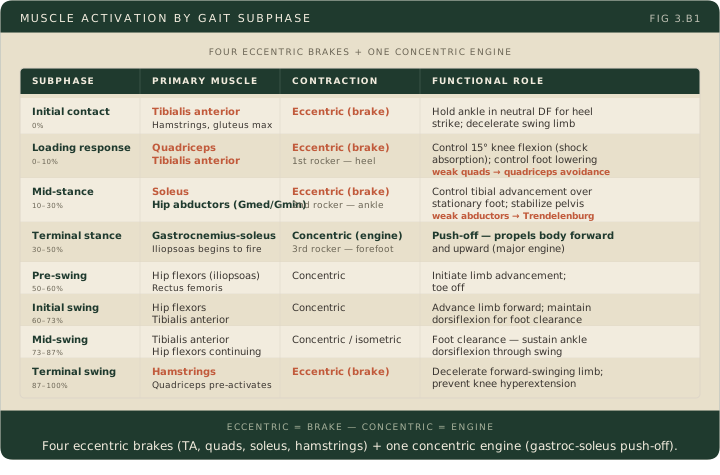
Bottom line: the vast majority of muscle activity during normal walking is eccentric (lengthening under load) rather than concentric, because the body is constantly braking against gravity and momentum; the tibialis anterior eccentrically controls foot lowering at initial contact and loading response (loss produces the foot slap of steppage gait), the quadriceps contract eccentrically at loading response to absorb the 15 degrees of knee flexion under body weight (loss produces quadriceps avoidance gait), the hip abductors (gluteus medius and minimus) fire at mid-stance to keep the pelvis level (loss produces Trendelenburg gait), the soleus eccentrically controls tibial advancement at mid-stance (the second rocker), the gastrocnemius-soleus shifts to concentric push-off at terminal stance (the third rocker), and the hamstrings eccentrically decelerate the forward-swinging limb at terminal swing.
Understanding which muscles fire during each phase of gait — and whether they contract concentrically or eccentrically — is one of the highest-yield gait topics for the board examination. The framework collapses cleanly once a single principle is internalized. Concentric contraction is muscle shortening that generates motion against a load — the engine. Eccentric contraction is muscle lengthening under load that controls or decelerates motion — the brake. During normal walking, the vast majority of lower extremity muscle activity is eccentric. The body spends most of the gait cycle braking against gravity and momentum rather than actively pushing itself forward.
At initial contact (0 percent), the tibialis anterior is active, holding the ankle in neutral dorsiflexion in preparation for heel strike. The hamstrings are still active, decelerating the forward-swinging limb to prevent the knee from snapping into hyperextension. The gluteus maximus is firing in preparation to stabilize the hip as body weight is accepted.
During loading response (0-10 percent), two key eccentric events occur. The quadriceps contract eccentrically to control the approximately 15 degrees of knee flexion that occurs during weight acceptance. Without this eccentric quadriceps activity, the knee would buckle under body weight and collapse to the floor; the controlled bend is what saves the joints from impact destruction. Simultaneously, the tibialis anterior continues to contract eccentrically to control the rate of plantarflexion as the foot lowers to the ground. This controlled lowering is the first rocker (heel rocker). Without tibialis anterior activity, the foot slaps down uncontrolled, producing the audible foot slap that is the bedside hallmark of foot drop.
During mid-stance (10-30 percent), the hip abductors — the gluteus medius and gluteus minimus — are critically active, stabilizing the pelvis in the frontal plane. When standing on one leg, the pelvis tends to drop on the unsupported swing side due to gravity. The hip abductors on the stance side fire to prevent this drop. If they are weak, the pelvis drops on the swing side and a Trendelenburg pattern emerges. The hip abductors are the muscles that move the leg away from the midline of the body (abduct = away). Also during mid-stance, the soleus contracts eccentrically to control the forward advancement of the tibia over the stationary foot; this is the second rocker (ankle rocker).
During terminal stance (30-50 percent), the gastrocnemius-soleus complex shifts from eccentric to concentric contraction, generating the powerful push-off force that propels the body forward and upward. This is the third rocker (forefoot rocker) and represents the major engine of forward progression. The hip flexors, particularly the iliopsoas, begin to activate in preparation for swing phase. During swing phase (60-100 percent), the hip flexors contract concentrically to advance the limb forward, and the tibialis anterior maintains ankle dorsiflexion to clear the foot from the ground. In terminal swing (87-100 percent), the hamstrings contract eccentrically to decelerate the forward-swinging limb, controlling knee extension and preventing hyperextension before the next initial contact.
 ::: {.callout-important}
## High Yield — Muscle activation
::: {.callout-important}
## High Yield — Muscle activation
- Tibialis anterior eccentric at initial contact and loading response (controls foot lowering; loss produces foot slap).
- Quadriceps eccentric at loading response (controls 15 degrees knee flexion for shock absorption).
- Hip abductors (gluteus medius and minimus) at mid-stance (stabilize pelvis; weakness produces Trendelenburg).
- Soleus eccentric at mid-stance (controls tibial advancement; second rocker).
- Gastrocnemius-soleus concentric at terminal stance (push-off; third rocker).
- Hamstrings eccentric at terminal swing (decelerate the limb, prevent knee hyperextension). :::
During normal walking, the vast majority of our muscles are actually firing eccentrically. They are acting as brakes. During the loading response, when you land and the knee bends 15 degrees, the quadriceps fire eccentrically to control that knee flexion. If they didn’t act as a brake, the knee would bend completely and you would fall.
— BASIC-03-b podcast, ~18:44