BASIC · EP 06 · PHARMACOLOGY
Before You Listen
Episode Setup
- Topic in one line: the applied pharmacology layer that sits on top of the Part 1 absorption-distribution-metabolism-excretion (ADME) and cytochrome P450 (CYP450) framework, covering the opioid receptor system and the equianalgesic conversion math (oral-to-intravenous (IV) morphine 3:1; 25-50 percent dose reduction during rotation; methadone’s non-linear 4:1 to 20:1 ratio); the non-steroidal anti-inflammatory drug (NSAID) cyclooxygenase-1 (COX-1) versus cyclooxygenase-2 (COX-2) distinction with the celecoxib cardiovascular paradox; the neuropathic pain triad of gabapentinoids, tricyclic antidepressants (TCAs), and serotonin-norepinephrine reuptake inhibitors (SNRIs); the anticoagulant cascade (warfarin, heparins, direct oral anticoagulants (DOACs)) with the specific reversal agent matches (idarucizumab for dabigatran; andexanet alfa for the factor Xa inhibitors); the traumatic brain injury (TBI) neuropsychiatric kit anchored by amantadine and the Amantadine for Disorders of Consciousness (BIAS) trial; the particulate versus non-particulate corticosteroid distinction and the local anesthetic amide-versus-ester rule; bone-health agents (bisphosphonates, denosumab, teriparatide) with the bisphosphonate drug holiday logic; the four oral spasticity agents (baclofen, tizanidine, dantrolene, diazepam) and intrathecal baclofen pump physiology; and the four pillars of bioethics framing informed consent and advance directives.
- Prerequisites: Part 1 of this chapter (ADME, half-life, CYP450 inducer/inhibitor pairings, narrow-therapeutic-index drugs); comfort with the international normalized ratio (INR) for warfarin monitoring; familiarity with the Modified Ashworth Scale and the upper-motor-neuron versus lower-motor-neuron distinction.
- Runtime: 55 minutes.
Vignette. A 54-year-old man with a T6 American Spinal Injury Association Impairment Scale (AIS) A spinal cord injury (SCI) is six weeks into inpatient rehabilitation. He is on oral baclofen 20 mg four times daily for spasticity, enoxaparin 40 mg subcutaneous daily for venous thromboembolism (VTE) prophylaxis, gabapentin 300 mg three times daily for neuropathic pain, and oral morphine 60 mg daily divided as 15 mg every six hours. His pain remains poorly controlled and the team proposes rotating him to methadone using a calculated 10:1 morphine-to-methadone ratio. He also requests a cervical transforaminal epidural steroid injection (ESI) for a separate C6-C7 radiculopathy from a wheelchair-fall.
Which steps in the proposed methadone rotation are unsafe, what dose-reduction rule applies during opioid rotation, what specific corticosteroid must be used for the cervical transforaminal ESI and why, and which spasticity agents would be contraindicated if he developed acute hepatitis?
(Answer at the end of this chapter)
Section 3: Opioids, NSAIDs, and the Neuropathic Pain Triad
Bottom line: pain pharmacology in PM&R splits into three families. Opioids act at three G-protein-coupled receptors (mu, kappa, delta), with mu driving nearly all of analgesia, euphoria, respiratory depression, miosis, and constipation. Equianalgesic conversion uses oral morphine as the universal standard with the 3:1 oral-to-IV ratio from first-pass metabolism, hydromorphone five times more potent than morphine, oxycodone 1.5 times more potent, and the 25 microgram per hour fentanyl patch equal to about 60 mg of oral morphine per day. Methadone is the conversion trap: its equianalgesic ratio is non-linear, climbing from 4:1 at low morphine equivalents up to 20:1 at high equivalents because of its 15-60 hour variable half-life and lipophilic fat sequestration. A mandatory 25-50 percent dose reduction during opioid rotation accounts for incomplete cross-tolerance. Morphine milligram equivalents (MME) of 50 per day is the first overdose-risk threshold and 90 per day prompts mandatory plan reassessment. NSAIDs inhibit COX-1 (constitutive, gastric mucus, renal perfusion, platelet thromboxane) and COX-2 (inducible, inflammation, endothelial prostacyclin); selective COX-2 inhibitors (celecoxib) reduce gastrointestinal bleeding but increase myocardial infarction and stroke risk through the prostacyclin-thromboxane imbalance. Aspirin is unique because it irreversibly acetylates COX-1, giving a 10-day antiplatelet effect tied to platelet lifespan. Neuropathic pain uses gabapentinoids (alpha-2-delta calcium channel binding; renal clearance; saturable gut absorption for gabapentin but linear pharmacokinetics for pregabalin), TCAs (amitriptyline, nortriptyline, desipramine — anticholinergic burden, QT prolongation, Beers list), and SNRIs (duloxetine for diabetic peripheral neuropathy, fibromyalgia, chronic musculoskeletal pain; hepatotoxicity monitoring).
Opioid receptors and the mu monopoly. Opioids exert their analgesic effects through three G-protein-coupled receptor types: mu, kappa, and delta. When an opioid binds, it closes presynaptic voltage-gated calcium channels (cutting neurotransmitter release) and opens postsynaptic potassium channels (hyperpolarizing the next neuron), shutting down pain transmission at two levels at once. The mu receptor does almost all the clinical work. Mu activation produces analgesia, euphoria (the addiction driver, mediated by mesolimbic dopamine release), respiratory depression (mu receptors in the medullary chemoreceptors blunt the response to rising carbon dioxide), miosis, gastrointestinal hypomotility (peripheral mu receptors in the gut), and physical dependence. Kappa adds spinal-level analgesia but produces sedation and dysphoria rather than euphoria, which is a key reason kappa agonism does not drive addiction. Delta contributes modest analgesia and mood modulation. For the boards, every opioid adverse effect should map back to mu.
Equianalgesic dosing — the universal map. Oral morphine is the reference standard. The board-tested anchors are: 30 mg of oral morphine is approximately equivalent to 10 mg of intravenous morphine (the 3:1 oral-to-IV ratio, driven entirely by first-pass hepatic metabolism). Hydromorphone is approximately five times more potent than morphine on a milligram basis, so 1.5 mg of IV hydromorphone or 7.5 mg of oral hydromorphone equals 10 mg of oral morphine. Oxycodone is approximately 1.5 times more potent than oral morphine, so 7 mg of oral oxycodone equals 10 mg of oral morphine. Fentanyl operates on a completely different scale because it is highly lipophilic and crosses the blood-brain barrier rapidly; a 25 microgram per hour fentanyl patch delivers approximately the equivalent of 60 mg of oral morphine per day.
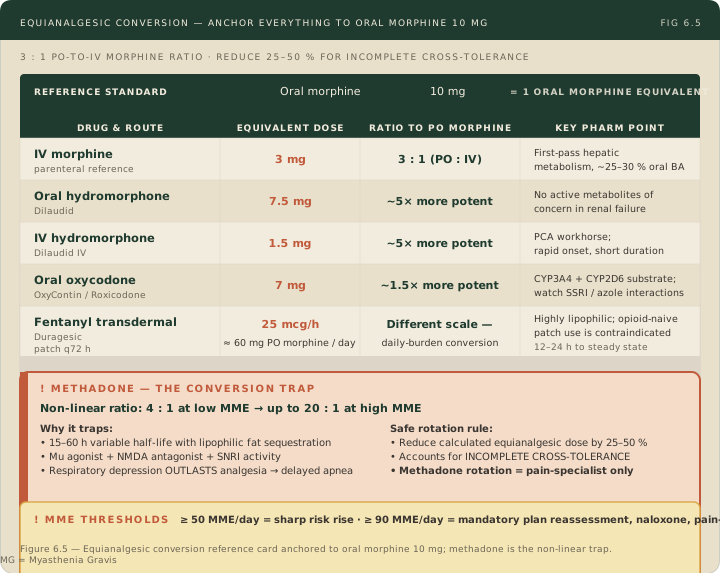 The 25-50 percent rotation rule and methadone’s trap. When rotating between opioids, the calculated equianalgesic dose must be reduced by 25-50 percent to account for incomplete cross-tolerance. Although every opioid acts at the mu receptor, the three-dimensional binding profile differs slightly between agents; tolerance to one opioid does not fully transfer to another, and the new agent hits with greater effect than the equianalgesic math predicts. Methadone is the dramatic exception to linear conversion. Its equianalgesic ratio is non-linear and dose-dependent, ranging from 4:1 at low morphine equivalents up to 20:1 at high morphine equivalents. Methadone’s danger comes from two pharmacokinetic properties: a 15-60 hour highly variable half-life with lipophilic fat sequestration that allows respiratory depression to outlast analgesia, and a unique multi-mechanism profile (mu agonism, N-methyl-D-aspartate (NMDA) receptor antagonism, and serotonin-norepinephrine reuptake inhibition) that complicates titration. Methadone rotation is a pain-specialist intervention, not a generalist one. Morphine milligram equivalents (MME) quantify the daily opioid burden: above 50 MME per day risk rises sharply, and above 90 MME per day the CDC and most guidelines require reassessment of the treatment plan, consideration of naloxone co-prescribing, and pain-specialist referral.
Methadone’s equianalgesic ratio is a trap. It is highly non-linear, climbing from a four-to-one ratio at low doses all the way up to a twenty-to-one ratio at high morphine equivalents.
— BASIC-06 podcast, ~01:35
NSAIDs — COX-1 versus COX-2. Cyclooxygenase-1 is constitutively expressed and runs the daily maintenance program: it produces prostaglandins that maintain the gastric mucus-bicarbonate barrier (protecting against acid erosion), it dilates the afferent renal arteriole (preserving glomerular perfusion), and it produces platelet thromboxane A2 (promoting aggregation when vessels are damaged). Cyclooxygenase-2 is inducibly upregulated at sites of tissue injury, generating the prostaglandins that mediate pain, fever, and inflammation, and it also produces endothelial prostacyclin, the major antithrombotic counterweight to thromboxane. Non-selective NSAIDs (ibuprofen, naproxen, indomethacin, ketorolac, diclofenac) inhibit both isoforms, which means they treat pain effectively but strip the gastric mucosal barrier, reduce renal blood flow, and impair platelet aggregation. Selective COX-2 inhibitors (celecoxib) were designed to preserve the analgesic effect of COX-2 inhibition while sparing the COX-1-dependent gastric protection. The unintended consequence is cardiovascular: with COX-1 uninhibited, platelets continue producing thromboxane at full rate, while COX-2 inhibition reduces endothelial prostacyclin. The prothrombotic-antithrombotic balance tips toward clotting, and selective COX-2 inhibitors carry an increased risk of myocardial infarction and stroke. Aspirin is unique because it irreversibly acetylates COX-1; platelets are anucleate and cannot synthesize new enzyme, so a single aspirin dose disables a platelet for its entire 10-day lifespan. Clopidogrel is the other major irreversible antiplatelet agent, blocking the P2Y12 adenosine diphosphate receptor rather than COX. Acetaminophen is not anti-inflammatory; it acts primarily on central COX, avoids the gastrointestinal, renal, and platelet penalties, and carries dose-dependent hepatotoxicity through the toxic metabolite N-acetyl-p-benzoquinone imine (NAPQI), which depletes glutathione in overdose. The maximum daily acetaminophen dose is 3 to 4 grams in adults with normal liver function.
Neuropathic pain — gabapentinoids, TCAs, SNRIs. Gabapentin and pregabalin bind the alpha-2-delta subunit of voltage-gated calcium channels on presynaptic terminals, reducing calcium influx and decreasing release of glutamate, substance P, and norepinephrine. Despite the name, neither drug binds gamma-aminobutyric acid (GABA) receptors. Both are renally cleared and need dose reduction in renal impairment. Pregabalin has linear pharmacokinetics (the dose-concentration relationship is predictable), while gabapentin has saturable active gut absorption (pushing the dose higher gives diminishing bioavailability returns). Tricyclic antidepressants enhance descending serotonergic and noradrenergic pain inhibition. Amitriptyline (tertiary amine) carries the heaviest anticholinergic, antihistaminic, and alpha-adrenergic blockade; nortriptyline and desipramine (secondary amines) have lower receptor promiscuity and are better tolerated. All TCAs prolong the QRS complex and QT interval through cardiac sodium channel blockade and are dangerous in overdose. TCAs are on the Beers list in older adults. Duloxetine, an SNRI, carries FDA approval for diabetic peripheral neuropathy, fibromyalgia, and chronic musculoskeletal pain; its main monitoring concern is hepatotoxicity. Tramadol deserves special caution: it is a weak mu agonist with moderate serotonin and norepinephrine reuptake inhibition, lowers the seizure threshold, and precipitates serotonin syndrome when combined with SSRIs, SNRIs, or other serotonergic agents.
High Yield — Opioids, NSAIDs, and neuropathic pain
- Opioid receptors: mu drives analgesia, euphoria, respiratory depression, miosis, constipation; kappa adds analgesia plus dysphoria and sedation; delta minor.
- Equianalgesic anchors: oral morphine 30 mg = IV morphine 10 mg (3:1 oral-to-IV); IV hydromorphone 1.5 mg = oral morphine 10 mg; oral oxycodone 7 mg = oral morphine 10 mg; fentanyl patch 25 micrograms per hour = oral morphine 60 mg per day.
- Rotation rule: reduce calculated equianalgesic dose by 25-50 percent for incomplete cross-tolerance.
- Methadone trap: non-linear 4:1 to 20:1 ratio; 15-60 hour variable half-life; pain-specialist rotation only.
- MME thresholds: 50 per day sharp risk rise; 90 per day mandatory reassessment.
- COX-1: gastric mucus, renal blood flow, platelet thromboxane (always on).
- COX-2: inflammation plus endothelial prostacyclin; selective inhibition raises cardiovascular event risk.
- Aspirin: irreversibly acetylates COX-1, 10-day platelet lifespan effect.
- Gabapentinoids: alpha-2-delta calcium channel; renal clearance; pregabalin linear, gabapentin saturable.
- SNRIs (duloxetine): diabetic peripheral neuropathy, fibromyalgia, chronic musculoskeletal pain; hepatotoxicity monitoring.
- Tramadol: lowers seizure threshold; serotonin syndrome with SSRIs/SNRIs.