Before You Listen
Episode Setup
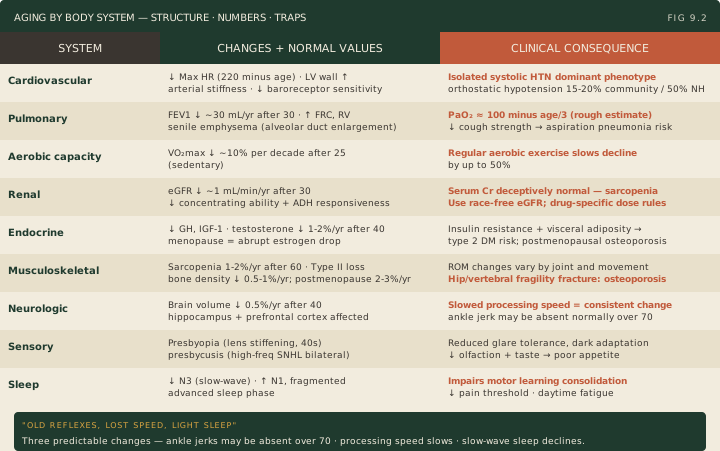
- Topic in one line: the predictable physiologic decline that drives every geriatric rehabilitation question: sarcopenia with preferential type II fiber loss; postmenopausal trabecular-first bone loss; cardiopulmonary changes (declining maximum heart rate, arterial stiffening producing isolated systolic hypertension, baroreceptor-driven orthostatic hypotension, declining maximal oxygen uptake (VO2 max), senile emphysema, age-adjusted PaO2); renal decline that hides behind a deceptively normal serum creatinine; pharmacokinetic shifts (phase I cytochrome P450 (CYP450) decline with preserved phase II conjugation, expanded adipose Vd for lipophilic drugs, lower albumin raising free fraction of warfarin and phenytoin); and the neurologic, sensory, and sleep changes that must be distinguished from disease.
- Prerequisites: comfort with basic exercise physiology (VO2 max, cardiac output, maximum heart rate (HRmax)), bone density terminology (T-score for osteoporosis), and the cross-cutting pharmacology framework from BASIC-06 (CYP450, volume of distribution (Vd), protein binding, renal clearance).
- Runtime: 23 minutes.
- Scope boundary: Part 1 maps the physiology. Part 2 turns the physiology into prescriptions: modified exercise protocols, fall risk assessment instruments, the multifactorial fall prevention bundle, and the geriatric syndromes (frailty, delirium, polypharmacy, incontinence, pressure injury) framed within the comprehensive geriatric assessment.
Vignette. An 82-year-old retired teacher is admitted to the inpatient rehabilitation unit after a left intertrochanteric hip fracture treated with cephalomedullary nail fixation. She lives alone in a two-story home, was previously independent with ambulation using a single-point cane, and was driving locally. Her past medical history includes hypertension (lisinopril, hydrochlorothiazide), atrial fibrillation (warfarin with international normalized ratio (INR) target 2-3), osteoporosis (T-score -3.0 at the lumbar spine, on alendronate), and glaucoma (latanoprost). On admission her serum creatinine is 0.9 mg/dL, which the 2021 race-free Chronic Kidney Disease Epidemiology Collaboration (CKD-EPI) creatinine equation turns into an estimated glomerular filtration rate (eGFR) of approximately 64 mL/min/1.73 m². On day 3 of rehabilitation she becomes lightheaded when standing: blood pressure 142/88 mmHg supine and 108/68 mmHg after 1 minute standing, with heart rate 72 beats per minute supine and 86 standing. Her medication administration record shows no pharmacologic venous thromboembolism prophylaxis (the primary team deferred it because she is on warfarin for her atrial fibrillation).
Why is her serum creatinine deceptive about her actual renal function, what age-related cardiovascular mechanisms explain the orthostatic drop and how should her heart rate response be read, what does her T-score indicate and how does the postmenopausal trabecular-versus-cortical bone loss pattern relate to this intertrochanteric fracture, and what drug-specific renal assessment do the renally cleared medications a rehabilitation team will reach for next actually require?
(Answer at the end of this chapter)
Section 1: Musculoskeletal Aging — Sarcopenia and Bone
Bottom line: sarcopenia preferentially destroys type II (fast-twitch) fibers, and anterior horn motor neuron loss with collateral sprouting is one of several contributors; the denervation-reinnervation cycle produces fiber type grouping. Bone loss accelerates to 2-3 percent per year for 5-10 years after menopause when estrogen withdrawal unleashes osteoclasts, hollowing trabecular bone first and priming the hip for cortical-shell failure decades later. T-score ≤ -2.5 = osteoporosis; a low-trauma hip or vertebral fracture establishes osteoporosis clinically regardless of T-score.
Musculoskeletal aging runs on two parallel tracks (loss of muscle, or sarcopenia, and loss of bone), with cartilage and connective-tissue degeneration layered on top. Together they determine whether the patient falls and whether the fall produces a fracture.
Sarcopenia is the age-related loss of skeletal muscle mass, strength, and power. It begins around age 30 with losses of approximately 3-8 percent per decade and inflects sharply after age 60, when sedentary adults lose 1-2 percent per year. By age 82 the engine has been shedding mass for half a century.
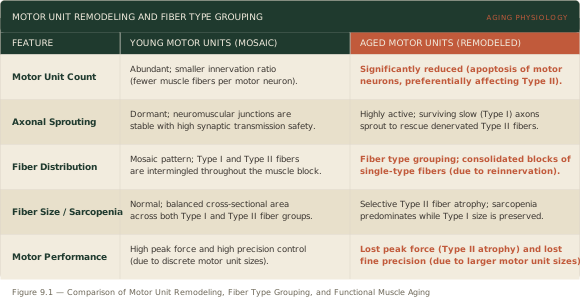
The pathophysiology is selective. Sarcopenia preferentially destroys type II (fast-twitch) muscle fibers (responsible for rapid, high-force generation), while type I (slow-twitch, oxidative) fibers are relatively spared. One mechanism originates upstream in the spinal cord, alongside intrinsic muscle, nutritional, hormonal, inflammatory and activity-related contributors. Anterior horn motor neurons undergo progressive age-related apoptosis. When a motor neuron supplying a cluster of type II fibers dies, those fibers are denervated and would atrophy without rescue.
The body mounts a rescue. Surviving anterior horn cells (predominantly the slow motor units innervating type I fibers) extend collateral sprouts and adopt the orphan fibers. The innervating motor neuron sets contractile phenotype, so fibers rescued by a slow motor neuron convert toward slow-twitch. Loading, habitual activity, disuse and hormonal status shift phenotype as well. The muscle survives but loses its explosive power.
The histological signature of that cycle is fiber type grouping. A young biopsy shows a mosaic of intermingled fast and slow fibers. An affected biopsy shows consolidated clumps of a single fiber type, where one slow motor neuron has adopted a wide territory of orphan fibers. Grouping is evidence of denervation and reinnervation rather than a diagnostic test for sarcopenia, and healthy older muscle does not always show it. The total number of independent motor units plummets while the average size of surviving units grows, destroying fine motor precision and peak force.
The functional consequence shapes the geriatric fall. A 30-year-old who catches a toe fires the type II fibers in milliseconds; the leg whips forward with explosive eccentric force and arrests the falling center of mass. The 82-year-old fires the same signal into a muscle that has lost much of its type II population, so it contracts with the slow rhythm of a tractor and cannot generate force fast enough to arrest the fall. The reactive stepping response is weakened, which raises fall risk rather than making a fall inevitable.
Hormonal and inflammatory shifts compound the neurological attrition. Older adults lose anabolic drive: declining testosterone, growth hormone, insulin-like growth factor 1 (IGF-1), and abruptly at menopause estrogen. Catabolic cytokines including tumor necrosis factor alpha (TNF-alpha) and interleukin 6 (IL-6) rise in parallel, producing the chronic low-grade inflammatory state called “inflammaging.” The net effect is anabolic resistance: a blunted muscle protein synthesis response to anabolic stimuli such as dietary protein and resistance exercise. Resistance training plus a protein target of 1.0-1.2 g/kg/day (above the 0.8 g/kg/day RDA) attenuates the process. Prescribing intense physical therapy without adequate protein is asking a construction crew to build a house without lumber.
Bone aging follows a parallel trajectory. Peak bone mass is achieved around age 25-30. Wolff’s law governs the load contribution: bone remodels in direct proportion to mechanical load. Weight-bearing exercise stimulates osteoblasts; absence of load (microgravity, prolonged bed rest, denervation, casting) drives massive resorption, the basis for disuse osteoporosis after complete spinal cord injury.
After age 40, both sexes lose bone density at approximately 0.5-1 percent per year. In women, menopause disrupts the linear curve catastrophically. When estrogen is abruptly withdrawn, regulatory suppression on osteoclasts is removed and osteoclast activity skyrockets, driving accelerated bone loss of 2-3 percent per year for the first 5 to 10 years.
The architectural pattern is high-yield. Trabecular bone is the metabolically active spongy internal honeycomb; cortical bone is the dense solid outer shell. Trabecular bone has a vastly higher surface-to-volume ratio and is destroyed first by the postmenopausal osteoclast surge. The vertebral bodies and distal radius are trabecular-dominant, which explains the epidemiological timeline: the classic initial fragility fracture in a woman in her 60s is a Colles’ fracture of the distal radius or a silent wedge compression fracture of the thoracic spine. Cortical bone catches up over decades. The femoral neck and intertrochanteric region rely on internal trabecular struts plus a thick cortical shell to withstand the torsional loads of walking. By 82, the trabecular core was hollowed out decades ago and the cortical shell has been thinning by roughly 1 percent annually. The intertrochanteric region is structurally primed for catastrophic failure.
T-score compares current bone mineral density to a healthy 30-year-old reference. Osteopenia is a T-score below -1.0 and above -2.5. Osteoporosis is ≤ -2.5 at the hip or lumbar spine. A frequently tested override: a low-trauma hip or vertebral fracture establishes osteoporosis clinically regardless of T-score. A low-trauma distal forearm, proximal humerus or pelvic fracture with osteopenia also warrants pharmacologic treatment; at those sites with normal bone density, treatment is individualized. Severe (established) osteoporosis means an osteoporosis-range T-score plus a fragility fracture, not a T-score of -3.0 alone. The dual-energy X-ray absorptiometry (DEXA) scan is still ordered to establish a baseline for pharmacologic management (bisphosphonates, denosumab, teriparatide).
First-line pharmacologic treatment is usually an oral bisphosphonate, the prototype being alendronate, typically 70 mg once weekly. The administration rule is a full glass of plain water (not coffee or juice) on an empty stomach, then at least 30 minutes upright and until after the first food of the day, because the drug injures the esophageal mucosa and the aging esophagus, with slowed peristalsis and a lax lower sphincter, is unusually prone to holding the pill in place. Water and posture protect the esophagus; the fasting rule governs absorption. New dysphagia, odynophagia, retrosternal pain or worsening heartburn means stopping the oral drug and arranging assessment. Contraindications include esophageal stricture or achalasia that delays emptying, and inability to stay upright for 30 minutes. When intolerance, a contraindication, or an inadequate response (continued bone loss or a new fracture on therapy) blocks effective oral treatment, review adherence, secondary causes and fracture risk, then choose the next agent: intravenous zoledronic acid (once yearly), subcutaneous denosumab (a RANKL inhibitor, every 6 months), or bone-forming therapy for very high risk. Because bisphosphonate already embedded in bone keeps working after dosing stops, reassess after 5 years of oral therapy or 3 years of IV zoledronic acid: lower-risk patients can take a drug holiday, while high-risk patients (prior hip or vertebral fracture, T-score still below -2.5, ongoing glucocorticoid therapy) continue treatment with reassessment. Denosumab gets no unplanned holiday: stopping or delaying it releases a rebound surge of RANKL signaling that can produce multiple vertebral fractures within months, so anyone coming off denosumab transitions directly onto another antiresorptive.
Cartilage, tendons, and ligaments complete the chassis. Articular cartilage progressively desiccates (decreased water, proteoglycan, and chondrocyte synthetic capacity), increasing vulnerability to osteoarthritis; cartilage aging and osteoarthritis are not the same process. Tendons and ligaments stiffen from collagen cross-linking and elastin loss, explaining the rise in rotator cuff tears and Achilles ruptures. Range-of-motion loss is joint- and movement-specific: healthy older adults show only a few degrees of difference at most hip and knee arcs, so a substantial restriction is a finding to evaluate rather than a normal 25-30 percent decline.
High Yield — Musculoskeletal aging
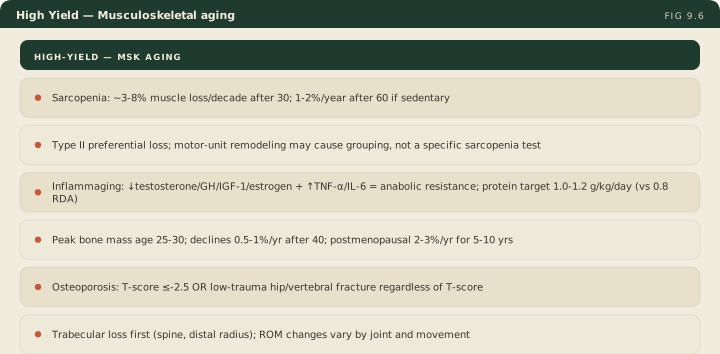
- Sarcopenia: ~3-8 percent per decade after age 30; 1-2 percent per year sedentary after 60.
- Type II fibers preferentially lost; anterior horn cell apoptosis with collateral sprouting from surviving slow motor units is one contributor → fiber type grouping on biopsy, which shows denervation and reinnervation rather than diagnosing sarcopenia.
- Inflammaging: declining testosterone, GH, IGF-1, estrogen + rising TNF-alpha, IL-6 = anabolic resistance.
- Protein target 1.0-1.2 g/kg/day (vs 0.8 g/kg/day RDA).
- Peak bone mass age 25-30; decline 0.5-1 percent/year after 40; postmenopausal 2-3 percent/year for 5-10 years.
- Wolff’s law: bone remodels to mechanical load (basis of disuse osteoporosis in SCI, casting, bed rest).
- Trabecular bone fails first (vertebrae, distal radius); cortical (hip, intertrochanteric) catches up.
- Osteoporosis T-score ≤ -2.5; osteopenia below -1.0 and above -2.5; a low-trauma hip or vertebral fracture establishes osteoporosis clinically regardless of T-score. Severe/established osteoporosis = osteoporosis-range T-score plus a fragility fracture.
- First-line: alendronate 70 mg once weekly, empty stomach, full glass of plain water, upright ≥ 30 minutes and until after the first food, to protect the esophagus. New dysphagia, odynophagia or retrosternal pain = stop and assess.
- Reassess treatment on any one of: intolerance, contraindication, inadequate response → IV zoledronic acid, subcutaneous denosumab (RANKL inhibitor) or a bone-forming agent by risk. Reassess for a holiday after 5 years oral or 3 years IV if risk is low; denosumab gets no unplanned holiday (rebound RANKL surge → vertebral fractures), so arrange the next antiresorptive.
- Joint ROM loss is movement-specific; a substantial restriction is not automatically normal aging.
Mnemonic — “Type II, trabecular, then trouble”
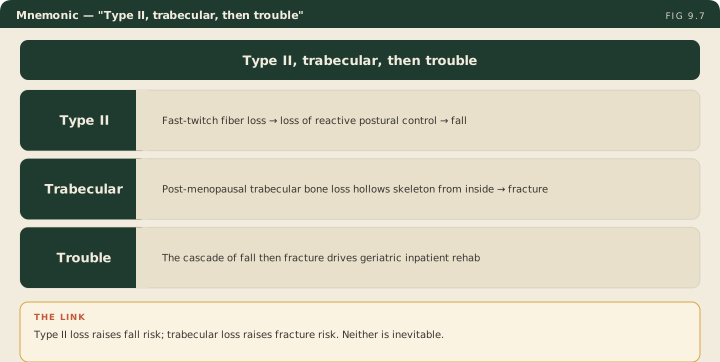
Type II fast-twitch fiber loss removes reactive postural control. Trabecular bone loss after menopause hollows the skeleton from the inside. Type II fiber loss is what raises fall risk; trabecular bone loss is what raises fracture risk. Neither outcome is inevitable. That cascade (trouble) drives geriatric inpatient rehabilitation.
Board Trap — “New chest pain/dysphagia on alendronate = reflux”
An elderly patient on weekly oral alendronate develops new dysphagia and substernal chest pain a few weeks into therapy. The tempting answer is an empiric proton pump inhibitor, because the symptoms sound like reflux. The right move is to suspect alendronate-related esophageal injury, stop the oral drug and arrange assessment; the symptoms are not proof of ulceration, and they do not prove the patient took the pill wrongly. Stacking acid suppression on continued oral dosing leaves the caustic pill sitting on an injured esophagus every week. Once the patient is assessed, a non-oral route such as intravenous zoledronic acid or subcutaneous denosumab avoids further esophageal exposure.
The broken bone is the mechanical proof that the structure has already failed. You don’t argue with a broken femur.
— BASIC-09 podcast, ~12:33
The personality of a muscle fiber is dictated entirely by the nerve that plugs into it.
— BASIC-09 podcast, ~4:47
On that quote: the motor neuron does set a fiber’s contractile phenotype, which is why reinnervation by a slow unit converts an orphaned fast fiber and produces fiber-type grouping. It is not the only determinant: loading, habitual activity, disuse and hormonal status shift phenotype too, and age-related sarcopenia is multifactorial rather than purely neurogenic.