MEDREH · EP 02 · PULMONARY
Before You Listen
Episode Setup
- Topic in one line: the downstream interventions for the diseased lung mapped in Part 1, including the strict objective criteria for supplemental oxygen, oxygen delivery hardware and the hypoxic drive trap, ventilator weaning by the rapid shallow breathing index (RSBI), tracheostomy tube anatomy, the Passy-Muir speaking valve and the cuff-deflation safety rule, decannulation, airway clearance techniques and the cough-versus-huff distinction, and four disease-specific pulmonary rehab paradigms (neuromuscular disease, cystic fibrosis, interstitial lung disease, and asthma exercise-induced bronchoconstriction).
- Prerequisites: Part 1 of MEDREH-02 (obstructive vs restrictive vs mixed pulmonary function test (PFT) patterns, the Global Initiative for Chronic Obstructive Lung Disease (GOLD) staging system, the diffusing capacity of the lung for carbon monoxide (DLCO), flow-volume loop pattern recognition, pursed-lip auto-positive end-expiratory pressure (PEEP) physiology, the BODE index); the oxygen-hemoglobin dissociation curve; basic mechanical ventilation vocabulary (positive end-expiratory pressure (PEEP), fraction of inspired oxygen (FiO2), tidal volume).
- Runtime: approximately 32 minutes for Part 2.
Vignette. A 71-year-old woman with severe chronic obstructive pulmonary disease (post-bronchodilator FEV1 28 percent of predicted) is admitted to inpatient rehabilitation after a 14-day ICU stay for a community-acquired pneumonia complicated by acute hypercapnic respiratory failure. She was intubated, then tracheostomized on hospital day 10 after failing two extubation attempts. On rehab admission she is on a size-8 cuffed fenestrated tracheostomy tube, no longer ventilated, on 2 L/min by tracheostomy collar. Her resting SaO2 is 91 percent. On the second hospital day, a covering resident attempts to start her on a Passy-Muir speaking valve without deflating the cuff. Within 90 seconds she becomes diaphoretic, agitated, and her oxygen saturation falls to the low 70s. Separately, her chart shows a peak cough flow of 220 L/min and her serial respiratory rate is 28 with an average tidal volume of 280 mL on a 1-minute spontaneous trial.
Identify the four discrete teaching points this case raises: (1) what specific physical event occurred in the first 90 seconds of valve placement and why the cuff-deflation rule is non-negotiable, (2) what her rapid shallow breathing index (RSBI) is and what it predicts about further weaning, (3) what her peak cough flow threshold mandates as a piece of durable medical equipment, and (4) which oxygen prescription category she does and does not qualify for at her current resting saturation.
(Answer at the end of this chapter)
Section 1: Supplemental Oxygen — Strict Objective Criteria and the Hypoxic Drive Trap
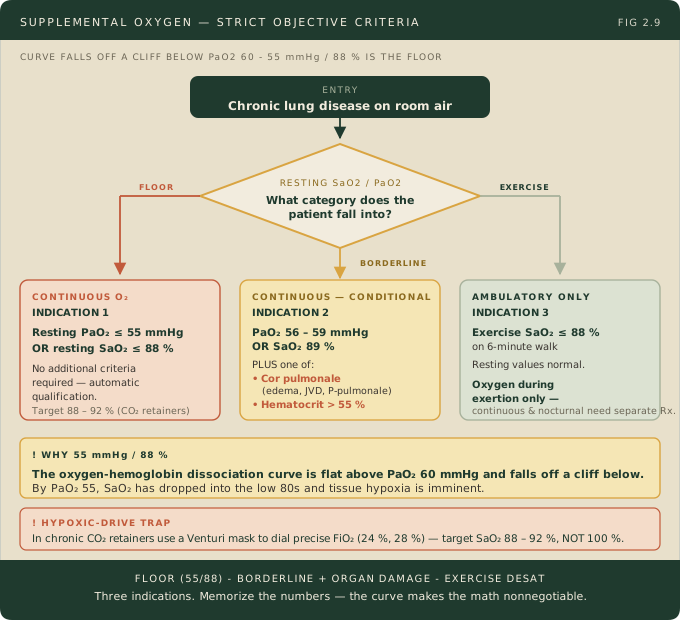
Bottom line: supplemental oxygen is not prescribed for breathlessness, comfort, or appearance. It is prescribed by three strict objective indications anchored to the shape of the oxygen-hemoglobin dissociation curve. Indication one is a resting arterial partial pressure of oxygen (PaO2) of 55 mmHg or less, or a resting arterial oxygen saturation (SaO2) of 88 percent or less. Indication two is a borderline resting PaO2 of 56 to 59 mmHg or SaO2 of 89 percent, but only when cor pulmonale or a hematocrit greater than 55 percent documents secondary organ damage. Indication three is exercise-induced desaturation to 88 percent or less, which qualifies the patient for ambulatory oxygen only. Delivery hardware progresses from nasal cannula (1-6 L/min, roughly 4 percent fraction of inspired oxygen per liter) through simple face mask (minimum 5 L/min to prevent rebreathing), to the precise Venturi mask preferred in chronic obstructive pulmonary disease, to the non-rebreather mask. In end-stage chronic obstructive pulmonary disease the central nervous system can shift from carbon dioxide drive to hypoxic drive, and uncontrolled oxygen blunts the only remaining respiratory stimulus.
When the architecture of the diseased lung imposes a ceiling on oxygen extraction below survival thresholds, supplemental oxygen becomes a medical necessity. The board treats the prescription criteria as memorized constants.
The first indication is the floor of resting oxygenation. A patient breathing room air whose resting arterial partial pressure of oxygen (PaO2) is 55 mmHg or less, or whose resting arterial oxygen saturation (SaO2) is 88 percent or less, qualifies for continuous supplemental oxygen. The 55 mmHg threshold is not arbitrary. The oxygen-hemoglobin dissociation curve is flat across the top, so a PaO2 falling from 100 to 80 mmHg barely moves saturation off the high 90s. Below a PaO2 of roughly 60 mmHg, the curve drops off a cliff. By 55 mmHg the saturation has fallen into the low 80s and tissue hypoxia is imminent.
The second indication is the borderline patient: resting PaO2 between 56 and 59 mmHg, or resting SaO2 of exactly 89 percent. Borderline values alone do not qualify the patient. The borderline range only qualifies when secondary organ damage is documented: cor pulmonale (right-sided heart failure from pulmonary hypertension, manifested as peripheral edema, jugular venous distension, or P-pulmonale on electrocardiography) or erythrocytosis defined as a hematocrit greater than 55 percent. Both reflect compensation for chronic hypoxia. Global hypoxic pulmonary vasoconstriction drives up pulmonary vascular resistance and eventually causes right heart failure; the kidney senses chronic hypoxemia and ramps up erythropoietin, expanding red cell mass.
The third indication is exercise-induced desaturation. If resting oxygenation is adequate but the SaO2 drops to 88 percent or less during a 6-minute walk or formal exercise test, the patient qualifies for ambulatory oxygen during exertion only. Continuous and nocturnal prescriptions require separate documentation.
 Oxygen delivery progresses through escalating hardware. The nasal cannula delivers 1 to 6 L/min; each additional liter per minute raises the FiO2 by approximately 4 percent above the 21 percent baseline (1 L gives ~25 percent, 6 L gives ~45 percent). The cannula is leaky by design.
The simple face mask runs 5 to 10 L/min. The mandatory minimum flow of 5 L/min is a board point: at lower flows the fresh oxygen stream cannot flush exhaled CO2 from the mask, and the patient rebreathes their own CO2.
The Venturi mask (air-entrainment mask) uses interchangeable color-coded orifices exploiting the Bernoulli principle to deliver a precise, predictable FiO2 at the dialed setting (24 percent, 28 percent, and so on). It is the device of choice for COPD patients at risk for hypercapnia.
The non-rebreather mask uses one-way valves and a reservoir bag to deliver up to ~90 percent FiO2 at 10 to 15 L/min, serving as the bridge device before intubation.
A specific physiologic trap drives the obsession with precise FiO2 in COPD. Patients with long-standing severe COPD become chronic carbon dioxide retainers: the central chemoreceptors desensitize, and the respiratory drive shifts to hypoxic drive generated by peripheral chemoreceptors sensing low PaO2. If a clinician pushes SaO2 to 100 percent with high-flow oxygen, the peripheral chemoreceptor alarm shuts off, minute ventilation drops, PaCO2 climbs, and the patient slides into a hypercapnic coma. The Venturi mask threads the needle: enough oxygen to keep tissues alive (target SaO2 roughly 88-92 percent) without extinguishing the only remaining drive to breathe.
High Yield — Oxygen Prescription and Delivery
- Indication one: resting PaO2 ≤ 55 mmHg OR resting SaO2 ≤ 88 percent → continuous oxygen.
- Indication two: resting PaO2 56-59 mmHg OR SaO2 89 percent + cor pulmonale OR hematocrit > 55 percent → continuous oxygen.
- Indication three: exercise SaO2 ≤ 88 percent → ambulatory oxygen only.
- Nasal cannula: 1-6 L/min, ~4 percent FiO2 per liter above the 21 percent room-air baseline.
- Simple face mask: minimum 5 L/min to prevent CO2 rebreathing.
- Venturi mask: precise FiO2 by Bernoulli entrainment; preferred in COPD at risk for hypercapnia.
- Non-rebreather: up to ~90 percent FiO2 at 10-15 L/min.
- Hypoxic drive trap: uncontrolled oxygen in the chronic CO2 retainer abolishes the respiratory stimulus → hypercapnic coma.
Board Trap — “Just give them more oxygen”
A 68-year-old man with end-stage COPD arrives at the emergency department with a COPD exacerbation. His resting SaO2 is 84 percent. A well-intentioned trainee places a non-rebreather at 15 L/min and his SaO2 climbs to 100 percent. Over the next 20 minutes he becomes lethargic and unrousable. The trap is to call this sepsis or stroke. The correct diagnosis is iatrogenic hypercapnic encephalopathy from blunting the hypoxic drive. Target SaO2 is 88-92 percent in this population, ideally delivered through a Venturi mask at a precise low FiO2, not maximal supplemental oxygen.
A Venturi mask prevents this. It allows you to dial in exactly twenty-four percent or twenty-eight percent FiO2, giving them just enough oxygen to keep their tissues alive without knocking out their drive to breathe.
— MEDREH-02 podcast, Part 2, ~16:25