Before You Listen
Episode Setup
- Topic in one line: the counterintuitive fact that exercise, not rest, is the treatment for cancer-related fatigue (CRF), alongside cognitive behavioural therapy and mindfulness-based programs; the blood counts and clinical findings that shape chemotherapy exercise precautions; the upper-trunk versus lower-trunk distinction between radiation plexopathy (myokymic discharges on EMG) and tumor plexopathy (painful, Horner syndrome with Pancoast tumor); four-component complete decongestive therapy (CDT) for lymphedema; Mirels scoring for long-bone fracture risk (9 or more for fixation assessment, 7 or less for radiation); the emergency imaging, steroid and specialist pathway for MSCC; chemotherapy-induced peripheral neuropathy (CIPN) by drug class (taxanes, vinca, platinums with coasting, bortezomib), Lambert-Eaton myasthenic syndrome (LEMS) and other paraneoplastic syndromes, anthracycline cardiomyopathy, bleomycin pulmonary fibrosis, steroid myopathy, late radiation effects, hematopoietic stem cell transplant (HSCT) deconditioning and graft-versus-host disease (GVHD), and the four-tier Dietz continuum.
- Prerequisites: chemotherapy mechanism categories, brachial plexus anatomy from upper trunk (C5-C6) to lower trunk (C8-T1), lymphatic drainage of the upper extremity through the axilla, the dorsal root ganglion as the cell body for sensory neurons, and the neuromuscular junction with presynaptic voltage-gated calcium channels and postsynaptic acetylcholine receptors.
- Runtime: 58 minutes.
Vignette. A 58-year-old woman with stage IIB right-sided breast cancer completed adjuvant chemotherapy with doxorubicin and paclitaxel followed by axillary lymph node dissection and right-sided chest wall radiation 18 months ago. She presents with progressive right upper extremity weakness over 4 months, mild paresthesias in the C5-C6 distribution, and visible undulating skin movements over her right shoulder. She denies pain. Examination shows 4-/5 right deltoid and biceps strength, decreased sensation over the lateral arm, and 3+ pitting edema of the right arm with non-pitting fibrotic changes at the proximal forearm. Magnetic resonance imaging of the brachial plexus shows diffuse thickening and enhancement of the upper trunk without a discrete mass. Electromyography shows myokymic discharges in C5-C6 innervated muscles. She also reports overwhelming fatigue, sleeps 14 hours daily, and has stopped exercising because “it makes me more tired.”
What is the diagnosis of her plexopathy and what EMG finding supports it, what is the lymphedema stage and the four components of the gold-standard treatment, what evidence-based intervention should be prescribed for her cancer-related fatigue, and what late cardiac and pulmonary surveillance is indicated given her chemotherapy regimen?
(Answer at the end of this chapter)
Section 1: Cancer-Related Fatigue and Lab-Value Exercise Precautions
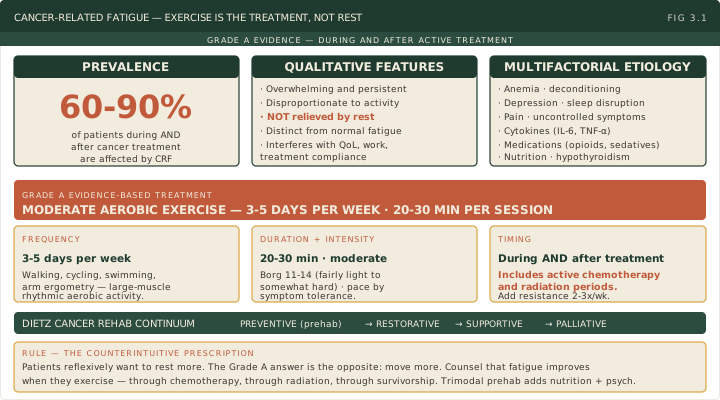
Bottom line: cancer-related fatigue is the most common symptom in cancer patients, it is not relieved by rest, and the treatment is exercise, not rest. The 2024 ASCO-SIO guideline strongly recommends exercise, cognitive behavioural therapy and mindfulness-based programs during and after treatment. A common starting prescription is moderate aerobic exercise 3 to 5 days a week for 20 to 30 minutes a session, titrated to tolerance. Blood counts inform the precautions, and the count alone never decides: weigh bleeding, the trajectory of the count, symptoms, fall risk and the activity proposed. The Dietz continuum has four tiers: preventive (prehabilitation), restorative, supportive, and palliative. Prehabilitation combines exercise, nutrition and psychological preparation before treatment.
Cancer-related fatigue is the single most common symptom in cancer patients. It is qualitatively distinct from normal fatigue: overwhelming, persistent, disproportionate to activity, and not relieved by rest. Etiology is multifactorial, so assess anemia, deconditioning, depression, sleep disruption, pain, cytokines, medications and nutrition. The board fact to hold is that exercise is the treatment, and rest is not. Patients reflexively assume they should rest more; the evidence runs the other way. Exercise, cognitive behavioural therapy (CBT) and mindfulness-based programs all carry a strong recommendation in the 2024 ASCO-SIO guideline for fatigue during and after treatment, which found no single winner among the three. The board starting prescription is moderate aerobic exercise 3 to 5 days a week for 20 to 30 minutes a session, during active treatment as well as in survivorship; titrate type, frequency, intensity and duration to clinical status, prior activity and tolerance. When a patient reports that activity makes the fatigue worse, reassess and adjust rather than dismiss the report. Prevalence figures vary widely with the population, treatment phase, severity cutoff and instrument, so learn the pattern rather than a percentage (ASCO-SIO 2024; prevalence meta-analysis).
Lab-value exercise precautions during chemotherapy reflect myelosuppression from cytotoxic agents. Counts frame the risk; the clinical picture sets the prescription.
Platelet count. Platelet count is the bleeding-risk input, not a permission slip in either direction. No guideline body has ever published a validated activity ladder by platelet count, and the supervised inpatient cohorts that are often cited for one were small, selected and retrospective, with bleeding events at the lowest counts. Decide with the haematology and rehabilitation team on the bleeding history, the trajectory of the count, the treatment, the fall risk and the specific activity proposed. Marked thrombocytopenia may mean deferral or closely supervised low-load activity under local protocol. Active bleeding means medical assessment and no exercise (supervised HSCT cohort).
Hemoglobin. Anemia reduces oxygen delivery and therefore exercise tolerance. Set intensity by symptoms and the hemoglobin trend rather than by one cutoff, and separate the exercise decision from the transfusion decision. Tachycardia, dyspnea, dizziness and presyncope during exercise are stop signals.
Absolute neutrophil count (ANC). ASCO and IDSA define neutropenia as an ANC below 1,000/microliter, severe below 500, and profound below 100; fever is a single oral temperature of 38.3 degrees Celsius, or 38.0 sustained over an hour. Severe neutropenia calls for individualized exposure precautions with the treating team, and a clean home environment is not by itself exercise clearance. Febrile neutropenia is an emergency: empirical antibacterial therapy within 1 hour of triage. Structured exercise waits for assessment and stabilization; essential care and mobility continue as the team directs (ASCO/IDSA 2018).
Bone metastases restrict high-impact activity at involved sites. Orthopaedic assessment, informed by Mirels scoring for long bones (Section 3), sets the precautions.
Recall — Bleeding, oxygen delivery, infection
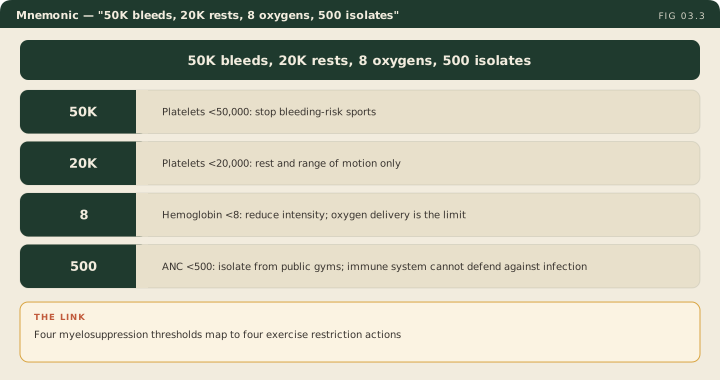
Three counts, three questions. Platelets ask can this patient bleed. Hemoglobin asks can this patient deliver oxygen. ANC asks can this patient fight infection. Each one shapes the session; none of them clears or forbids activity on its own. Acute bleeding or acute illness defers the session, and fever with neutropenia outranks the whole exercise plan.
The cancer rehabilitation continuum (Dietz) has four tiers. Preventive (prehabilitation) intervenes before treatment to optimize baseline function. Restorative aims to return the patient to baseline after treatment. Supportive maintains function during chronic or progressive disease. Palliative focuses on comfort and meaningful function in advanced disease.
Prehabilitation is the trimodal program delivered before major cancer surgery or chemotherapy: structured exercise (aerobic plus resistance), nutritional optimization, and psychological support, front-loaded into whatever preparation window the treatment plan allows. ESPEN’s cancer-nutrition target is protein above 1 g/kg/day, and up to 1.5 g/kg/day where possible, individualized with a dietitian rather than applied as a fixed prehabilitation dose. What prehabilitation buys depends on the cancer, the operation, the program and the outcome measured: ASCO 2022 gives preoperative exercise before lung-cancer surgery a weak recommendation, and the colorectal trials disagree with one another, with fewer severe complications in one and no advantage over postoperative rehabilitation in a frail cohort. Fit the program to the time the oncology and surgical plan allows; never delay cancer treatment to finish a preset course (ASCO, PREHAB trial, frailty trial, ESPEN).
High Yield — CRF, exercise precautions, rehab continuum
- CRF: the most common symptom in cancer patients, not relieved by rest. Exercise, CBT and mindfulness-based programs all carry a strong ASCO-SIO recommendation; a usual starting dose is moderate aerobic exercise 3-5x/wk, 20-30 min. Prevalence figures vary by population and instrument.
- Platelets: the bleeding-risk input. No validated activity ladder by count exists. Weigh bleeding, count trajectory, fall risk, treatment and the activity proposed. Active bleeding stops exercise.
- Hemoglobin: anemia limits oxygen delivery; set intensity by symptoms and trend. Tachycardia, dyspnea, dizziness and presyncope are stop signals.
- Neutropenia: ANC <1,000 neutropenic, <500 severe, <100 profound; fever = 38.3 C once or 38.0 C for an hour. Febrile neutropenia = antibiotics within 1 hour of triage, exercise deferred.
- Cancer rehab continuum (Dietz): Preventive → Restorative → Supportive → Palliative.
- Prehabilitation: trimodal (exercise + nutrition + psychological support) before treatment; protein above 1 g/kg/day and up to 1.5 where possible. Benefits vary by cancer, operation and outcome; never delay treatment for it.