MEDREH · EP 12 · POLYTRAUMA
Before You Listen
Episode Setup
- Topic in one line: the polytrauma rehabilitation framework integrating the Veterans Affairs (VA) Polytrauma System of Care, the polytrauma triad of traumatic brain injury (TBI), posttraumatic stress disorder (PTSD), and chronic pain in returning service members, the bedside Medical Research Council (MRC) sum score for intensive care unit (ICU)-acquired weakness, the single electrodiagnostic finding — the sensory nerve action potential (SNAP) — that separates critical illness polyneuropathy (CIP) from critical illness myopathy (CIM), the Schweickert early-mobilization evidence, the Assess pain-Both SAT/SBT-Choice of sedation-Delirium-Early mobility-Family engagement (ABCDEF) bundle, blast-injury classification, and heterotopic ossification (HO) by anatomic site.
- Prerequisites: electrodiagnostic principles from EDX-10 (axonal versus demyelinating polyneuropathy) and EDX-12 (myopathic motor unit potentials), TBI agitation pharmacology, and the deconditioning and venous thromboembolism (VTE) prophylaxis material from REHAB-09.
- Runtime: 1 hour 6 minutes.
Vignette. A 23-year-old service member presents to a Polytrauma Rehabilitation Center 4 weeks after a roadside improvised explosive device (IED) blast. He sustained a moderate TBI with right frontal contusion, bilateral tympanic membrane rupture, blast lung that required 12 days of mechanical ventilation in the field hospital ICU on cisatracurium and dexamethasone for severe acute respiratory distress syndrome (ARDS) with prone positioning, a left transtibial traumatic amputation, and a closed right femur fracture that was treated with intramedullary nailing. On arrival he is awake, agitated at Rancho Los Amigos Level IV, follows simple one-step commands, and demonstrates symmetric proximal-predominant weakness with an MRC sum score of 38 out of 60. Sensation appears intact to pinprick where testable. Deep tendon reflexes are 1+ symmetrically. The right residual limb is warm and tender at the anterolateral thigh with limited hip range of motion (ROM). Alkaline phosphatase is 320 U/L. Plain radiographs of the hip are unremarkable.
Which blast-injury category produced his tympanic membrane rupture and blast lung; which category produced his femur fracture and amputation; what is the most likely electrodiagnostic phenotype of his weakness given the medication exposure; what is the next imaging step for his hip pain; and which agent is first-line for his agitation while avoiding the two drug classes that worsen TBI outcomes?
(Answer at the end of this chapter)
Section 1: The Polytrauma Definition, the VA System of Care, and the Polytrauma Triad
Bottom line: polytrauma is defined as injury to two or more body regions or organ systems with at least one life-threatening, classically tracked by an Injury Severity Score (ISS) greater than 15; the VA Polytrauma System of Care is a four-tier hub-and-spoke network anchored by five Polytrauma Rehabilitation Centers (PRCs) at Richmond, Tampa, Minneapolis, Palo Alto, and San Antonio, with regional Polytrauma Network Sites, local Polytrauma Support Clinic Teams, and Polytrauma Points of Contact; the most commonly tested wartime presentation is the polytrauma triad of TBI plus PTSD plus chronic pain in returning service members from Operation Iraqi Freedom, Operation Enduring Freedom, and Operation New Dawn, a clustering driven by the same blast event injuring brain, psyche, and musculoskeletal system simultaneously and demanding integrated rather than sequential rehabilitation; civilian polytrauma is dominated by the combination of TBI plus orthopedic injury (long-bone, pelvic, spine) where cognitive impairment compromises weight-bearing compliance and complicates pain management.
Polytrauma is operationally defined as injury to two or more body regions or organ systems with at least one of the injuries life-threatening. The numerical anchor is an ISS greater than 15, the threshold above which mortality and long-term disability rise steeply. The clinical implication is competing demands: every rehabilitation problem in a polytrauma patient interacts with every other problem. A weight-bearing restriction matters less when the patient is cognitively intact than when they have a TBI and cannot recall the restriction; opioid pain control carries a different cost on a ventilator with delirium than when the patient is awake and engaged.
The VA Polytrauma System of Care (PSC) was created in response to the complex multi-system injuries returning from Operation Iraqi Freedom, Operation Enduring Freedom, and Operation New Dawn. It is a four-tier hub-and-spoke network. Tier 1 is the five Polytrauma Rehabilitation Centers (PRCs) at Richmond, Tampa, Minneapolis, Palo Alto, and San Antonio, delivering acute inpatient interdisciplinary rehabilitation. Tier 2 is the regional Polytrauma Network Sites for post-acute and complex outpatient care. Tier 3 is the local Polytrauma Support Clinic Teams providing community outpatient management. Tier 4 is the Polytrauma Points of Contact at smaller VA facilities for upstream referrals.
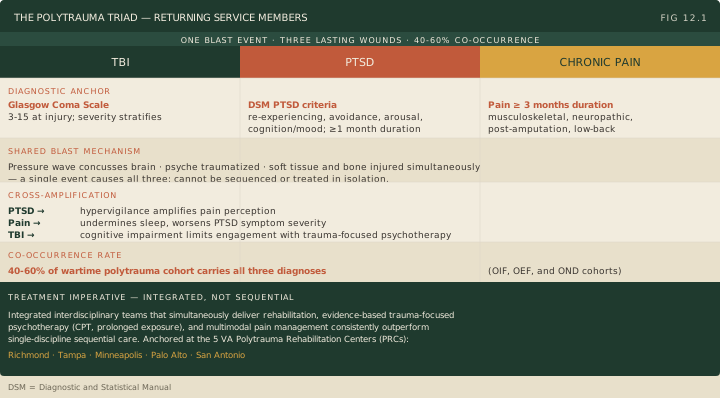
Figure 12.2 — ICU-acquired weakness body diagram: anterior and posterior whole-body figures with shaded muscle groups corresponding to the six MRC sum-score test sites (wrist extension, elbow flexion, shoulder abduction, ankle dorsiflexion, knee extension, hip flexion). Highlights the symmetric, proximal-predominant pattern of weakness that drives ventilator weaning failure. Annotations: respiratory muscle involvement (diaphragm) overlay, intrinsic foot muscle involvement in CIP. Open-source anatomy pending.
The polytrauma triad is the single most heavily tested concept in this domain. It refers to the co-occurrence of TBI, PTSD, and chronic pain in a single returning service member; prevalence of all three in the same patient runs 40 to 60 percent in the wartime polytrauma cohort. The mechanism is simple: a single blast event concusses the brain, traumatizes the psyche, and tears soft tissue or fractures bone simultaneously. None of the three problems can be treated in isolation. PTSD-driven hypervigilance amplifies pain perception; chronic pain undermines sleep and worsens PTSD; TBI-related cognitive impairment limits engagement with trauma-focused psychotherapy. Integrated teams that simultaneously deliver rehabilitation, evidence-based trauma-focused psychotherapy, and multimodal pain management consistently outperform single-discipline sequential care.
In the civilian polytrauma cohort, the dominant combination is TBI plus orthopedic injury (long-bone fracture, pelvic ring injury, spinal column fracture). The most common motor vehicle collision pattern combines a closed head injury with one or more long-bone fractures and a thoracic or pelvic injury. The challenge is the collision between cognitive impairment and weight-bearing restrictions: a patient at Rancho Level IV who cannot recall a partial weight-bearing instruction will mobilize on a non-healing fracture, dislodge a femoral nail, or remove an external fixator. Effective strategies include simplification to full weight-bearing (WB) or non-weight-bearing (NWB) rather than nuanced partial restrictions, environmental cues (colored tape on the floor, signage on the wheelchair), one-to-one supervision during all mobility, and tight communication between orthopedic surgery and the rehabilitation team about the minimum safe weight-bearing status rather than the optimal one.
High Yield — Polytrauma definition and system
- Polytrauma = injury to ≥2 body regions/systems with ≥1 life-threatening; ISS > 15 is the numeric anchor.
- VA PSC is a 4-tier hub-and-spoke: 5 PRCs (Richmond, Tampa, Minneapolis, Palo Alto, San Antonio) → Network Sites → Support Clinic Teams → Points of Contact.
- Polytrauma triad in returning service members = TBI + PTSD + chronic pain; co-occurrence 40-60 percent; demands integrated, not sequential, treatment.
- Civilian polytrauma = TBI + orthopedic; cognitive impairment and weight-bearing restrictions collide. Simplify to full WB or NWB; one-to-one supervision; environmental cues.
Mnemonic — “Three Ps Travel Together”
The wartime polytrauma triad is post-traumatic stress, chronic pain, and physical brain injury. One blast event, three lasting wounds, tied to the same patient. Wherever you find one, screen for the other two.