Before You Listen
Episode Setup
- Topic in one line: palliative care delivered alongside disease-directed treatment at any stage versus the Medicare hospice benefit (prognosis of six months or less if the illness runs its normal course, two 90-day periods then unlimited 60-day periods, bereavement counseling up to one year), the World Health Organization (WHO) three-step analgesic ladder and why severe pain starts at step 3, opioid rotation using an approximate equianalgesic conversion with a 25 to 50 percent reduction for incomplete cross-tolerance, methadone’s N-methyl-D-aspartate (NMDA) antagonism, nonlinear conversion and QT risk, advanced-cancer dyspnea managed with reversible causes, facial airflow and a monitored opioid trial, nausea matched to mechanism, a stimulant or osmotic bowel regimen with every opioid, glycopyrrolate versus scopolamine for terminal secretions, the Setting-Perception-Invitation-Knowledge-Emotions-Strategy (SPIKES) protocol, the difference between an advance directive and a Physician Orders for Life-Sustaining Treatment (POLST) form, substituted judgment before patient-centered best interests, the Palliative Performance Scale (PPS) and Karnofsky Performance Status (KPS) as function measures rather than survival tables, overlapping restorative, supportive and comfort rehabilitation goals, and the four-condition principle of double effect that separates proportionate palliative sedation from euthanasia.
- Prerequisites: delirium framework from MEDREH-09 (Confusion Assessment Method, hyperactive versus hypoactive phenotypes, haloperidol pharmacology), opioid pharmacology and equianalgesic principles from REHAB-01, and the goal-setting and goal-shifting framework from MEDREH-07 (Geriatrics).
- Runtime: 58 minutes.
Vignette. A 67-year-old woman with metastatic pancreatic adenocarcinoma is admitted to inpatient rehabilitation following a debulking laparotomy. She has known peritoneal carcinomatosis and is receiving palliative chemotherapy. Her oncologist estimates a prognosis of three to four months. On arrival she has a Palliative Performance Scale score of 50 percent, an Eastern Cooperative Oncology Group performance status of 3, and the following symptom burden: pain rated 8 out of 10 (mixed visceral and neuropathic), fatigue, anorexia with a 9 kg weight loss over six weeks, episodic nausea, opioid-induced constipation on her current regimen of long-acting morphine 60 mg twice daily plus immediate-release morphine 15 mg every 4 hours as needed, and breathlessness on minimal exertion despite an oxygen saturation of 96 percent on room air. She is alert and asks the team directly, “Am I dying?” Her son tells the rehabilitation physician privately that he does not want her told the truth.
Which conversational protocol should structure the conversation with this patient; what is the next analgesic step; what is the first-line treatment for her dyspnea given her oxygen saturation; and what is the appropriate response to the son’s request?
(Answer at the end of this chapter)
Section 1: Palliative Care Versus Hospice and the Medicare Hospice Benefit
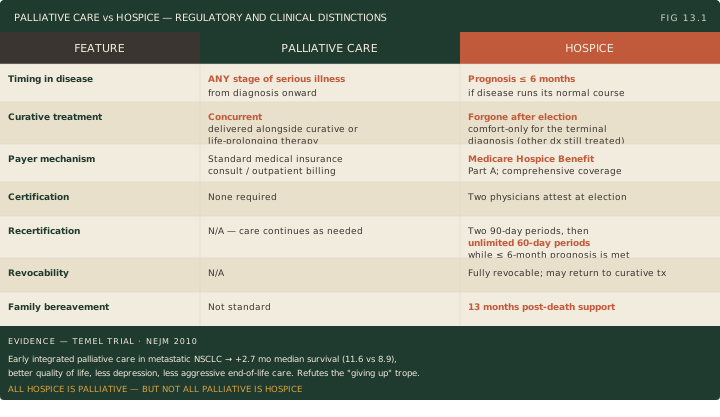
Bottom line: palliative care can accompany disease-directed treatment at any stage. Medicare hospice requires a prognosis of six months or less if illness follows its normal course and an election of palliative care for the terminal illness; palliative chemotherapy or radiation may still be included. The benefit has two 90-day periods followed by unlimited 60-day periods while eligibility persists. Patients may revoke and later re-elect. Temel’s metastatic-NSCLC trial found better quality of life and a 2.7-month longer median survival.
Palliative care is interdisciplinary medical care focused on relieving the symptoms, pain, and stress of serious illness. The defining and most heavily tested feature is that palliative care is appropriate at any stage of serious illness and is delivered concurrently with curative and life-prolonging treatment. A patient receiving curative-intent chemotherapy for stage III colon cancer can and should simultaneously receive palliative care for pain, nausea, fatigue, and psychosocial distress. The two approaches are not in competition. The palliative team manages the collateral damage of cure while the oncology team targets the disease.
The Temel trial (NEJM 2010) randomized 151 ambulatory patients with newly diagnosed metastatic non-small cell lung cancer and ECOG performance status 0 to 2 to early integrated palliative care plus standard oncology or standard oncology alone. The early-care group had better quality of life, less depression, less aggressive end-of-life care, and a 2.7-month longer median survival (11.6 versus 8.9 months). Quality of life at 12 weeks was the primary outcome; the survival difference was secondary. This is the canonical refutation of the lay belief that palliative care means giving up. It was a single-center, nonblinded trial in one population, so treat the 2.7 months as that trial’s result rather than a survival benefit promised to every patient, and do not present better treatment tolerance or reduced cachexia as a demonstrated mechanism.
Medicare hospice care serves patients with a prognosis of six months or less if the terminal illness follows its normal course. Initial certification is by the hospice physician together with the attending MD/DO if the patient has one; subsequent certification is by a hospice physician alone. An attending NP or PA does not independently certify terminal illness. Under Part A, the patient elects palliative rather than curative care for the terminal illness, and the hospice plan may still include palliative chemotherapy or radiation directed at symptoms. Care for conditions unrelated to the terminal illness remains separately eligible under the patient’s other Medicare coverage. Covered services include medications related to the terminal diagnosis, durable medical equipment, nursing visits, home health aide services, social work, chaplaincy, volunteer support and family bereavement counseling up to one year after death; individual programs may offer longer support. Hospice is delivered at home, in a dedicated hospice facility, in a skilled nursing facility or in a hospital. Revocation requires a signed statement with an effective date, ends the current election period, and leaves the patient free to re-elect later if still eligible. A Medicare rule is not a description of every hospice program, and no program guarantees every expensive modality.
 ::: {.callout-tip}
## Mnemonic — “Concurrent or Comfort-Focused”
::: {.callout-tip}
## Mnemonic — “Concurrent or Comfort-Focused”
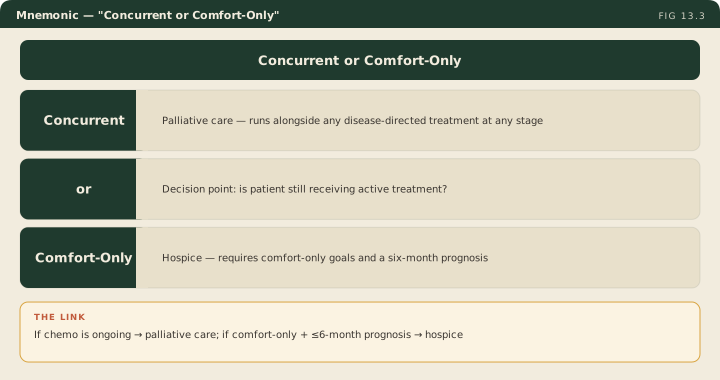
Palliative care runs concurrently with disease-directed treatment at any stage. Medicare hospice is comfort-focused and requires a prognosis of six months or less if the illness runs its normal course, plus an election of palliative rather than curative care for the terminal illness. Chemotherapy alone does not distinguish them: clarify whether treatment is curative or included as palliation in the hospice plan. :::
She simply signs a revocation form, her hospice benefit pauses, and she walks straight back into the clinic for curative intent treatment. If hospice were a one way door, an irrevocable permanent election, it would mean that one single pair of estimates from two doctors would permanently foreclose a patient’s access to future medical innovation.
— MEDREH-13 podcast, ~10:56