MEDREH · EP 13 · PALLIATIVE
Before You Listen
Episode Setup
- Topic in one line: the World Health Organization (WHO) three-step analgesic ladder with morphine first-line for severe cancer pain, opioid rotation using equianalgesic conversion with a 25 to 50 percent dose reduction for incomplete cross-tolerance, methadone as a refractory-pain agent with N-methyl-D-aspartate (NMDA) antagonism and complex pharmacokinetics, low-dose opioids and trigeminal-mediated fan therapy as first-line treatment for refractory dyspnea, glycopyrrolate-versus-scopolamine selection for terminal secretions when delirium is a concern, the actionable-orders distinction between Physician Orders for Life-Sustaining Treatment (POLST) and statement-of-preferences advance directives, the substituted-judgment-then-best-interest hierarchy for surrogate decision-making, the Palliative Performance Scale (PPS) and Karnofsky Performance Status (KPS) prognostication thresholds, the restorative-to-supportive-to-palliative goal shift in rehabilitation, and the four-condition principle of double effect that distinguishes palliative sedation from euthanasia.
- Prerequisites: Part 1 (palliative versus hospice, the Medicare Hospice Benefit, and the SPIKES protocol), the delirium framework from MEDREH-09 (Confusion Assessment Method, hyperactive versus hypoactive phenotypes, haloperidol pharmacology), opioid pharmacology and equianalgesic principles from REHAB-01, and the goal-shifting framework from MEDREH-07 (Geriatrics).
- Runtime: 1 hour 8 minutes.
Vignette. A 67-year-old woman with metastatic pancreatic adenocarcinoma is admitted to inpatient rehabilitation following a debulking laparotomy. She has known peritoneal carcinomatosis and is receiving palliative chemotherapy. Her oncologist estimates a prognosis of three to four months. On arrival she has a Palliative Performance Scale score of 50 percent, an Eastern Cooperative Oncology Group performance status of 3, and the following symptom burden: pain rated 8 out of 10 (mixed visceral and neuropathic), fatigue, anorexia with a 9 kg weight loss over six weeks, episodic nausea, opioid-induced constipation on her current regimen of long-acting morphine 60 mg twice daily plus immediate-release morphine 15 mg every 4 hours as needed, and breathlessness on minimal exertion despite an oxygen saturation of 96 percent on room air. She is alert and asks the team directly, “Am I dying?” Her son tells the rehabilitation physician privately that he does not want her told the truth.
What is the next analgesic step; what is the first-line treatment for her dyspnea given her oxygen saturation; what is the appropriate response to the son’s request; and what is the appropriate rehabilitation goal-setting framework given her trajectory?
(Answer at the end of this chapter)
Section 1: Pain Management — The WHO Ladder, Opioid Rotation, and Methadone
Bottom line: the WHO three-step analgesic ladder organizes pain by severity with step 1 non-opioids for mild pain (1 to 3), step 2 weak opioids (tramadol, codeine) for moderate pain (4 to 6), and step 3 strong opioids (morphine first-line) for severe pain (7 to 10); severe presenting pain is started at step 3 rather than slowly escalated; opioid rotation uses equianalgesic conversion (oral morphine 30 mg ≈ oral hydromorphone 6 mg ≈ oral oxycodone 20 mg ≈ fentanyl 12.5 mcg/hour patch) with a 25 to 50 percent dose reduction for incomplete cross-tolerance; methadone is reserved for refractory pain because it adds NMDA-receptor antagonism, but its variable equianalgesic ratio, 15 to 60-hour half-life, and QT-interval prolongation require expert prescribing.
The WHO three-step analgesic ladder organizes analgesic selection by pain severity. Step 1 is non-opioid therapy for mild pain rated 1 to 3 on a 0 to 10 scale: acetaminophen and nonsteroidal anti-inflammatory drugs (NSAIDs). Step 2 is weak opioids for moderate pain rated 4 to 6: tramadol or codeine, with or without a non-opioid co-analgesic. Step 2 is increasingly bypassed in modern practice in favor of low-dose strong opioids because weak agents like codeine have unpredictable CYP2D6 metabolism, but the three-step framework remains the tested model. Step 3 is strong opioids for severe pain rated 7 to 10: morphine, hydromorphone, oxycodone, fentanyl, and methadone. Morphine remains the WHO-recommended first-line strong opioid for cancer pain. Adjuvants may be added at any step.
The ladder is conceptualized as a progressive escalation, but in practice the clinician matches the analgesic to the pain intensity at presentation. A patient presenting with severe pain rated 9 of 10 is started at step 3, not at step 1. The board distractor is a slow climb up the ladder for a patient who needs a strong opioid now.
Adjuvant analgesics target specific pain mechanisms and may be added at any step. For neuropathic pain: gabapentin, pregabalin, duloxetine, and tricyclic antidepressants such as amitriptyline and nortriptyline, which act by amplifying descending inhibitory pain pathways at doses lower than antidepressant doses. For bone pain from metastases: dexamethasone, bisphosphonates (zoledronic acid, pamidronate), denosumab, and palliative radiation therapy. Dexamethasone is versatile in palliative care because it reduces peritumoral edema, improves appetite, and elevates mood. For muscle spasm: baclofen, tizanidine, and benzodiazepines. For malignant bowel obstruction: octreotide reduces gastrointestinal secretions and dexamethasone reduces inflammation. Prokinetics are contraindicated in complete bowel obstruction because forced peristalsis against a fixed obstruction causes cramping and risks perforation.
Opioid prescribing principles. Start with immediate-release morphine and titrate to effect. Once a stable daily requirement is established, convert to a long-acting formulation for around-the-clock dosing with breakthrough doses at 10 to 15 percent of the total daily dose every 1 to 2 hours as needed. Constipation prophylaxis is mandatory and nausea is anticipated and managed by mechanism (Section 2).
Opioid rotation is indicated for intolerable side effects, inadequate analgesia despite dose escalation, or a needed change in route. The rotation uses equianalgesic conversion tables followed by a 25 to 50 percent dose reduction for incomplete cross-tolerance — the safety margin that accounts for individual receptor-binding variability between agents. Subtle differences in how each opioid molecule fits the mu-opioid receptor mean that tolerance to one drug does not transfer perfectly to another.
The conversion ratios to know:
- Oral morphine 30 mg ≈ oral hydromorphone 6 mg ≈ oral oxycodone 20 mg ≈ fentanyl 12.5 mcg/hour transdermal patch.
- Oral morphine to subcutaneous or intravenous morphine: 3:1 (oral 30 mg ≈ IV 10 mg, because of first-pass metabolism).
- Oral morphine to oral hydrocodone: 1:1.
A worked example: a patient on chronic oral morphine 60 mg twice daily develops intolerable nausea and is rotated to oral hydromorphone. Total daily morphine = 120 mg. Using the 30:6 ratio, 120 mg morphine = 24 mg oral hydromorphone. Reduce by 25 to 50 percent for incomplete cross-tolerance: 12 to 18 mg oral hydromorphone per day, divided into dosing intervals. This calculation is a common board question format.
Methadone is a strong opioid reserved for refractory pain because it combines mu-opioid agonism with NMDA-receptor antagonism, which targets the opioid-resistant neuropathic pain component that drives many treatment failures. Three properties make methadone an expert-level prescribing problem.
- Variable equianalgesic ratio: the conversion ratio from morphine increases with the morphine dose. At low morphine doses the ratio may be 4:1; at very high doses, 10:1 or higher. There is no fixed conversion factor.
- Long and variable elimination half-life of 15 to 60 hours: analgesia onset is typical for an opioid (hours), but steady-state accumulation takes days. Dose escalation must be slow to avoid late respiratory depression from silent accumulation.
- QT-interval prolongation: methadone blocks the hERG potassium channel and carries a small but real risk of torsades de pointes. A baseline electrocardiogram and follow-up monitoring are standard, with caution at corrected QT above 450 to 500 ms or in patients on other QT-prolonging drugs.
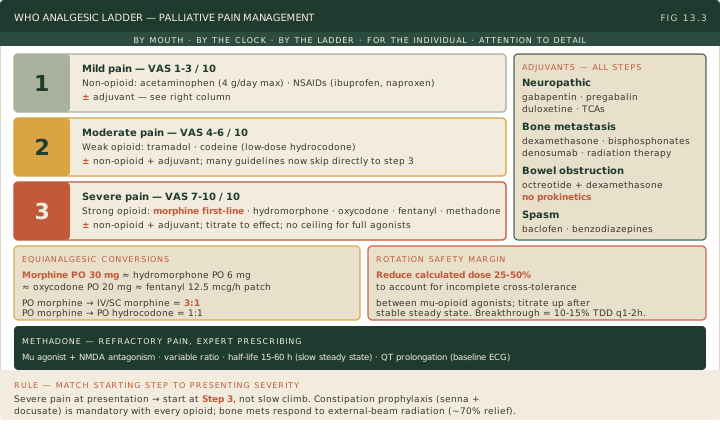
High Yield — WHO ladder, rotation, methadone
- Step 1 non-opioids (acetaminophen, NSAIDs) for pain 1 to 3; Step 2 weak opioids (tramadol, codeine) for 4 to 6; Step 3 strong opioids (morphine first-line) for 7 to 10. Adjuvants at any step.
- Severe presenting pain → start at Step 3, not climb slowly.
- Equianalgesic: morphine PO 30 ≈ hydromorphone PO 6 ≈ oxycodone PO 20 ≈ fentanyl 12.5 mcg/h patch. PO-to-IV morphine = 3:1.
- Reduce calculated dose by 25 to 50 percent for incomplete cross-tolerance.
- Methadone: NMDA antagonist for refractory pain; variable ratio, half-life 15 to 60 hours, QT prolongation (baseline ECG, monitor).
- Breakthrough dose = 10 to 15 percent of total daily dose every 1 to 2 hours as needed.
Board Trap — “Climb the ladder slowly”
Vignette: a patient with new metastatic bone pain rated 9 of 10 is started on scheduled acetaminophen and sent home. Two days later they are admitted in pain crisis. The trap is the literalist reading of the WHO ladder as a mandatory slow climb. The correct move was starting at step 3 — a strong opioid titrated to effect, with adjuvant dexamethasone for the bone pain — at the first visit. The ladder organizes options by severity; it does not require sequential climb when severity is already high.