MEDREH · EP 14 · ENDOCRINE
Before You Listen
Episode Setup
- Topic in one line: the second half of the endocrine-rehabilitation framework, beginning with Charcot neuroarthropathy of the insensate diabetic foot and the Wagner ulcer classification with total contact casting as the gold-standard off-loading device; the contrast between hypothyroid myopathy (elevated creatine kinase, hung-up delayed-relaxation deep tendon reflexes, carpal tunnel from myxedematous deposition) and hyperthyroid myopathy (normal creatine kinase, brisk reflexes, postural tremor); post-traumatic brain injury anterior pituitary dysfunction (25 to 50 percent of moderate-severe TBI; growth hormone deficiency most common); secondary adrenal insufficiency with hyponatremia but no hyperkalemia because aldosterone is renin-angiotensin regulated; Cushing syndrome and steroid myopathy with normal creatine kinase distinguishing it from inflammatory myopathy; immobilization hypercalcemia with stones-bones-groans-psychic moans, IV saline first then loop diuretics (thiazides contraindicated), bisphosphonates first-line definitive treatment; vitamin D screening with 25-hydroxyvitamin D and the enzyme-inducing anticonvulsant trap (phenytoin, carbamazepine, phenobarbital accelerate vitamin D metabolism); spinal cord injury BMI cutoffs (>22 overweight, >25 obese); Paget disease with elevated alkaline phosphatase and normal calcium; HIV polyneuropathy and AZT versus HIV myopathy; and Ehlers-Danlos syndrome rehabilitation with stabilization not flexibility as the focus.
- Prerequisites: Part 1 of MEDREH-14 (diabetes exercise thresholds, distal symmetric polyneuropathy, monofilament screening), ICU-AW and CIP versus CIM framework from MEDREH-12, opioid pharmacology and bisphosphonate review from REHAB-01, and the standard immobilization complication framework from REHAB-07 and REHAB-09.
- Runtime: approximately 35 minutes of the 1 hour 10 minute episode.
Vignette. A 58-year-old man with type 2 diabetes for 18 years (most recent hemoglobin A1c 9.2 percent), hypertension, and a remote stroke is admitted to inpatient rehabilitation following a left fifth-metatarsal partial amputation for an infected diabetic foot ulcer. On day 3 of rehabilitation, the therapy team reports that his right foot has become “red and swollen and warm” overnight; he is afebrile with vital signs at baseline. Skin temperature of the right foot is 4.8°C above the contralateral side. The foot is dramatically erythematous and edematous but the patient rates pain only 2 of 10. Plain radiographs show midfoot fragmentation at the tarsometatarsal joints without periosteal reaction. White blood cell count is 7.8 × 10⁹/L. On review of his home medications, he is on hydrochlorothiazide for hypertension and was started on phenytoin one year ago for post-stroke seizures.
What is the most likely diagnosis of his right foot finding and what is the immediate weight-bearing status; what is the appropriate diuretic-and-mobilization framework if he develops immobilization hypercalcemia; what specific vitamin D screening test should be ordered and why; and what is the long-term off-loading strategy after the acute phase resolves?
(Answer at the end of this chapter)
Section 1: Charcot Neuroarthropathy, Wagner Classification, and Total Contact Casting
Bottom line: Charcot neuroarthropathy is progressive joint destruction, fragmentation, and deformity in the insensate diabetic foot, most commonly at the midfoot tarsometatarsal joints, producing the rocker-bottom deformity; acute Charcot mimics cellulitis with erythema, warmth, swelling, and elevated skin temperature 2°C or more above the contralateral foot, but the patient is typically nontender despite the dramatic appearance, and that pain-appearance discrepancy is the diagnostic clue; management requires strict non-weight-bearing with total contact casting until the temperature differential falls below 2°C (typically 3 to 6 months), then transition through a Charcot Restraint Orthotic Walker (CROW) boot to definitive custom-molded accommodative footwear with rocker-bottom modification; the Wagner classification grades diabetic foot ulcers from 0 (intact skin with deformity) to 5 (extensive gangrene); total contact casting is the gold standard for off-loading Wagner grade 1 to 2 ulcers without infection or critical ischemia, reducing focal pressure 60 to 80 percent.
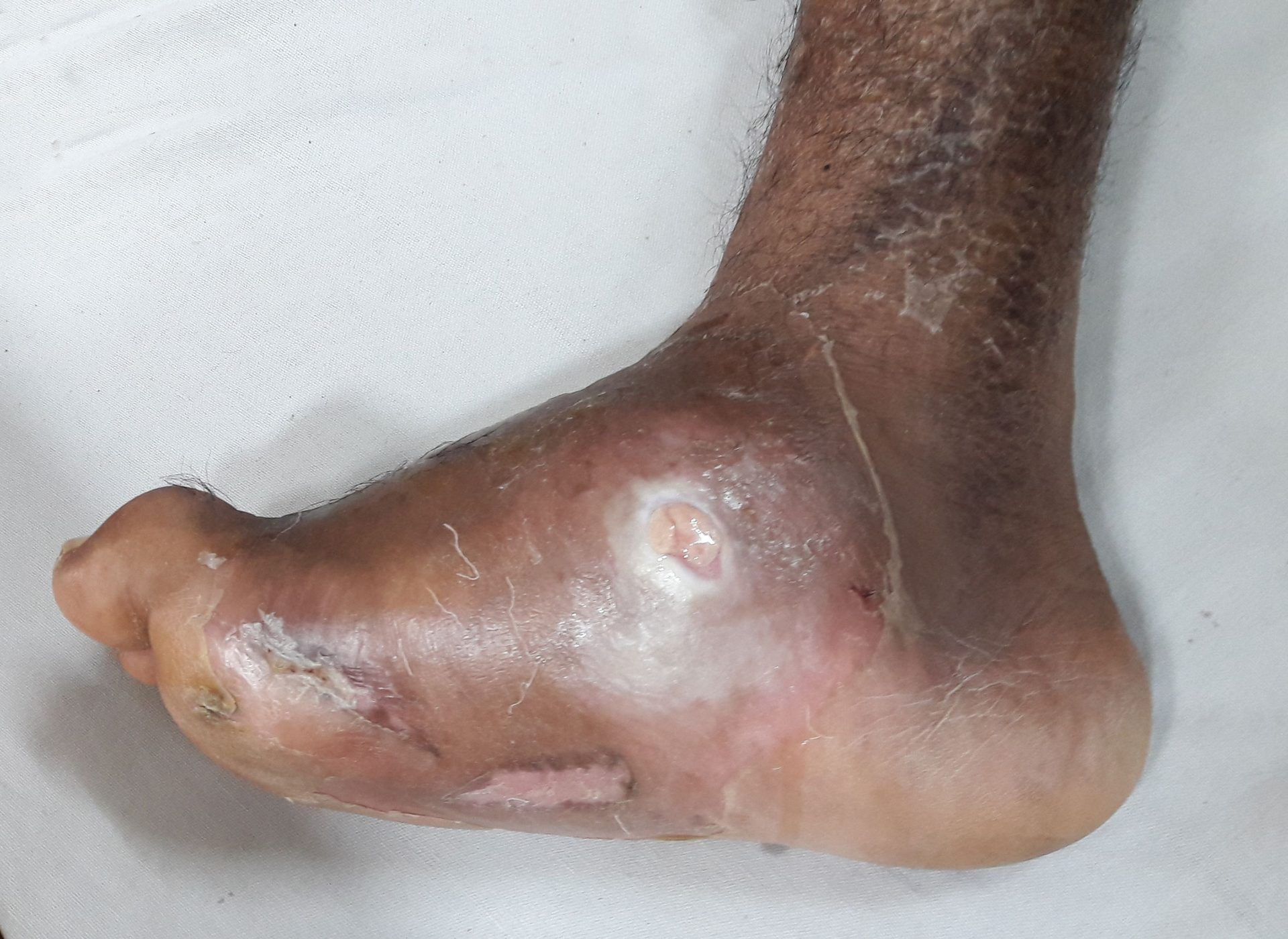
Charcot neuroarthropathy is progressive joint destruction, fragmentation, and deformity in the insensate foot of a patient with diabetic neuropathy. The midfoot (tarsometatarsal joints) is the most commonly affected site, producing the classic rocker-bottom foot deformity with collapse of the longitudinal arch and a bony prominence on the plantar surface that becomes the new high-pressure ulcer site.
Acute Charcot foot presents with erythema, warmth, swelling, and elevated skin temperature versus the contralateral foot. The presentation mimics cellulitis, osteomyelitis, DVT, and gout. The board pearl: the patient is typically nontender or minimally tender despite the dramatic inflammatory appearance, owing to the underlying neuropathy. The discrepancy between appearance and symptoms is the diagnostic clue.
Management of acute Charcot requires strict non-weight-bearing with total contact casting until inflammation resolves, assessed by measuring the temperature differential between the affected and contralateral foot, with resolution defined as a difference of less than 2°C. This may take 3 to 6 months or longer. Premature weight-bearing accelerates destruction.
The transition from acute treatment to definitive footwear runs through a Charcot Restraint Orthotic Walker (CROW) boot. Definitive management is custom-molded accommodative footwear with a rocker-bottom sole modification. Lifelong podiatric surveillance and patient education are standard.
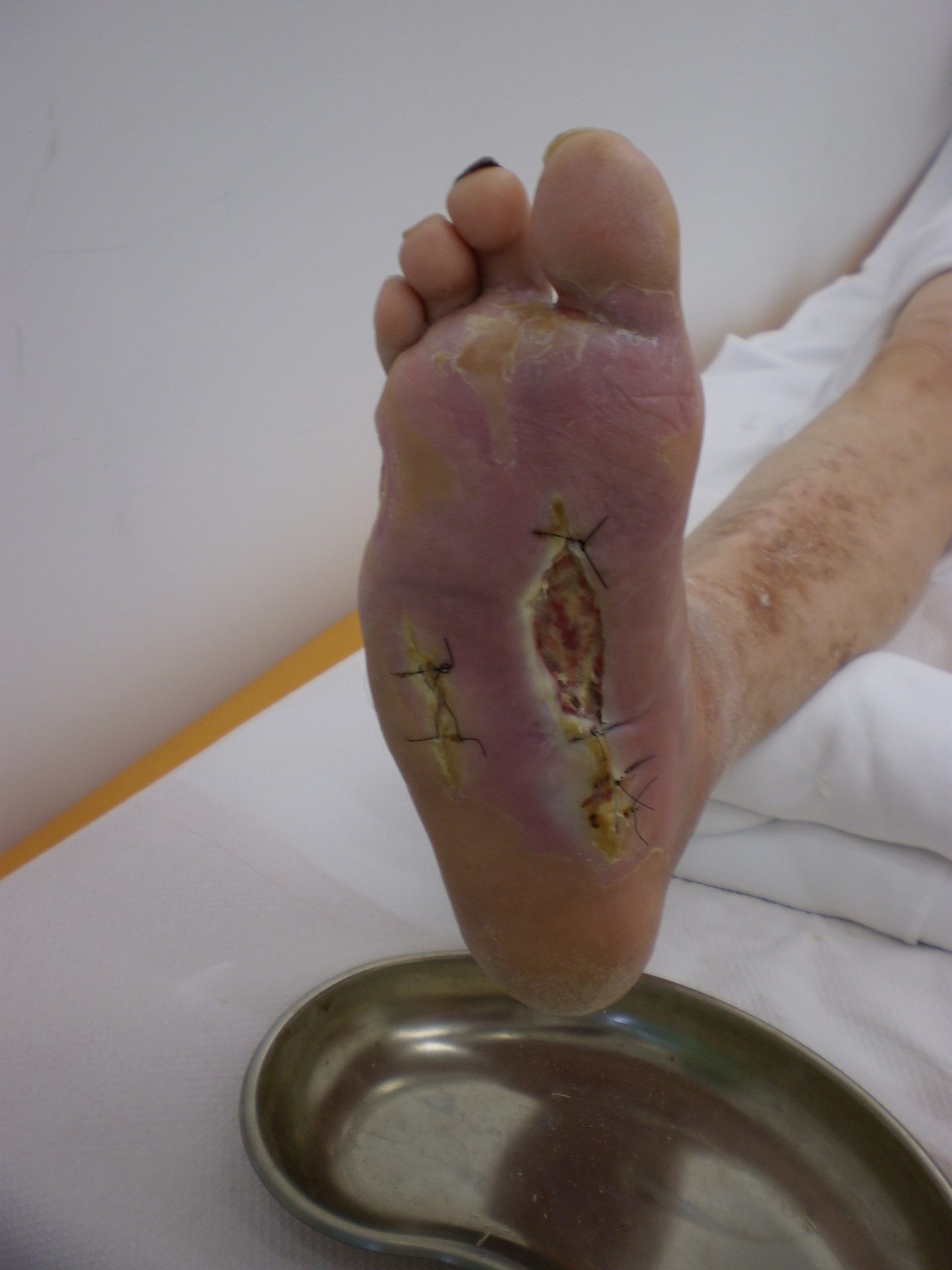
The Wagner classification grades diabetic foot ulcers by depth and the presence of infection or ischemia:
- Grade 0: intact skin with bony deformity and callus (the at-risk foot).
- Grade 1: superficial ulcer (partial or full thickness).
- Grade 2: deep ulcer penetrating to tendon, capsule, or bone without abscess or osteomyelitis.
- Grade 3: deep ulcer with abscess, osteomyelitis, or joint sepsis.
- Grade 4: localized gangrene of the forefoot or heel.
- Grade 5: extensive gangrene requiring major amputation.
Source: Intermedichbo, Wikimedia Commons, CC BY-SA 3.0
Source: Medicalpal, Wikimedia Commons, CC BY-SA 4.0
Total contact casting is the gold standard for off-loading neuropathic plantar ulcers at Wagner grade 1 to 2 without infection or critical ischemia, reducing focal pressure at the ulcer site by 60 to 80 percent. Alternatives include removable cast walkers and therapeutic footwear with custom insoles. Adherence to off-loading is the single most important determinant of healing.
High Yield — Charcot, Wagner, total contact casting
- Charcot neuroarthropathy: insensate diabetic foot with progressive joint destruction; midfoot/tarsometatarsal most common; rocker-bottom deformity.
- Acute Charcot mimics cellulitis with erythema, warmth, swelling, and temperature differential ≥2°C, but minimally tender because of underlying neuropathy. Pain-appearance discrepancy = the clue.
- Management: strict non-weight-bearing with total contact casting until temperature differential <2°C (typically 3 to 6 months); then CROW boot → custom accommodative footwear with rocker-bottom sole.
- Wagner: 0 (deformity, intact skin) → 1 (superficial) → 2 (deep to tendon/bone) → 3 (abscess/osteomyelitis) → 4 (localized gangrene) → 5 (extensive gangrene, major amputation).
- Total contact casting = gold standard for grade 1 to 2 without infection/ischemia; reduces focal pressure 60 to 80 percent.
Board Trap — “It must be cellulitis”
Vignette: a diabetic patient develops a red, hot, swollen foot overnight with minimal pain, no fever, normal white blood cell count, and a temperature 4°C above the contralateral foot. The trap is anchoring on cellulitis because of the inflammatory appearance and starting empiric antibiotics with weight-bearing as tolerated. The correct move is acute Charcot neuroarthropathy until proven otherwise: strict non-weight-bearing, total contact casting initiated, plain radiographs to look for fragmentation at the tarsometatarsal joints, and serial temperature measurements to track resolution. Pain that is wildly out of proportion to the appearance, in this case almost no pain at all, is the diagnostic discrepancy.
You must use the specific 5.07 Semmes-Weinstein monofilament, which is calibrated to exert exactly 10 grams of force when it buckles against the skin. If they can’t feel it, they have a profound loss of protective sensation, placing them at an exponentially elevated risk for ulceration.
— MEDREH-14-b podcast, ~17:59