Before You Listen
Episode Setup
- Topic in one line: the cellular machinery that drives every nerve conduction study and needle electromyogram (EMG): the neuron, the action potential, the motor unit, saltatory conduction, the neuromuscular junction safety factor, the Henneman size principle, and the Wallerian degeneration timeline that determines when an electrodiagnostic (EDX) study can detect what.
- Prerequisites: undergraduate-level membrane physiology (resting potential, ion channels), basic peripheral neuroanatomy (nerve roots, plexus, peripheral nerves), and the principle that the dorsal root ganglion (DRG) lies outside the spinal cord.
- Runtime: 1 hour 8 minutes.
Vignette. A 47-year-old electrician sustains a deep laceration to the volar forearm during a workplace accident. He is taken to the emergency department, where the wound is irrigated and closed. He has dense numbness over the median nerve sensory distribution and cannot oppose the thumb. Three days later he is referred for an electrodiagnostic study to determine the severity of the median nerve injury. The electromyographer performs nerve conduction studies and notes that the median compound muscle action potential (CMAP) recorded from abductor pollicis brevis (APB) is still present with stimulation distal to the laceration, although already slightly reduced in amplitude. Needle examination of APB shows reduced recruitment but no fibrillation potentials.
What immediate clinical action is required, what is the appropriate timing of a comprehensive electrodiagnostic study after acute axonal nerve injury, what are the expected findings on day three versus week three, what cellular event explains why fibrillation potentials are absent on day three, and at what rate would regenerating axons travel from the laceration toward the thenar eminence if axonotmesis is confirmed?
(Answer at the end of this chapter)
Section 1: The Neuron, Axonal Transport, and the Dorsal Root Ganglion Principle
Bottom line: the action potential is initiated at the axon initial segment, the stretch of axon immediately beyond the hillock, because that segment carries the highest density of voltage-gated sodium channels and therefore the lowest firing threshold; the dorsal root ganglion (DRG) sits in the intervertebral foramen, outside the spinal cord, so a root lesion proximal to an intact ganglion leaves the sensory nerve action potential (SNAP) normal even when the dermatome is densely numb; and regenerating peripheral axons advance at about 1 mm per day (about 1 inch per month), a clinical rate that is slower than, and distinct from, the slow axonal transport that supplies them.
The neuron is the fundamental signaling cell of the nervous system. A multipolar motor neuron has three principal domains: the cell body (soma) houses the nucleus and the entire protein-synthesis machinery, including the rough endoplasmic reticulum (Nissl bodies) and a prominent Golgi apparatus; the dendrites are branching extensions that receive synaptic input; and the axon is a single elongated projection that conducts the action potential away from the soma toward its target. Primary sensory neurons are built differently. Their cell bodies sit in the dorsal root ganglion and are pseudounipolar: a single stem leaves the soma and divides into one peripheral process and one central process.
The axon hillock lies between the soma and the proximal axon. Immediately beyond it, the axon initial segment (AIS) carries the highest density of voltage-gated sodium channels found anywhere on the neuron and therefore the lowest firing threshold, and that is where a somatically driven action potential begins. Most texts treat the hillock and the initial segment as a single trigger region, so a stem that offers “axon hillock” as the site of initiation is pointing at the same place. Two spikes do not start there: one evoked at a peripheral sensory ending, and one evoked by an electrical stimulus delivered to the axon, both begin where the stimulus is applied.
Where the 50-fold figure comes from. The often-quoted 50-fold sodium-channel density is the measured ratio at the axon initial segment against the proximal dendrites of cortical pyramidal neurons. Quote it with both halves of that comparison rather than as a property of the hillock in general.
The axon depends on the soma for most of its protein supply, delivered by axonal transport; some proteins are also made locally in the axon, particularly during repair. Fast anterograde transport, powered by kinesin motors along microtubules, carries vesicles, mitochondria, and membrane-associated proteins at approximately 200 to 400 mm per day. Slow anterograde transport carries cytoskeletal proteins such as neurofilaments and tubulin at only 0.5 to 5 mm per day. Retrograde transport, powered by dynein motors, returns degraded materials, endosomes, and neurotrophic factors at approximately 150 to 200 mm per day. Slow transport supplies the structural material a regenerating axon needs, but the transport rate is not the regrowth rate: regenerating axons advance at approximately 1 mm per day, the clinically quoted figure, which is about 1 inch (roughly 30 mm) per month. The 0.5 to 5 mm per day slow-transport figure is a mechanistic ceiling, not the number to quote for reinnervation timing. Distance is only half of recovery, because the denervated muscle must still be viable when the sprout arrives and the new connection must then mature.
The DRG holds the cell body of every spinal sensory neuron, and it sits in the intervertebral foramen, outside the spinal cord. This anatomical fact is the most powerful localization principle in electrodiagnostic medicine. A radiculopathy is a preganglionic lesion: the pathology sits at the root, proximal to the ganglion, so the sensory cell body and its peripheral axon stay connected, the distal sensory axon does not undergo Wallerian degeneration, and the SNAP stays normal even when the patient is densely numb in that dermatome. An abnormal SNAP in the numb territory puts the lesion at or distal to the ganglion: plexopathy or peripheral neuropathy. Two exceptions are worth carrying. Foraminal disease that reaches the ganglion itself can reduce the SNAP in a genuine radiculopathy, and early, mild, focally demyelinating or small-fiber disease distal to the ganglion can leave a routine distal SNAP normal.
Myelin is the lipid-rich insulating sheath that wraps around axons and dramatically increases conduction velocity while conserving metabolic energy. In the peripheral nervous system (PNS), myelin is produced by Schwann cells with a strict one-to-one relationship: one Schwann cell wraps a single internode of a single axon. In the central nervous system (CNS), myelination is performed by oligodendrocytes, where a single oligodendrocyte can myelinate segments of up to 40 to 50 different axons simultaneously. Schwann cells also have a basement membrane (oligodendrocytes do not), and that basement membrane contributes to the robust regenerative capacity of peripheral nerves. Unmyelinated axons in the PNS are also associated with Schwann cells but are not individually wrapped; instead, multiple small-diameter unmyelinated axons sit within invaginations of a single Schwann cell, forming Remak bundles. The internode length, the distance between successive nodes of Ranvier, is proportional to axon diameter, typically about 100 times the axon diameter. Larger axons therefore have longer internodes and faster conduction. After regeneration, remyelinated fibers have shorter internodes and thinner myelin than the original, and conduction velocity stays below the pre-injury baseline. Recovery is partial rather than complete, so do not read a shorter internode as a guarantee of a permanent fixed deficit.
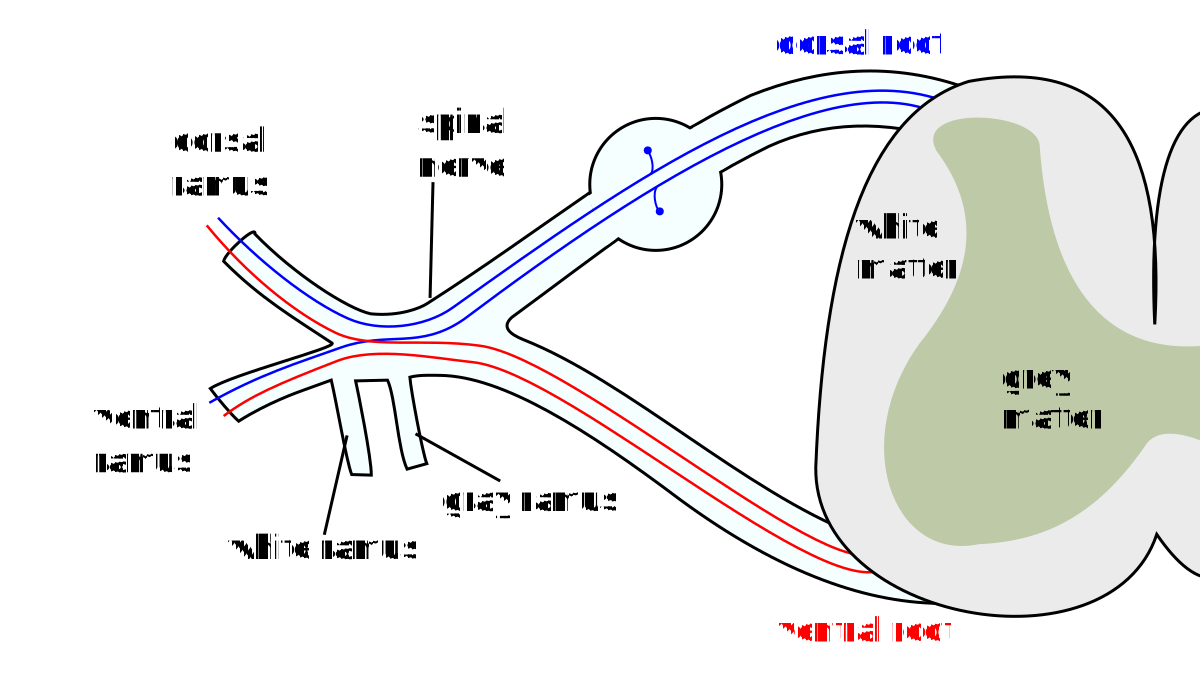
Source: Mysid (vectorized from Tristanb), “Spinal nerve”, via Wikimedia Commons, CC BY-SA 3.0. https://commons.wikimedia.org/wiki/File:Spinal_nerve.svg
High Yield — Neuron, transport, and the DRG rule
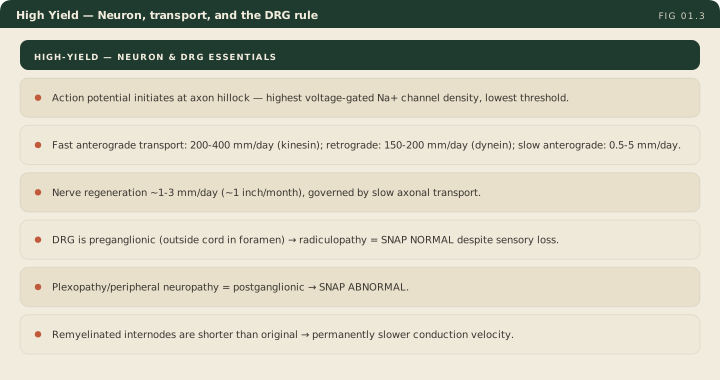
- Action potential initiation = axon initial segment, just beyond the hillock (highest voltage-gated Na+ channel density, lowest threshold).
- Axonal transport speeds: fast anterograde 200-400 mm/day (kinesin); slow anterograde 0.5-5 mm/day (cytoskeleton); retrograde 150-200 mm/day (dynein).
- Nerve regeneration rate = ~1 mm/day (~1 inch/month). Slow axonal transport (0.5-5 mm/day) is a related but distinct transport measurement, not the number to quote for reinnervation timing.
- DRG sits in the intervertebral foramen (outside the cord). Radiculopathy = preganglionic = SNAP NORMAL even when the patient is numb.
- Plexopathy / peripheral neuropathy = postganglionic = SNAP ABNORMAL. Two exceptions: foraminal disease reaching the ganglion can drop the SNAP in a true radiculopathy, and small-fiber or early focal demyelinating disease can spare it.
- Schwann cell = 1 cell per 1 internode of 1 axon (PNS); oligodendrocyte = up to 40-50 axons (CNS).
- Remak bundle = multiple unmyelinated axons in one Schwann cell.
- Internode length ~100x axon diameter; remyelinated internodes are shorter and the myelin thinner, so conduction velocity stays below baseline.
Mnemonic — “Numb but normal” = preganglionic
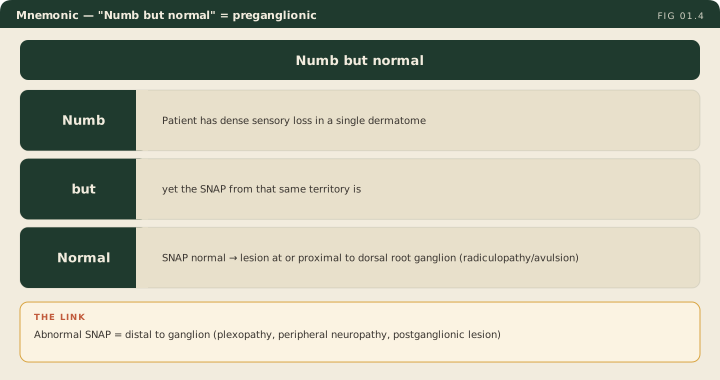
If the stem says the patient is densely numb in a single dermatome but the SNAP from that territory is normal, the lesion is at or proximal to the dorsal root ganglion: a radiculopathy or a root avulsion. If the SNAP is abnormal in the same numb territory, the lesion is distal to the ganglion: plexopathy or peripheral neuropathy. Before you commit, check the stem for the three things that break the rule: foraminal disease reaching the ganglion itself, a study done too early for Wallerian degeneration to have reached the recording site, and pain or temperature loss without large-fiber loss, which is small-fiber disease that routine sensory studies cannot see.
You will get a robust, beautiful SNAP on your screen, even though the patient sitting in front of you is genuinely experiencing dense, undeniable numbness in that exact dermatome. That is just wild to wrap your head around at first.
— EDX-01 podcast, ~10:27
If you are asked to identify where the action potential starts based on standard textbook physiology, the universally accepted answer remains the axon hillock.
— EDX-01 podcast, ~5:08