MSK · EP 05 · ELBOW
Before You Listen
Episode Setup
- Topic in one line: the supracondylar fracture as the most common pediatric elbow fracture and the index injury for Volkmann ischemic contracture, the Mason classification of radial head fractures, the functional test that drives olecranon fracture surgery, the Panner-versus-osteochondritis-dissecans age dichotomy, the supination-flexion reduction for nursemaid’s elbow, the terrible triad of adult elbow dislocation, and the CRITOE ossification sequence that lets a trainee read a pediatric elbow radiograph without missing a medial epicondylar avulsion.
- Prerequisites: Part 1 of this episode (pronator syndrome, cubital tunnel, and the spiral-groove radial nerve), elbow anatomy from MSK-04, and the principle that compartment syndrome diagnosis depends on pain with passive stretch rather than pulselessness.
- Runtime: 1 hour 8 minutes (Part 2 covers the second half).
Vignette. A 7-year-old boy falls from monkey bars onto an outstretched hand. He is brought to the emergency department with a swollen, deformed elbow. Plain radiographs reveal a displaced supracondylar fracture of the distal humerus with posterior displacement of the distal fragment. On examination, the radial pulse is faintly palpable. The capillary refill is 3 seconds at the fingertips. He cries with passive extension of the fingers in the affected hand. His distal sensation appears intact, but he cannot make the OK sign by opposing the thumb to the index finger because of weakness of thumb interphalangeal joint flexion and index finger distal interphalangeal joint flexion.
Which fracture pattern is this in the Gartland classification, which specific peripheral nerve has been injured given the inability to make the OK sign, what is the most ominous physical finding in this clinical picture, and what does that finding mandate within the next 6 hours?
(Answer at the end of this chapter)
Section 4: Supracondylar Fracture and Volkmann Contracture
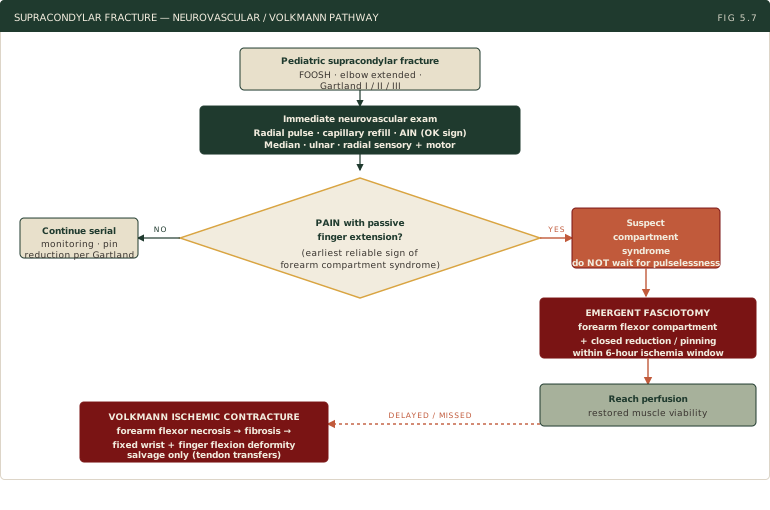
Bottom line: the supracondylar fracture is the most common pediatric elbow fracture, classified by Gartland into Type I (non-displaced), Type II (displaced with an intact posterior cortex), and Type III (completely displaced); the brachial artery and the anterior interosseous nerve (AIN) are at risk because they course immediately anterior to the distal humerus; Volkmann ischemic contracture is the dreaded complication of forearm-compartment ischemia, with pain on passive finger extension as the earliest reliable warning sign that mandates emergent fasciotomy within approximately 6 hours; the anterior humeral line and Baumann angle are the radiographic measurements that flag occult malalignment.
The supracondylar fracture of the distal humerus is the most common elbow fracture in children. It occurs just above the condyles in the thin, flat region of the distal humeral metaphysis, where the bone narrows between the olecranon fossa posteriorly and the coronoid fossa anteriorly. The typical mechanism is a fall on an outstretched hand with the elbow in extension, which drives the olecranon into the distal humerus like a chisel and shears the metaphysis. The boards test this fracture for two dangerous complications: vascular injury and nerve injury. The brachial artery runs directly anterior to the distal humerus, and a displaced distal fragment can kink, compress, or lacerate the vessel. The median nerve also courses anteriorly through the antecubital fossa and is at risk. The AIN, the pure motor branch that arises from the median nerve in the proximal forearm, is the most commonly injured nerve in extension-type supracondylar fractures because the displaced fragment pinches the median nerve trunk at the level where the AIN is branching off. The clinical signature is inability to make the OK sign with intact sensation. A complete neurovascular examination must be performed on every child with a supracondylar fracture, documenting the radial pulse, capillary refill, and motor and sensory function of the median, ulnar, and radial nerves both before and after any manipulation.
The Gartland classification stratifies supracondylar fractures by displacement and determines management. Type I is non-displaced; treatment is long arm casting at approximately 90 degrees of flexion for 3 to 4 weeks. Type II has displacement of the distal fragment with an intact posterior cortex acting as a hinge; treatment is closed reduction and percutaneous pinning, typically with two or three smooth Kirschner wires driven from the lateral condyle across the fracture into the medial column. Type III is completely displaced with no cortical continuity; treatment is closed reduction and percutaneous pinning, often performed urgently if there is vascular compromise. Two key radiographic lines guide assessment of subtle displacement. The anterior humeral line is drawn along the anterior cortex of the distal humerus on a true lateral view; in a normal elbow it should bisect the middle third of the capitellum. Posterior displacement of the distal fragment shifts the capitellum behind the line, which is the radiographic signature of an extension-type supracondylar fracture even when the cortices look intact. The Baumann angle measures the angle between the long axis of the humerus and the line of the capitellar physis on an anteroposterior view; the normal value is approximately 70 to 75 degrees, and a change of more than 5 degrees compared with the contralateral side suggests cubitus varus or valgus malalignment that will not remodel.
The most feared complication is Volkmann ischemic contracture, a devastating, irreversible condition caused by ischemia to the forearm flexor compartment. When the brachial artery is compromised by direct injury, sustained compression, or rising compartment pressures, blood flow to the forearm muscles is reduced below the threshold required for cellular viability. If ischemia is not recognized and treated within hours, the muscles undergo necrosis and are replaced by fibrotic scar tissue, which shortens permanently and pulls the wrist and fingers into a fixed flexion contracture. The classic established Volkmann posture is forearm with wrist flexed, fingers flexed at the metacarpophalangeal and interphalangeal joints, and thumb adducted across the palm. The diagnostic bedside maneuver in an established case is the Volkmann sign: with the wrist held in flexion the fingers passively extend, but when the wrist is brought into a neutral or extended position the fingers will not extend because the fibrotic flexors are too short to span both joints simultaneously.
The earliest clinical sign of impending Volkmann contracture is pain with passive extension of the fingers, particularly out of proportion to the injury and unrelieved by the doses of analgesia that should be sufficient for the underlying fracture. This is the hallmark of compartment syndrome in the forearm. The classic five P’s apply (pain out of proportion, pain with passive stretch, pallor, pulselessness, paresthesias), but they are not weighted equally. Pain with passive stretch of the muscles within the compartment is the earliest and most reliable indicator. Waiting for pulselessness is waiting too long, because muscle ischemia can occur even with palpable distal pulses if compartment pressures rise above the diastolic perfusion threshold. The arteries that supply the compartment are perfused at diastolic pressure; once tissue pressure exceeds that number, capillary flow stops while the larger arterial conduit continues to transmit a palpable wave. A child with a supracondylar fracture, a weak radial pulse, and pain with passive finger extension requires emergent fasciotomy to restore perfusion before irreversible muscle death occurs. The window is narrow: irreversible muscle damage begins after approximately 6 hours of ischemia, and once Volkmann contracture is established no surgical procedure restores normal muscle function.
Several practical points reinforce the bedside logic. First, an analgesic-resistant pain pattern in a child whose fracture has been splinted and elevated is itself a red flag; opioid escalation should prompt examination, not further dosing. Second, the AIN palsy that frequently accompanies these fractures can mask the pain on passive extension of the index and thumb distal joints because the patient cannot voluntarily contract those muscles, so the examiner must passively extend the metacarpophalangeal joints and the proximal interphalangeal joints of all four fingers to elicit the reliable sign. Third, the pediatric forearm has four compartments (volar superficial, volar deep, dorsal, and the mobile wad), and the volar deep compartment is the one most often involved in post-supracondylar Volkmann contracture; a single dorsal fasciotomy is not sufficient when the volar deep compartment is the source.
It can’t be pulselessness, right? Because if you were waiting for the radial pulse to disappear, the muscle is probably already dead. Waiting for pulselessness is a catastrophic error. You can literally have a bounding radial pulse while the muscle above it is actively undergoing necrosis.
— MSK-05-b podcast, ~30:21
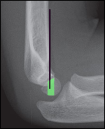
Source: Mikael Häggström, Wikimedia Commons, CC BY-SA 4.0. Annotated lateral elbow radiograph of a 4-year-old child showing the anterior humeral line (black) which should pass through the middle third of the capitellum (green region) — the key landmark for evaluating pediatric supracondylar humerus fractures.
High Yield — Supracondylar fracture and Volkmann
- Most common pediatric elbow fracture; fall on outstretched hand in extension.
- Gartland classification: Type I non-displaced (cast); Type II displaced with intact posterior cortex (closed reduction + percutaneous pinning); Type III completely displaced (closed reduction + percutaneous pinning).
- Anterior humeral line bisects the middle third of the capitellum on a true lateral; posterior shift of the capitellum is the radiographic tell.
- Baumann angle ~70-75 degrees on anteroposterior view; a change of more than 5 degrees from the opposite side signals malalignment.
- AIN is the most commonly injured nerve in extension-type supracondylar fractures: inability to make the OK sign with intact sensation.
- Volkmann ischemic contracture: pain on passive finger extension is the earliest sign; emergent fasciotomy within ~6 hours; do not wait for pulselessness.
Board Trap — Waiting for pulselessness in compartment syndrome
A stem describes a child with a supracondylar fracture, severe forearm pain, and a faint but palpable radial pulse. The trap is to reassure that perfusion is adequate because the pulse is present. Compartment pressures can rise above the diastolic threshold while distal arterial pulses remain palpable. Pain with passive stretch is the earliest reliable sign of impending Volkmann contracture, and the approximately 6-hour fasciotomy window opens the moment that finding emerges. Waiting for pulselessness misses the perfusion window and produces an irreversible contracture.