MSK · EP 27 · PEDS
Before You Listen
Episode Setup
- Topic in one line: the pediatric musculoskeletal toolkit covering the growth-plate (physis) histology, the Salter-Harris classification with SALTR (Slipped, Above, Lower, Through, cRush), the apophysitis cluster (Osgood-Schlatter, Sinding-Larsen-Johansson, Sever, Iselin, Little Leaguer’s elbow and shoulder), the pediatric hip pillars, the pediatric fracture morphologies (greenstick, torus or buckle, plastic deformation, toddler fracture), the Galeazzi versus Monteggia rule, nursemaid’s elbow, the Gartland-classified supracondylar humerus fracture, and the non-accidental trauma fracture patterns physiatrists are mandated to report.
- Prerequisites: long-bone structure (epiphysis, physis, metaphysis, diaphysis), endochondral ossification, the obturator-nerve sensory referral pattern from hip to medial knee covered in MSK-09, and the Gartland classification framework introduced in MSK-05.
- Runtime: 1 hour 5 minutes.
Vignette. A 13-year-old boy with a body mass index (BMI) at the 95th percentile is brought to clinic for two months of progressive left medial knee pain without acute trauma. He plays middle-school football. The pain is dull, worse with running, and recently has caused him to limp at the end of practice. On exam he is afebrile. The left knee has full passive range of motion with no effusion, no joint-line tenderness, no ligamentous laxity, and a negative McMurray test. As you flex the left hip to 90 degrees, the leg drifts into obligate external rotation. Hip internal rotation is restricted. He is reluctant to bear full weight on the left leg.
What is the unifying diagnosis, what is the anatomic basis for the knee pain, what is the classic radiographic line and which view is most sensitive, what is the urgent surgical management, and which manipulation must be specifically avoided and why?
(Answer at the end of this chapter)
Section 1: Growth Plate Anatomy and the Salter-Harris Classification
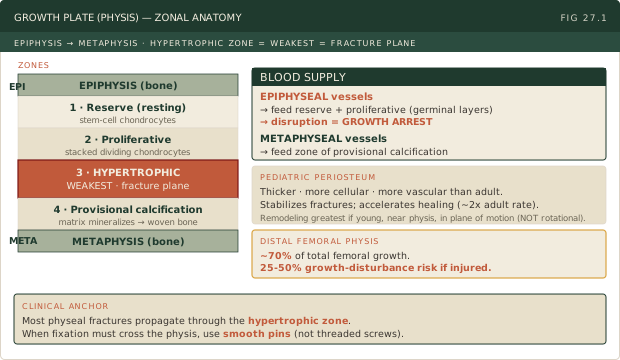
Bottom line: the growth plate (physis) is cartilage between epiphysis and metaphysis with four zones (reserve, proliferative, hypertrophic, provisional calcification), and the hypertrophic zone is the weakest and the plane through which most physeal fractures propagate; the Salter-Harris classification follows SALTR (Slipped, Above, Lower, Through, cRush) where higher grade = more germinal-layer disruption = higher growth-arrest risk; Type II is most common (~75 percent), Type IV is the worst standard prognosis from physeal bar.
The physis is cartilage between epiphysis and metaphysis responsible for longitudinal growth, active until skeletal maturity (~14 to 16 years in girls, 16 to 18 in boys). Four zones progress from epiphyseal to metaphyseal side: the reserve (resting) zone with stem-cell chondrocytes; the proliferative zone with stacked dividing chondrocytes producing growth; the hypertrophic zone with enlarged chondrocytes preparing for apoptosis; and the zone of provisional calcification where matrix mineralizes and is replaced by woven bone.
The single most testable point: the hypertrophic zone is the weakest layer, and physeal fractures preferentially propagate through it because the swollen dying chondrocytes and partially calcified matrix create a structural plane of weakness. Epiphyseal vessels supply the reserve and proliferative zones (the germinal layers); metaphyseal vessels supply the zone of provisional calcification. Disruption of the epiphyseal blood supply is the route to growth arrest.
The pediatric periosteum is thicker, more cellular, and more vascular than its adult counterpart, stabilizing fractures and accelerating healing. Remodeling is greatest in younger patients, fractures close to the physis, and deformity in the plane of joint motion. Rotational deformity does not remodel. The distal femoral physis contributes ~70 percent of total femoral growth, which is why distal-femur Salter-Harris injuries carry a 25 to 50 percent rate of growth disturbance.
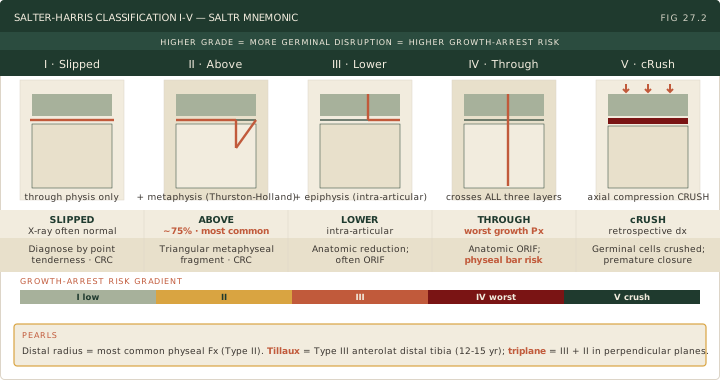
The Salter-Harris classification stratifies physeal fractures by the path of the fracture line. The SALTR mnemonic captures all five types and is the highest-yield single mnemonic in pediatric orthopedics.
Type I (Slipped). Fracture through the physis only, separating epiphysis from metaphysis along the hypertrophic zone. The radiograph may be normal with only subtle physeal widening; diagnosis is frequently clinical (point tenderness over the growth plate after trauma). Prognosis is excellent.
Type II (Above). Fracture through the physis exiting into the metaphysis, producing a triangular Thurston-Holland fragment. Type II is the most common Salter-Harris fracture, accounting for approximately 75 percent of all physeal injuries. Prognosis is excellent. Treatment is closed reduction and casting.
Type III (Lower). Fracture through the physis exiting the epiphysis into the joint (intra-articular). Anatomic reduction is required, often by open reduction with internal fixation. Growth prognosis is generally good if alignment is achieved.
Type IV (Through). Fracture from metaphysis, across the physis, through the epiphysis (all three structures). Intra-articular, requires anatomic reduction. Worst growth prognosis among the standard types because the line crosses the germinal layers and a bony bridge (physeal bar) frequently forms, tethering growth and producing angular deformity or limb-length discrepancy.
Type V (cRush). Axial compression crushes the physis without a visible fracture line. Initial radiograph is often normal; most commonly diagnosed retrospectively when premature physeal closure becomes apparent. Germinal cells are crushed; prognosis is poor.
Types I and II are typically treated with closed reduction and casting; Types III and IV require anatomic reduction (often open reduction with internal fixation) because they are intra-articular. When fixation must cross the physis, smooth pins are preferred over threaded screws because they cause less physeal damage. Harris growth-arrest lines are dense transverse metaphyseal lines: parallel to the physis indicates symmetric growth, while angled lines indicate partial closure and impending deformity.
The most commonly injured physes are the distal radius (the most common physeal fracture and most common Type II site), distal tibia, and distal fibula. Two transitional fractures of the closing distal tibia in early adolescents (12 to 15 years): the Tillaux fracture is a Type III of the anterolateral distal tibial epiphysis (the anterior tibiofibular ligament avulses the anterolateral epiphysis along the still-open lateral physis); the triplane fracture appears as a Type III in one plane and a Type II in the perpendicular plane.
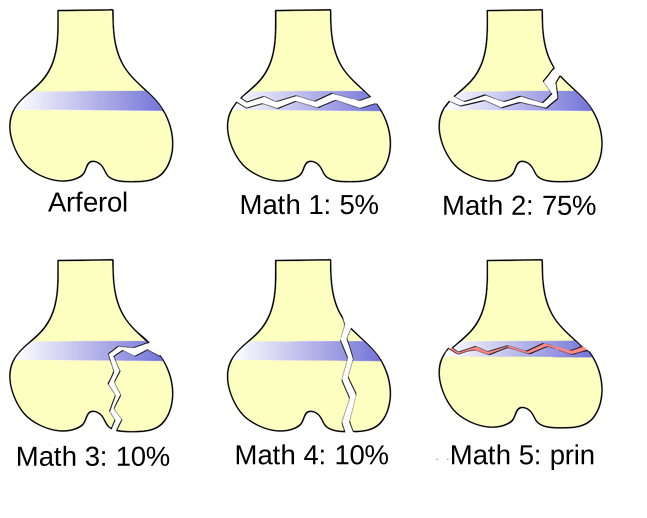
Source: Llywelyn2000, Wikimedia Commons, CC BY-SA 4.0
High Yield — Physis anatomy and Salter-Harris
- Physis zones epiphysis to metaphysis: reserve, proliferative, hypertrophic (weakest, fracture plane), provisional calcification.
- Epiphyseal blood supply feeds germinal layers; disruption produces growth arrest.
- Distal femoral physis = ~70 percent of femoral growth; 25-50 percent growth-disturbance risk if injured.
- SALTR: Slipped (I, through physis), Above (II, ~75 percent, Thurston-Holland, most common), Lower (III, intra-articular), Through (IV, intra-articular, worst standard prognosis), cRush (V, retrospective).
- Type I may have normal X-rays; diagnose clinically by point tenderness.
- Types III and IV require anatomic reduction.
- Smooth pins preferred when hardware must cross the physis.
- Distal radius = most common physeal fracture; Tillaux and triplane = transitional distal-tibial fractures.
Mnemonic — SALTR
Slipped through physis (I) — X-ray may be normal, diagnose clinically. Above into metaphysis (II) — most common, Thurston-Holland fragment. Lower into epiphysis (III) — intra-articular, anatomic reduction. Through metaphysis-physis-epiphysis (IV) — intra-articular, worst standard prognosis. cRush of physis (V) — diagnosed retrospectively when growth arrests.
Higher number = higher disruption of germinal layers = higher growth-arrest risk.
You cannot dismiss this as a simple sprain. Exquisite point tenderness over a pediatric growth plate with normal x-rays is a Salter-Harris type 1 fracture until proven otherwise. It is a purely clinical diagnosis, and the treatment for that clinical diagnosis is immediate immobilization.
— MSK-27-a podcast, ~12:07
In a child, the periosteum is a thick, highly vascularized osteogenic sleeve. When a child’s bone breaks, this periosteum often doesn’t even tear completely; it acts as a robust hinge. And because it’s so rich in osteoprogenitor cells, it generates a massive callus very quickly, which explains why kids heal fractures in half the time an adult would.
— MSK-27-a podcast, ~6:50