Before You Listen
- Prerequisites: upper vs lower motor neuron signs; CNS oligodendrocyte vs PNS Schwann cell myelination; Babinski sign and the corticospinal tract.
- Runtime: 1 hour.
- Topic in one line: relapsing-remitting MS (RRMS) / secondary progressive MS (SPMS) / primary progressive MS (PPMS) / clinically isolated syndrome (CIS) subtypes, the 2017 McDonald criteria (dissemination in space [DIS] + dissemination in time [DIT], with oligoclonal bands now substituting for DIT), the classic clinical signs (optic neuritis, internuclear ophthalmoplegia [INO], Lhermitte, Uhthoff), the disease-modifying therapy (DMT) ladder with progressive multifocal leukoencephalopathy (PML)/John Cunningham virus (JCV) and rebound traps, neuromyelitis optica spectrum disorder (NMOSD) vs MS treatment distinction, and the Expanded Disability Status Scale (EDSS)-driven equipment progression.
Vignette. A 32-year-old woman presents with 5 days of right eye pain worse with movement, central scotoma, and red desaturation. A relative afferent pupillary defect (RAPD) is present on the right. Brain MRI shows three periventricular T2 lesions oriented perpendicular to the lateral ventricles plus one cervical cord lesion, one of the brain lesions enhances with gadolinium and the others do not. CSF is bland with 4 oligoclonal bands and elevated IgG index. She also reports an electric-shock sensation down her spine when she flexes her neck.
What is the diagnosis, the named MRI pattern, the named neck-flexion sign, the criterion that lets you diagnose at this single visit, and the first-line acute treatment?
Section 1 — Disease Overview, Subtypes, and Pathophysiology
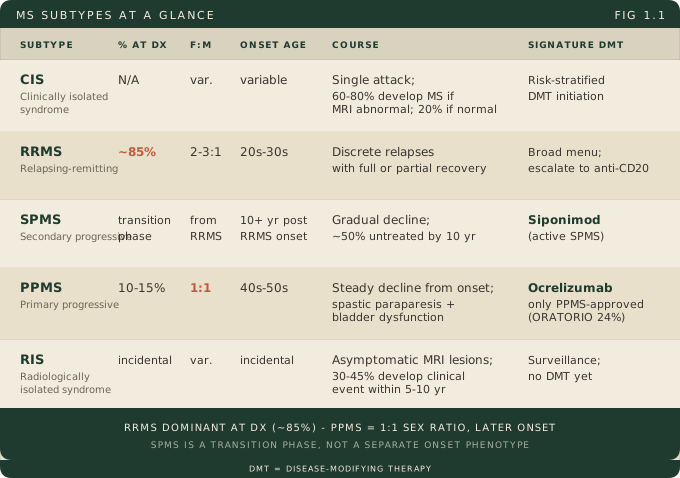
Bottom line: MS is a CNS-only autoimmune demyelinating disease producing UMN signs; 85% start as relapsing-remitting MS (RRMS); ~50% convert to secondary progressive MS (SPMS) within 10 years untreated; primary progressive MS (PPMS) is a separate demographic with a 1:1 sex ratio and later onset.
Multiple sclerosis (MS) is the most common non-traumatic cause of neurological disability in young adults in the developed world, affecting roughly one million Americans. Onset peaks in the early thirties. The disease selectively attacks central nervous system (CNS) myelin produced by oligodendrocytes while sparing peripheral myelin produced by Schwann cells. This single anatomical distinction drives the examination signature: MS produces upper motor neuron (UMN) signs (hyperreflexia, spasticity, Babinski) whereas demyelinating PNS diseases like Guillain-Barré (GBS) and chronic inflammatory demyelinating polyneuropathy (CIDP) produce hyporeflexia and areflexia. The CSF mirrors the divide: MS shows oligoclonal bands and an elevated IgG index, while GBS/CIDP show albuminocytologic dissociation (high protein, normal cells).
Risk reflects a gene-environment interaction. The latitude gradient (MS prevalence rising with distance from the equator) tracks lower vitamin D synthesis from reduced UVB at higher latitudes; vitamin D promotes regulatory T-cell function and suppresses pro-inflammatory T-helper 1 (Th1) and Th17 responses. Migration before puberty adopts the new region’s risk; migration after puberty retains the original risk, marking puberty as the developmental window. HLA-DRB1*15:01 is the strongest single genetic factor, conferring roughly a three-fold increase. Monozygotic twin concordance is ~25-30% (vs 5% dizygotic), so MS is neither purely genetic nor purely environmental. Epstein-Barr virus (EBV) seropositivity is now considered a necessary (not sufficient) cause, with infectious mononucleosis raising risk 2-3×. Smoking (1.5×, dose-dependent) and adolescent obesity (BMI > 30 doubles risk) round out the modifiable factors.
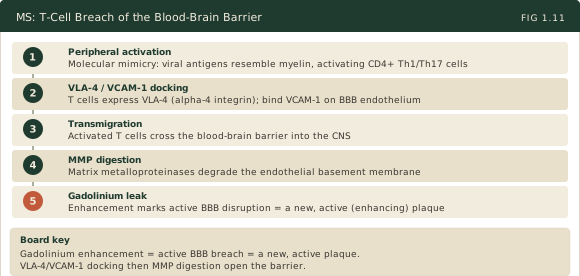
The pathology is driven by autoreactive CD4+ T cells (Th1 and Th17 subsets), activated peripherally (likely through molecular mimicry between viral antigens and myelin epitopes) that express VLA-4 (alpha-4 integrin) and bind VCAM-1 on the blood-brain barrier (BBB) endothelium to transmigrate into the CNS. Matrix metalloproteinases degrade the basement membrane. Gadolinium enhancement marks this active BBB disruption. Inside the CNS, T cells are reactivated by local antigen-presenting cells; Th1 cells secrete IFN-γ and TNF-α to activate macrophages that phagocytose myelin; Th17 cells secrete IL-17. B cells serve dual roles as antigen-presenting cells producing pro-inflammatory cytokines and as plasma cell precursors making anti-myelin antibodies. The dramatic efficacy of anti-CD20 therapies (which deplete B cells but not antibody-producing plasma cells, which lack CD20) demonstrates that B-cell antigen presentation (not antibody production) is the primary therapeutic target.
The hallmark lesion is the demyelinating plaque: circumscribed myelin loss with relative axonal sparing, perivascular inflammation, and reactive gliosis. Plaques favor periventricular white matter and orient perpendicular to the lateral ventricles along medullary veins, producing Dawson fingers on sagittal MRI. Active plaques correspond to gadolinium-enhancing lesions. Chronic active plaques have an inactive core with a rim of activated microglia driving slow outward expansion and are increasingly recognized as drivers of progressive MS. Shadow plaques mark remyelination by their thinner-than-normal myelin. Axonal damage starts early and accumulates; in progressive MS, chronic microglial activation, mitochondrial dysfunction, and oxidative stress drive neurodegeneration that is poorly responsive to anti-inflammatory DMTs. Demyelination converts saltatory conduction (jumping between nodes of Ranvier) into slow continuous conduction or block, and this conduction failure is temperature-sensitive, the molecular basis of the Uhthoff phenomenon.
Clinical Pearl — The CNS-PNS divide
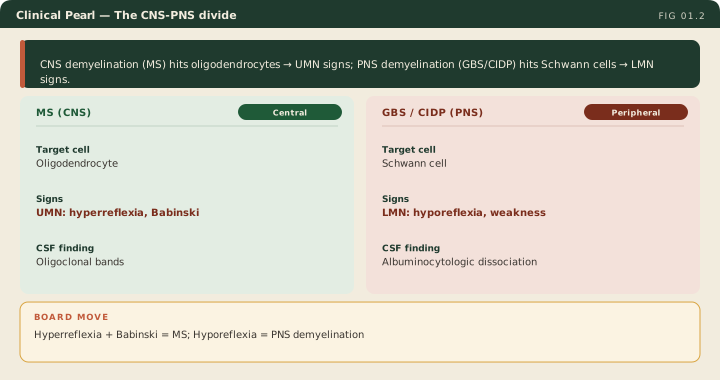
MS attacks CNS myelin (oligodendrocytes) and produces UMN signs with oligoclonal bands; GBS and CIDP attack PNS myelin (Schwann cells) and produce LMN signs with albuminocytologic dissociation. Demyelination + hyperreflexia + Babinski = MS; demyelination + hyporeflexia = peripheral disease.
Board Trap — RRMS vs PPMS demographics
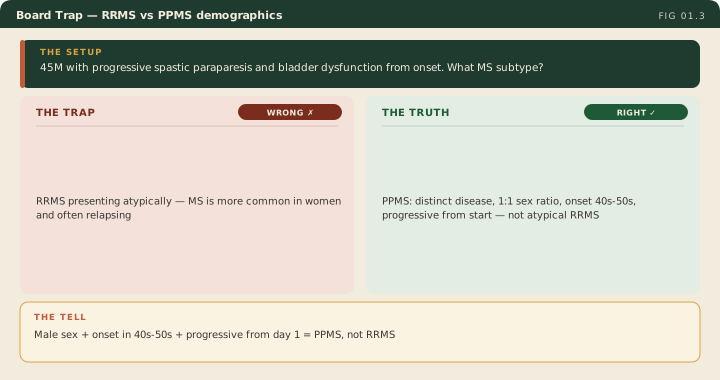
PPMS is not RRMS that started progressively. It is a separate disease with a 1:1 sex ratio and later onset (40s-50s). A 45-year-old man with progressive spastic paraparesis and bladder dysfunction from onset is PPMS, not “atypical RRMS.”
High Yield — Subtypes and biology
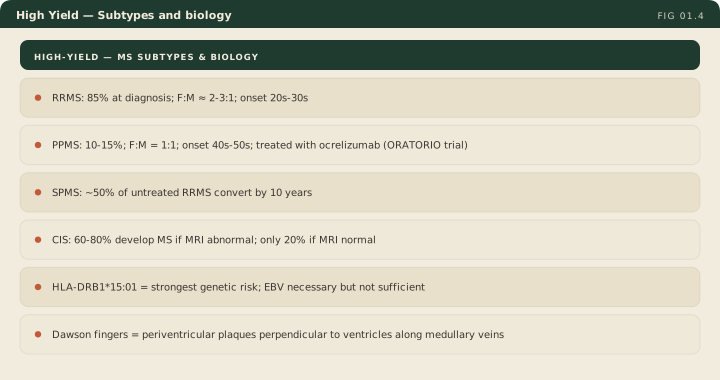
- RRMS 85% at diagnosis; F:M ≈ 2-3:1; onset 20s-30s.
- SPMS = transition phase; ~50% of untreated RRMS by 10 years.
- PPMS 10-15%; F:M = 1:1; onset 40s-50s; ocrelizumab (ORATORIO).
- Clinically isolated syndrome (CIS) = first attack; 60-80% develop MS if MRI abnormal, 20% if normal.
- HLA-DRB1*15:01 strongest genetic factor; EBV necessary not sufficient; vitamin D, smoking, adolescent obesity modifiable.
- Dawson fingers = periventricular plaques perpendicular to ventricles along medullary veins.
So that proves that the primary therapeutic target isn’t the antibody production at all. The target is the B cells’ day job as an antigen presenter.
— NEURO-01 podcast, ~14:27
If a patient has absent reflexes, they cannot possibly have a purely central lesion. Because a central lesion in the brain or spinal cord has absolutely no physiological way to abolish a reflex arc that remains fully intact down below it.
— NEURO-01 podcast, ~5:25