PEDS · EP 03 · SPINABIFIDA · PT 2
Before You Listen
Episode Setup
- Topic in one line: the lifelong rehabilitation framework for myelomeningocele after the embryology and prenatal-repair material of Part 1, anchored on four threads: tethered cord (a clinical not radiographic diagnosis driven by progressive change), functional motor levels that determine ambulation prognosis (L4 plus tibialis anterior is the classic ankle-foot orthosis community ambulator), neurogenic bladder protection through clean intermittent catheterization with the McGuire 40 cm H₂O detrusor leak point pressure threshold, neurogenic bowel management culminating in the Malone antegrade continence enema (MACE) procedure, latex precautions using the BACK food list (Banana, Avocado, Chestnut, Kiwi), and the orthopedic philosophy that contrasts sharply with cerebral palsy because hip reduction in spina bifida does not improve ambulation.
- Prerequisites: Part 1 of PEDS-03 (embryology, MOMS trial, Chiari II, hydrocephalus); the spinal cord level-to-muscle map; and the upper-versus-lower motor neuron bladder/bowel framework.
- Runtime: approximately 35 minutes for Part 2 (Part 1 covers the first 35 minutes).
Vignette. A 2-day-old neonate is born with a 4 cm lumbosacral skin defect, exposed neural tissue, and absent voluntary motion below the knees. Prenatal ultrasound at 20 weeks showed the lemon and banana signs. Maternal serum alpha-fetoprotein was 4.2 multiples of the median at 16 weeks. Postnatal exam shows quadriceps strength 4/5 bilaterally, absent ankle dorsiflexion, and absent foot intrinsics. The neonate has a tense anterior fontanelle, increasing head circumference, and weak cry with intermittent stridor. Renal ultrasound reveals mild bilateral hydronephrosis.
What is the functional motor level, what is the most likely cause of the head circumference change, what is the most life-threatening current finding, what bladder management must begin now, and what is the long-term prognosis for community ambulation?
(Answer at the end of this chapter)
Section 3: Tethered Cord, Functional Motor Levels, and Ambulation
Bottom line: radiographic tethering is present in virtually all post-repair myelomeningocele patients, so tethered cord is a clinical not radiographic diagnosis driven by progressive motor, urological, or orthopedic change. Functional motor level determines ambulation prognosis with the canonical pairings thoracic and L1 to L2 wheelchair, L3 quadriceps household ambulator, L4 tibialis anterior community ambulator with ankle-foot orthoses (AFOs), L5 lateral hamstrings and peroneals (Trendelenburg gait), and S1 gastrocnemius near-normal walker. Foot deformities map predictably to level (L4 calcaneovalgus, L5 calcaneus, S1 cavovarus). Ambulation status declines from approximately 75 percent in early childhood to 50 percent in young adulthood, driven by obesity, deformity, and energy cost.
Tethered cord. Symptomatic tethered cord in myelomeningocele is the consequence of chronic traction on the spinal cord during longitudinal growth when scar, lipoma, or tight filum prevents normal cord ascent. Radiographic tethering with a low-lying conus medullaris (below L2 in adults, below L3 in infants) is present in essentially all post-repair myelomeningocele patients. Therefore tethered cord in myelomeningocele is a clinical diagnosis driven by progressive change, not a radiographic one. The imaging tells you what is anatomically present; the exam tells you whether it has become dangerous.
Symptoms of progressive tethering include progressive scoliosis (rapidly progressive or new onset), change in gait pattern or loss of ambulation, increasing lower extremity spasticity, new or worsening unilateral foot deformity, positional back pain (worse with flexion), progressive neurogenic bladder changes (new incontinence, increased post-void residual, urodynamic deterioration), and upper extremity symptoms if associated syringomyelia is present. Symptomatic tethered cord requiring surgical release affects 10 to 30 percent of myelomeningocele patients (some series cite 20 to 50 percent). Surgical untethering (laminectomy with release of adhesions) aims to halt progression; recovery of lost function is variable, and the re-tethering rate is 10 to 20 percent.
Rule of progressive change. New or rapidly progressive scoliosis, new urodynamic deterioration, or worsening foot deformity in a spina bifida patient demands evaluation for tethered cord and shunt malfunction. Evaluate the shunt first because shunt malfunction can mimic tethered cord symptoms and is more rapidly reversible.
Functional motor levels are the highest-yield topic in spina bifida rehabilitation because they predict orthotic needs, foot deformity pattern, and ambulation prognosis.
| Level | Key muscle | Orthotic | Ambulation prognosis | Foot deformity |
|---|---|---|---|---|
| Thoracic | None in lower extremity | Parapodium / reciprocating gait orthosis (RGO) (therapeutic) | Wheelchair; therapeutic standing only | Equinovarus (positioning) |
| L1-L2 | Iliopsoas (hip flexion) | Hip-knee-ankle-foot orthosis (HKAFO) / RGO | Household ambulator as child; wheelchair as adult | Variable |
| L3 | Quadriceps (knee extension) | Knee-ankle-foot orthosis (KAFO) | Household / limited community as child; wheelchair as adult | Variable |
| L4 | Tibialis anterior (ankle dorsiflexion) | AFO | Community ambulator with AFO | Calcaneovalgus |
| L5 | Lateral hamstrings, peroneals, partial gluteus medius | AFO | Community ambulator; Trendelenburg gait | Calcaneus |
| S1 | Gastrocnemius/soleus (plantar flexion) | AFO or shoe insert | Near-normal ambulation | Cavovarus |
| S2-S3 | Foot intrinsics, sphincters | None | Normal or near-normal | Mild |
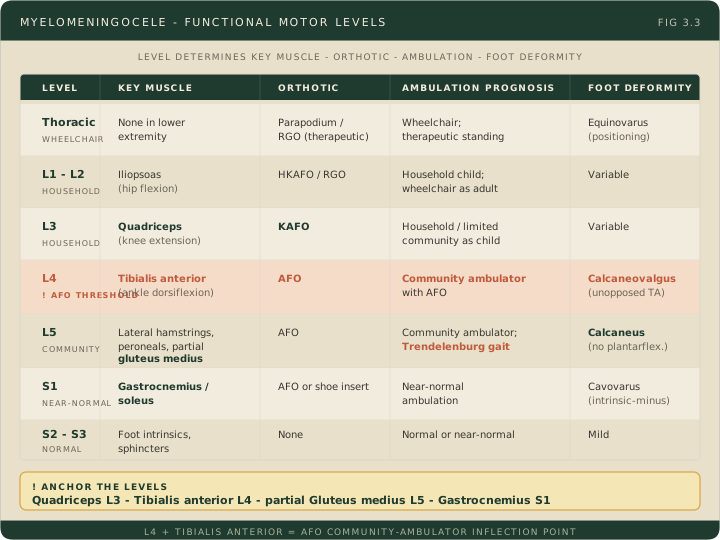 The L4 inflection point. Quadriceps function (L3) is the key determinant of any meaningful ambulation potential, and L4 (tibialis anterior plus quadriceps) is the classic threshold for community ambulation with AFOs. L5 adds lateral hamstrings and peroneals but lacks gluteus medius, producing the Trendelenburg gait (pelvic drop on the swing-leg side from contralateral hip abductor weakness). S1 plantar flexors give near-normal ambulation, although bowel and bladder dysfunction persists even at this near-normal level because the sacral autonomic roots remain affected.
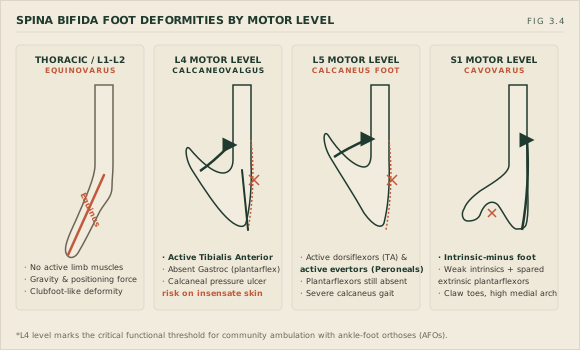
Foot deformity by level. Higher levels with no muscle innervation produce equinovarus from positioning and gravity. L4 levels develop calcaneovalgus because active tibialis anterior dorsiflexion is unopposed by gastrocnemius and soleus plantar flexion. L5 develops calcaneus because dorsiflexors and evertors fire without plantar flexor counterweight. S1 develops cavovarus, the classic intrinsic-minus foot, because foot intrinsics are weak while extrinsic plantar flexors and invertors remain intact. The deformity pattern reflects muscle imbalance from differential innervation and is predictable from the motor level alone.
Energy cost of ambulation. Walking energy cost at thoracic level using HKAFOs is 2 to 4 times normal walking energy cost, which is physiologically unsustainable for daily mobility. Most patients with thoracic through L2 levels eventually transition to wheelchair use despite successful childhood orthotic ambulation programs. This is not a failure of bracing or therapy; it is the predictable consequence of the metabolic arithmetic of swinging a non-functional limb segment through space with proximal compensation. A child can sustain that energy cost; an adolescent putting on growth-related body mass cannot. The orthotic prescription philosophy therefore matures with the patient: the parapodium and RGO that allowed therapeutic standing at age 3 are rarely the patient’s primary mobility device at age 23.
Orthotic progression by level in practice. For thoracic and L1 to L2 patients, a parapodium provides supported standing in young children, while the reciprocating gait orthosis pairs hip-knee-ankle-foot bracing with a cable mechanism that converts contralateral hip extension into ipsilateral hip flexion for swing — a clever piece of engineering that nonetheless cannot overcome the energy cost cap. For L3, the KAFO locks the knee in extension against quadriceps fatigue and gravity. For L4, the AFO supports the absent gastrocnemius and soleus, with a hinged versus solid choice driven by tibialis anterior strength and ground reaction force requirements. For L5, an AFO is often still required even though the dorsiflexor is partially preserved, because the plantar flexor weakness leaves the patient with a calcaneus gait. For S1, a flexible foot orthosis or simple shoe insert is usually sufficient.
Ambulation prognosis trajectory. Approximately 75 percent of children with myelomeningocele are ambulatory in early childhood; this decreases to approximately 50 percent in young adulthood. Predictors of loss of ambulation include higher neurological level, obesity, musculoskeletal deformity, hydrocephalus and shunt complications, and lower cognitive function. The Hoffer ambulatory classification sorts patients into four practical categories: community ambulator (walks for most daily activities, possibly with orthoses), household ambulator (walks indoors but uses a wheelchair for community distances), exercise ambulator (walks only during therapy sessions), and non-functional (does not walk).
Mnemonic — “Quadriceps L3, Tibialis L4, Glutes L5, Gastroc S1”
Anchor each pivotal motor level to its key muscle: L3 = Quadriceps (knee extension); L4 = Tibialis Anterior (ankle dorsiflexion, the AFO threshold); L5 = Gluteus medius (partial) plus peroneals (Trendelenburg gait); S1 = Gastrocnemius/Soleus (plantar flexion, near-normal ambulation).
High Yield — Tethered cord, levels, and ambulation
- Tethered cord in MMC is a CLINICAL, not radiographic, diagnosis (radiographic tethering present in virtually all post-repair patients).
- Progressive symptoms (motor loss, scoliosis, urodynamic decline, new foot deformity) trigger evaluation; check shunt first.
- L3 quadriceps; L4 tibialis anterior (community AFO ambulator); L5 partial gluteus medius (Trendelenburg gait); S1 gastrocnemius (near-normal).
- Foot deformities: thoracic equinovarus (positioning); L4 calcaneovalgus; L5 calcaneus; S1 cavovarus.
- Energy cost at thoracic-L2 is 2 to 4 times normal, driving wheelchair use in adulthood.
- Ambulation declines from ~75% in childhood to ~50% in young adulthood.
- Hoffer: community / household / exercise / non-functional.
But the absolute most sensitive indicator and frequently the earliest detectable clinical sign of a tethered cord is a subtle change in their neurogenic bladder function. This could present as new incontinence in a child who had previously mastered their bladder program. It could be an increased post-void residual volume seen on a quick clinic ultrasound, or it could be worsening, dangerously high pressures recorded on a routine urodynamic study.
— PEDS-03-b podcast, ~47:51