Before You Listen
Episode Setup
- Topic in one line: Part 1 of pediatric neuromuscular disease, anchored at the muscle and the anterior horn cell. The dystrophinopathies are framed by the reading frame hypothesis (Monaco, 1988), with Duchenne (DMD) as the out-of-frame phenotype (absent dystrophin, creatine kinase 50 to 100 times normal, Gower sign by age 3 to 5, ambulation loss 9 to 13) and Becker (BMD) as the in-frame phenotype (reduced or abnormal dystrophin, ambulation past 16, cardiomyopathy out of proportion to skeletal weakness). Care follows the Birnkrant 2018 framework. Succinylcholine is absolutely contraindicated. Spinal muscular atrophy (SMA) is autosomal recessive loss of SMN1 at 5q13 with SMN2 copy number setting severity. The three FDA-approved disease modifiers are nusinersen, onasemnogene abeparvovec, and risdiplam, and SMA was added to the United States Recommended Uniform Screening Panel (RUSP) in 2018.
- Prerequisites: the motor unit anatomy from EDX-01 (anterior horn cell, axon, neuromuscular junction, muscle fiber), the difference between myopathic and neurogenic electromyography patterns, and the basic transmission rules for X-linked recessive and autosomal recessive disease.
- Runtime: 1 hour 17 minutes.
Vignette. A 4-year-old boy is referred for delayed walking, frequent falls, and difficulty climbing stairs. He walked at 18 months. On examination he uses a Gower maneuver to rise from the floor, has bilateral calf pseudohypertrophy, demonstrates a waddling gait with hyperlordosis, and has 4-/5 hip flexor strength bilaterally. Deep tendon reflexes are diminished. Serum creatine kinase is 22,000 IU/L. There is no family history.
What is the most likely diagnosis, what is the underlying genetic mechanism that distinguishes the two main phenotypes of this disease, what disease-modifying therapy should be initiated now, and what anesthesia precaution must be communicated to every clinician who sees this child?
(Answer at the end of this chapter)
Section 1: Duchenne Muscular Dystrophy — Genetics, Clinical Presentation, and Diagnosis
Bottom line: Duchenne muscular dystrophy (DMD) is X-linked recessive at Xp21.2, the largest known human gene at roughly 2.4 megabases, and the severe phenotype is produced by out-of-frame mutations that yield absent dystrophin. Boys present between ages 2 and 5 with Gower sign, calf pseudohypertrophy, hyperlordotic Trendelenburg gait, and proximal lower extremity weakness; creatine kinase is 10,000 to 50,000 IU/L (50 to 100 times normal) from birth. Approximately 30 percent of cases are de novo, so absent family history is not reassuring. First-line diagnosis is multiplex ligation-dependent probe amplification (MLPA), with next-generation sequencing for MLPA-negative cases.
Genetics. DMD is X-linked recessive, caused by mutations in the dystrophin gene at Xp21.2. Dystrophin is a 427-kDa cytoskeletal protein that anchors the actin cytoskeleton to the extracellular matrix through the dystrophin-associated glycoprotein complex. Loss of dystrophin destabilizes the sarcolemma, so each muscle contraction tears the membrane and triggers repeated necrosis-regeneration cycles. The mutation distribution is characteristic: deletions account for roughly 65 percent of cases (60 to 70 percent) and cluster in hotspots at exons 44 to 55 and 2 to 20; duplications make up roughly 10 percent; point mutations and small insertions and deletions account for the remaining 20 to 25 percent.
The reading frame hypothesis (Monaco, 1988). The single rule that explains the two phenotypes. Out-of-frame mutations in DMD disrupt the translational reading frame and produce a truncated, nonfunctional dystrophin that is rapidly degraded; the result is absent dystrophin and the severe DMD phenotype. In-frame mutations preserve the reading frame and allow production of a shortened but partially functional dystrophin; the result is the milder Becker phenotype. The rule holds in roughly 90 to 95 percent of cases and is the conceptual scaffold for exon-skipping therapy.
Epidemiology and carrier status. DMD affects approximately 1 in 3,500 to 5,000 live male births. About 30 percent of cases arise from de novo mutations, so the mother is not always a carrier and family history may be completely silent. BMD is 3 to 6 times less common. Female carriers are usually asymptomatic, but 2.5 to 10 percent develop clinical symptoms (manifesting carriers) because of skewed X-inactivation. All female carriers require periodic cardiac surveillance regardless of symptoms, because dilated cardiomyopathy can emerge independently of skeletal muscle involvement.
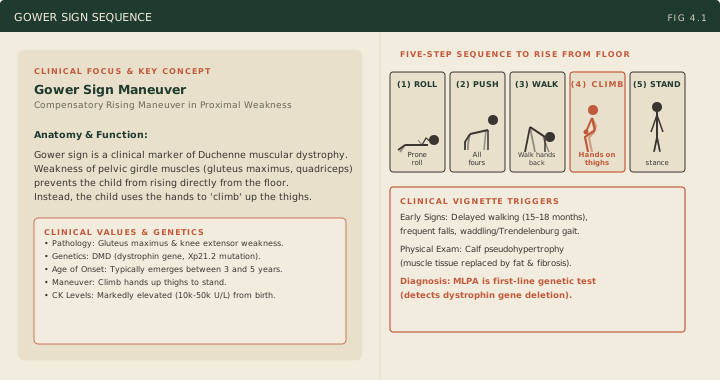
Clinical presentation. Boys typically present between ages 2 and 5. About 40 to 50 percent of muscle power is already lost by age 6. The early signs are delayed walking (commonly 15 to 18 months), frequent falls, difficulty with stairs, and toe walking. The Gower sign, the compensatory maneuver of climbing the hands up the thighs to rise from the floor, is evident by age 3 to 5 and reflects proximal hip and knee extensor weakness. Calf pseudohypertrophy is the second classic sign and represents replacement of muscle by fat and fibrosis, not true hypertrophy. Gait shows compensatory hyperlordosis (offsetting hip extensor weakness), a wide-based waddling Trendelenburg pattern, and progressive equinus. Neck-flexor weakness appears first, in the preschool years, before the pelvic girdle. Weakness then follows a proximal-to-distal gradient, hitting the pelvic girdle before the shoulder girdle and the lower extremities before the upper. Cognitive involvement affects roughly one-third of boys (mean IQ approximately 85, with about 30 percent meeting intellectual disability criteria) and follows a mutation-position gradient: the full-length brain isoform Dp427c runs off a promoter near the 5’ end of the gene and is lost in essentially all DMD mutations, but Dp140 (intron 44 promoter) and Dp71 (intron 62 promoter) are lost only by mutations distal to those points — so the more distal the mutation, the more brain isoforms are lost and the lower the mean IQ. The common exon 44-55 deletion hotspot lies upstream of intron 62 and therefore spares Dp71 in most boys; assuming Dp71 is universally absent in DMD is a classic wrong-answer trap that reverses the severity gradient.
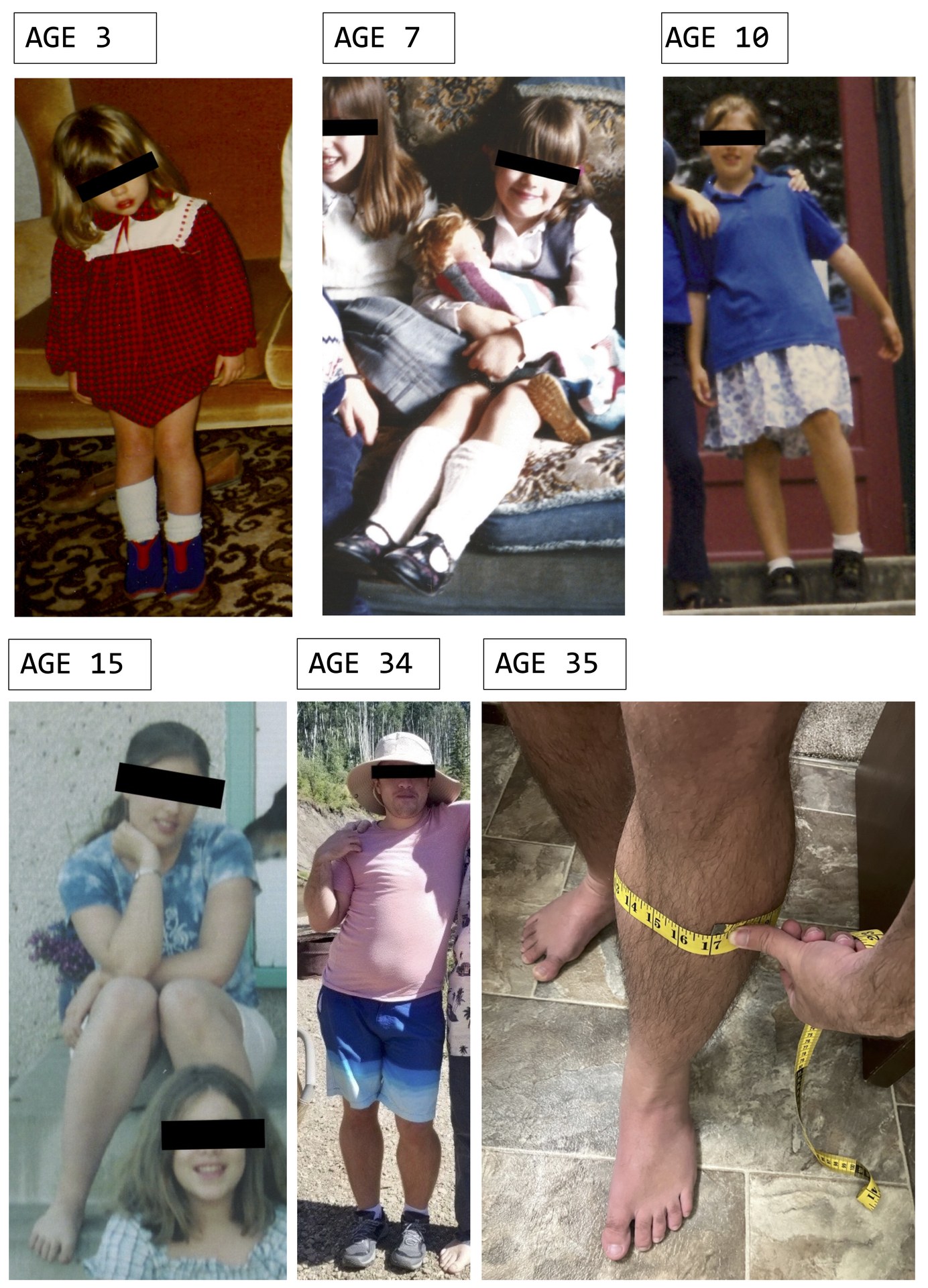
Source: WikEric7, “Pseudoathletic appearance of calf muscle hypertrophy”, via Wikimedia Commons, CC BY-SA 4.0. https://commons.wikimedia.org/wiki/File:Pseudoathletic_appearance_of_calf_muscle_hypertrophy.png
Creatine kinase (CK). CK is the most sensitive screening test in DMD: 10,000 to 50,000 IU/L, 50 to 100 times the upper limit of normal, present from birth and detectable in cord blood. CK peaks in early childhood and then declines as muscle mass is lost. BMD CK is 2,000 to 20,000 IU/L. Aldolase and the aminotransferases (AST, ALT) are also elevated; an unexplained AST/ALT elevation in a young boy should prompt a CK rather than a hepatology consult.
Diagnosis. Genetic-first is the modern strategy. Multiplex ligation-dependent probe amplification (MLPA) is first-line and detects the 70 to 80 percent of cases caused by deletions and duplications. If MLPA is negative, next-generation sequencing identifies point mutations and small insertion/deletions. Muscle biopsy is reserved for inconclusive genetic testing and shows the dystrophic triad (fiber size variation with central nucleation, necrotic and regenerating fibers, and endomysial fibrosis with fatty infiltration) plus absent dystrophin on immunohistochemistry. Duchenne muscle retains under 3 percent dystrophin; Becker retains 20 to 80 percent, or a normal amount of an abnormal protein.
High Yield — DMD genetics and presentation
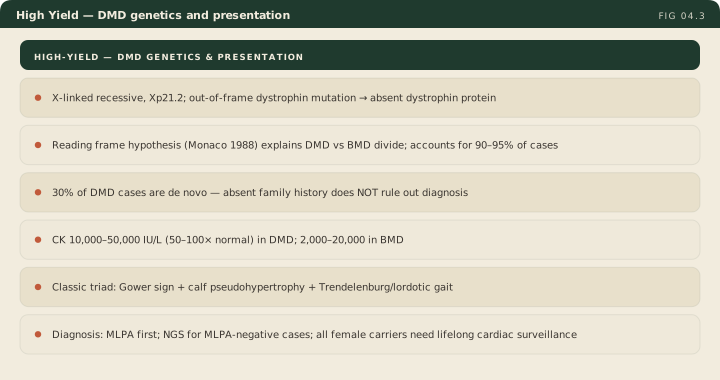
- DMD = X-linked recessive, Xp21.2, out-of-frame dystrophin mutation, absent dystrophin protein.
- Reading frame hypothesis (Monaco, 1988) explains the DMD versus BMD divide and 90 to 95 percent of cases.
- 30 percent of DMD cases are de novo; absent family history is not reassuring.
- CK 10,000 to 50,000 IU/L (50 to 100 times normal) in DMD; 2,000 to 20,000 in BMD.
- Gower sign plus calf pseudohypertrophy plus Trendelenburg/lordotic gait is the classic triad.
- Neck flexors weaken first (preschool years), then the pelvic girdle before the shoulder girdle; about 40 to 50 percent of muscle power is lost by age 6.
- Diagnosis: MLPA first, then next-generation sequencing for MLPA-negative cases.
- All female carriers need lifelong cardiac surveillance; 2.5 to 10 percent are manifesting carriers.
So just to be clear, a patient could have a massive deletion missing huge sections of the gene and have a relatively mild disease because it stayed in frame. Meanwhile, another patient could be missing just a single nucleotide, one tiny letter, but because it throws the whole frame out of alignment, they get the devastating Duchenne phenotype.
— PEDS-04 podcast, ~10:45
The dystrophin protein is the physical metal anchor bolted into the rock, tying the climber’s rope to the wall through this complex of glycoproteins in the cell membrane.
— PEDS-04 podcast, ~5:23