PEDS · EP 09 · MSK
Before You Listen
Episode Setup
- Topic in one line: the second half of PEDS-09 covers the spine and the rest of the pediatric MSK skeleton: adolescent idiopathic scoliosis (AIS) with Cobb-angle thresholds and the BrAIST bracing-dose trial, congenital scoliosis and neuromuscular scoliosis, Scheuermann kyphosis, clubfoot and the Ponseti method, congenital muscular torticollis with its mandatory DDH screen, osteogenesis imperfecta versus non-accidental trauma, the limping child by age window, and pediatric bone tumors organized by intramedullary location.
- Prerequisites: Part 1 of PEDS-09 (the pediatric hip triad of DDH, LCPD, and SCFE; the Salter-Harris classification with the SALTR mnemonic; the apophysitis family; the MUGR forearm-fracture pairs); general orthopedic vocabulary (varus, valgus, abduction, adduction); and the limb examination framework from PEDS-01.
- Runtime: approximately 32 minutes for Part 2.
Vignette. A 13-year-old girl is brought to a school-based scoliosis screening. She is otherwise healthy, denies pain, and has been growing rapidly over the past 18 months. The Adams forward bend test reveals a prominent left-sided thoracic rib hump, and the scoliometer reads 9 degrees of trunk rotation at the apex. A standing posteroanterior spine radiograph confirms a 28-degree left thoracic curve, and the iliac apophysis ossification is graded Risser 1. Her clinician proposes immediate fitting for a thoracolumbosacral orthosis with a 13-hour-per-day wear prescription.
What is the single dominant red flag on this presentation, what study must be ordered before any brace is prescribed, what underlying pathologies must be excluded, and which validated trial established the bracing dose-response that the team was about to apply?
(Answer at the end of this chapter)
Section 1: Scoliosis, Kyphosis, and Spinal Deformity
Bottom line: adolescent idiopathic scoliosis (AIS) is a Cobb angle of 10 degrees or greater with no identifiable cause, age 10 to 18. Management thresholds: under 10 degrees normal variant, 10 to 24 degrees observation, 25 to 40 degrees bracing in a skeletally immature patient, 40 to 50 degrees and above surgical fusion. The BrAIST trial established a steep dose-response for brace wear: 13+ hours per day produces 90 to 93 percent success; fewer than 6 hours per day fares worse than no brace at all. Risser staging of the iliac apophysis grades skeletal maturity. A left thoracic curve is a red flag mandating MRI of the entire neuraxis for syringomyelia, Chiari malformation, or cord tumor. Congenital scoliosis arises from vertebral malformation and screens for VACTERL anomalies. Neuromuscular scoliosis is long, C-shaped, rapidly progressive, and continues to worsen past skeletal maturity. Scheuermann kyphosis is anterior wedging of at least 5 degrees in three or more contiguous thoracic vertebrae.
Scoliosis on the pediatric ABPMR exam is overwhelmingly adolescent idiopathic scoliosis (AIS), defined as a lateral spinal curvature of 10 degrees or greater measured by the Cobb angle in an otherwise healthy patient aged 10 to 18 with no identifiable underlying cause. Prevalence of curves greater than 10 degrees runs 2 to 3 percent of adolescents, and an epidemiologic asymmetry shows up as curves enlarge. For 10-degree curves the female-to-male ratio is roughly even, but for curves exceeding 30 degrees the ratio rises dramatically to 8:1 in favor of girls. Screening is supported by the Scoliosis Research Society, the AAOS, and the AAP at ages 10 and 12 for girls and once between 13 and 14 for boys, timed to peak growth velocity.
The bedside screening tool is the Adams forward bend test. The child stands with feet together and knees straight, then bends forward until the back is parallel to the floor with arms hanging freely. The examiner sights down the spine from behind. Because the structurally scoliotic spine rotates as it curves, the ribs on the convex side are pushed posteriorly, producing the prominent rib hump. A handheld scoliometer placed at the apex quantifies the rotation; a reading of 7 degrees or greater of trunk rotation is the threshold for ordering a standing full-length spinal radiograph.
The Cobb angle is then measured on that standing film. The clinician identifies the most tilted vertebra at the top of the curve and draws a line along its superior endplate, identifies the most tilted vertebra at the bottom and draws a line along its inferior endplate, then drops perpendiculars from each. The angle at which those perpendiculars intersect is the Cobb angle.
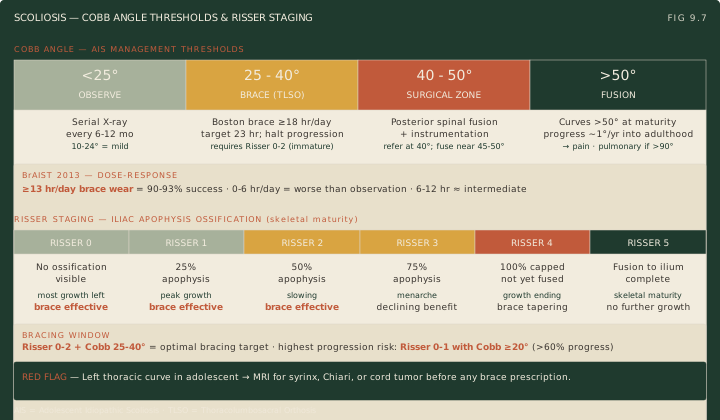
The four management thresholds are board-grade memorization. Under 10 degrees is a normal variant that does not earn the scoliosis label. From 10 to 24 degrees the patient is observed with serial radiographs every 6 to 12 months. From 25 to 40 degrees in a skeletally immature patient is the bracing window, with the standard appliance a rigid thoracolumbosacral orthosis (TLSO), often the Boston brace. Above 40 to 50 degrees the curve pushes toward surgical posterior spinal fusion with rod-and-screw instrumentation. Long-term natural-history studies tracking patients into their sixties and seventies showed that adolescents reaching skeletal maturity at a curve under 30 degrees essentially stabilize for life, while curves exceeding 50 degrees continue to collapse at roughly 1 degree per year into adulthood under the gravitational load of the torso, eventually compromising pulmonary function. Surgery prevents that lifelong collapse.
Prognosis hinges on remaining growth, and the radiographic tool that estimates it is the Risser sign, which grades ossification of the iliac apophysis along the top crest of the pelvis. Ossification proceeds from lateral to medial across five grades: Risser 0 means no ossification has begun (maximal growth remaining), and Risser 5 means the apophysis has completely fused to the ilium (skeletal maturity). The highest-risk profile is Risser 0 to 1 with a Cobb of 20 degrees or more, which carries roughly a 60 to 68 percent risk of significant progression. Bracing is most effective in the Risser 0 to 2 window.
The BrAIST trial (Bracing in Adolescent Idiopathic Scoliosis Trial, Weinstein et al., NEJM 2013) is the most testable scoliosis evidence base on the ABPMR. It enrolled 242 patients aged 10 to 15 with Risser 0 to 2 and Cobb angles of 25 to 40 degrees, randomizing them to a rigid TLSO versus observation, and was stopped early for efficacy. The headline finding was a 72 percent success rate in the braced group versus 48 percent with observation, but the dose-response is what changed practice. Adolescents who actually wore the brace for at least 13 hours per day achieved a 90 to 93 percent success rate, while those in the lowest wear quartile (0 to 6 hours per day) had outcomes worse than no brace at all. Braces are typically prescribed for 18 or more hours per day to leave a margin for non-compliance.
For the adolescents who actually wore the brace for at least 13 hours a day, the success rate skyrocketed to 90 to 93 percent. But the patients who wore it for fewer than 6 hours a day, well, they actually had worse outcomes than the kids who were just being observed without any brace at all.
— PEDS-09-b podcast, ~0:25
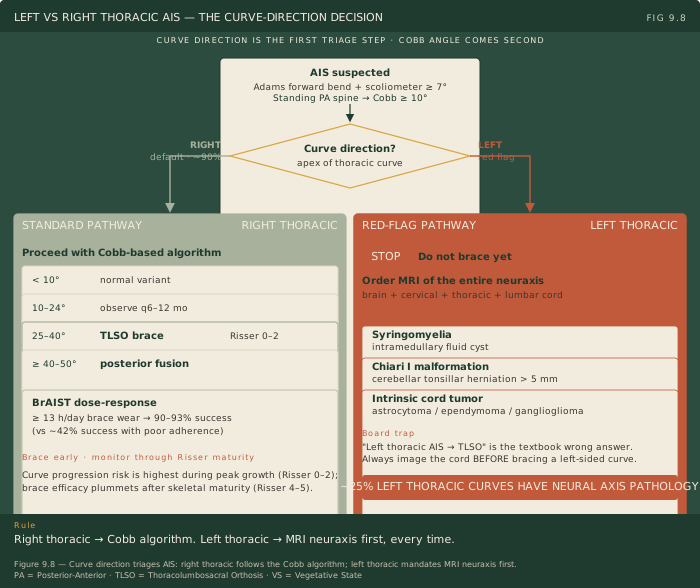
Before the bracing prescription, however, the clinician must look at curve direction. The default AIS curve is right thoracic. A left thoracic curve is a major red flag because it is highly associated with intrinsic neural-axis pathology and mandates MRI of the entire neuraxis before any brace is prescribed, hunting for syringomyelia (a fluid-filled cyst within the spinal cord), Chiari malformation, or an intrinsic spinal cord tumor. Prescribing a brace for a left thoracic curve without first ordering the MRI is a classic board trap.
Two non-idiopathic patterns have their own algorithms. Congenital scoliosis arises from vertebral malformation in utero, either failure of formation (hemivertebra) or failure of segmentation (a unilateral bar fusing adjacent vertebrae on one side). It tends to progress even before adolescence and screens for VACTERL anomalies (vertebral, anorectal, cardiac, tracheoesophageal, renal, limb). Neuromuscular scoliosis appears in cerebral palsy, Duchenne muscular dystrophy, and spinal muscular atrophy. It is typically a long sweeping C-shaped curve involving the entire thoracolumbar spine, progresses rapidly, and continues to worsen past skeletal maturity because the driving force is lifelong muscle imbalance rather than bony growth. Neuromuscular curves nearly always produce pelvic obliquity, devastating seated balance and producing skin breakdown in wheelchair-dependent patients. Bracing rarely cures these curves; it merely delays surgery. Definitive fusion typically extends to the pelvis to correct obliquity, and complication rates run 25 to 50 percent from blood loss, surgical-site infection, and pulmonary complications.
Scheuermann kyphosis is the third board-favorite spinal deformity, defined by anterior vertebral-body wedging of at least 5 degrees in three or more contiguous thoracic vertebrae, with thoracic kyphosis greater than 45 degrees and Schmorl nodes on plain film. It presents in adolescents (typically male) with rigid thoracic kyphosis that does not correct on hyperextension, distinguishing it from postural round-back. Treatment is bracing for curves of 50 to 70 degrees in skeletally immature patients; surgical correction is reserved for curves greater than 70 to 75 degrees, intractable pain, or progressive neurologic compromise.
 ::: {.callout-important}
## High Yield — Spinal deformity thresholds
::: {.callout-important}
## High Yield — Spinal deformity thresholds
- Cobb angle thresholds: under 10 degrees normal variant; 10 to 24 degrees observation; 25 to 40 degrees brace; 40 to 50 degrees fusion.
- AIS = age 10 to 18, Cobb at least 10 degrees, no identifiable cause; F:M 8:1 for curves greater than 30 degrees; right thoracic is the default direction.
- BrAIST trial: bracing 72 percent versus observation 48 percent success; at least 13 hours/day = 90 to 93 percent success; 0 to 6 hours/day = worse than observation.
- Risser staging 0 to 5; bracing window most effective at Risser 0 to 2.
- Left thoracic curve = red flag = MRI of entire neuraxis for syrinx, Chiari, or cord tumor before any brace.
- Congenital scoliosis = vertebral malformation; screen for VACTERL anomalies.
- Neuromuscular scoliosis = long C-curve, rapid progression, fusion often to the pelvis to correct obliquity.
- Scheuermann kyphosis = anterior wedging of at least 5 degrees in 3+ contiguous thoracic vertebrae; brace 50 to 70 degrees, surgery greater than 70 degrees. :::
Board Trap — “Brace and observe” for the wrong curve
A 30-degree right thoracic Cobb in a Risser 1 thirteen-year-old is a textbook bracing case. A 30-degree left thoracic Cobb in the same age and Risser is not. That one needs an MRI before any brace is prescribed. Prescribing a brace before the MRI in a left-thoracic curve is the recurring board trap.
A left thoracic curve is a major clinical red flag. It is highly associated with underlying neurological abnormalities. A left-sided thoracic curve must prompt an immediate MRI of the entire neuraxis to rule out severe pathologies like syringomyelia, a Chiari malformation, or an intrinsic spinal cord tumor.
— PEDS-09-b podcast, ~13:05