Before You Listen
Episode Setup
- Topic in one line: the pediatric rheumatic vignettes that drive ABPMR Part I: the seven International League of Associations for Rheumatology (ILAR) subtypes of juvenile idiopathic arthritis (JIA), antinuclear antibody (ANA) positivity as a uveitis risk beacon (not a disease activity marker), the stepwise non-systemic JIA ladder (intra-articular corticosteroid with non-steroidal anti-inflammatory drugs (NSAIDs) as adjuncts in oligoarthritis, methotrexate from the outset in polyarthritis, then a tumor necrosis factor (TNF) inhibitor as the usual first biologic), and the autoinflammatory pivot of systemic JIA where interleukin-1 (IL-1) and IL-6 blockade trumps TNF inhibition. The chapter closes on macrophage activation syndrome (MAS), the lethal sJIA complication with the highly suggestive ferritin-up / fibrinogen-down / erythrocyte sedimentation rate (ESR)-paradoxically-down signature.
- Prerequisites: familiarity with adult rheumatoid arthritis, systemic lupus erythematosus (SLE), and spondyloarthropathies (covered in MSK-20, MSK-21, MSK-22); the inflammation framework of cytokines and immune cells; the principle that pediatric rheumatology builds on adult rheumatology with age-specific twists.
- Runtime: 1 hour 22 minutes.
- Scope boundary: Part 1 maps JIA and its lethal sJIA complication. Part 2 (PEDS-10-b) turns to juvenile dermatomyositis (JDM), juvenile scleroderma, the inherited connective tissue disorders (osteogenesis imperfecta, Ehlers-Danlos, Marfan, Loeys-Dietz), and the acute pediatric rheumatic and infectious presentations (Kocher criteria for septic arthritis, Kawasaki disease, acute rheumatic fever, Lyme disease).
Vignette. A 4-year-old girl presents with three months of intermittent right knee swelling and a morning limp that improves through the day. There is no fever, rash, or weight loss. Examination shows a warm, swollen right knee with limited flexion and no other joint involvement. Antinuclear antibody (ANA) is positive at 1:320; rheumatoid factor (RF) and human leukocyte antigen B27 (HLA-B27) are negative. Erythrocyte sedimentation rate (ESR) is mildly elevated at 28 mm/hr. The pediatrician treats with a non-steroidal anti-inflammatory drug (NSAID) for six weeks with partial improvement. The mother asks about the eye exam the rheumatologist mentioned.
What is the most likely subtype of juvenile idiopathic arthritis (JIA), what is the patient’s risk for chronic uveitis given her antibody profile and age, what is the recommended slit-lamp screening frequency, what is the next step in pharmacologic management if the NSAID alone has not produced clinically inactive disease, and why does the eye examination matter even when the eye looks white and feels fine?
(Answer at the end of this chapter)
Section 1: Defining JIA and the Seven ILAR Subtypes
Bottom line: JIA is the most common chronic rheumatic disease of childhood, defined as arthritis of unknown cause beginning before age 16 and persisting at least 6 weeks after exclusion of other causes. The 2004 ILAR system (Petty et al.) replaced the older juvenile rheumatoid arthritis (JRA) nomenclature with seven mutually exclusive subtypes, each separable by age, sex distribution, joint count, antibody profile, and uveitis risk. Oligoarticular JIA dominates at 50 to 60 percent and carries the highest uveitis risk; polyarticular RF-positive disease has the worst joint prognosis; systemic JIA (Still disease) is the autoinflammatory outlier with quotidian fever and salmon rash.
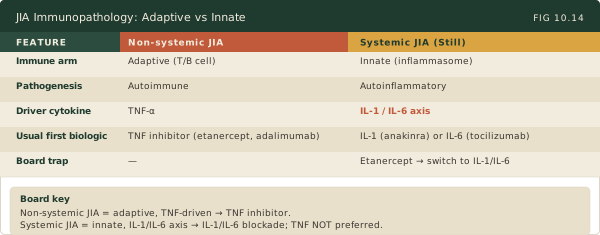
JIA is the umbrella diagnosis for chronic arthritis in childhood. The formal definition is arthritis of unknown cause beginning before age 16 years and persisting for at least 6 weeks after exclusion of other causes. Incidence is 2 to 20 per 100,000 children per year, prevalence in the United States is 70,000 to 100,000, and the overall female-to-male ratio is 2:1 to 3:1, though the ratio varies dramatically by subtype. The pathologic hallmark is pannus formation, a proliferative synovitis with granulation tissue invading cartilage and bone, analogous to the synovial pannus of adult rheumatoid arthritis. TNF-alpha drives inflammatory cell trafficking into the synovium in the non-systemic subtypes, while systemic JIA is increasingly framed as an autoinflammatory condition driven by innate immunity and the IL-1 / IL-6 axis, not by adaptive T- and B-cell autoreactivity.
The 2004 ILAR classification (Petty et al.) replaced the older JRA terminology with seven mutually exclusive subtypes: oligoarticular, polyarticular RF-negative, polyarticular RF-positive, systemic JIA (sJIA, Still disease), psoriatic, enthesitis-related arthritis (ERA), and undifferentiated. Each subtype is defined by the joint count in the first 6 months, the antibody profile, the age and sex distribution, and the pattern of extra-articular features.
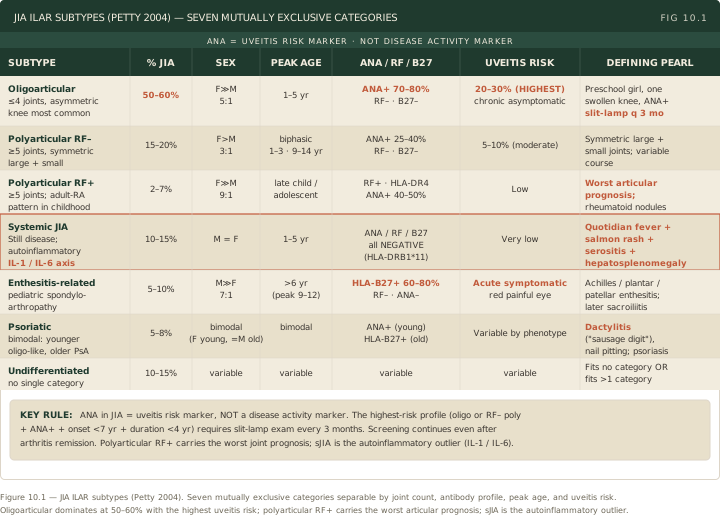
Oligoarticular JIA is the most common subtype, accounting for 50 to 60 percent of JIA. The defining feature is four or fewer joints involved in the first 6 months of disease. Female predominance is striking at 5:1, peak onset is ages 1 to 5, and the knee is the most commonly involved joint, with disease that is reliably asymmetric. ANA is positive in 70 to 80 percent, RF is negative, HLA-B27 is usually negative. The uveitis risk is the highest of any JIA subtype at 20 to 30 percent. The articular prognosis is bifurcated: the persistent form (four or fewer joints throughout disease course) carries the best joint prognosis of any subtype, while the extended form (more than four joints after the initial 6 months) behaves more like polyarticular disease.
Polyarticular RF-negative JIA accounts for 15 to 20 percent of JIA and involves five or more joints in the first 6 months. Female predominance is 3:1, and onset shows a biphasic peak (1 to 3 years and 9 to 14 years). Symmetric large- and small-joint involvement is typical. ANA is positive in 25 to 40 percent, uveitis risk is moderate at 5 to 10 percent, and disease course is variable. Polyarticular RF-positive JIA is much rarer at 2 to 7 percent and is essentially adult-pattern rheumatoid arthritis presenting in childhood. Female predominance is striking at 9:1, peak age is late childhood and adolescence, and the disease shares the HLA-DR4 association of adult RA. ANA is positive in 40 to 50 percent. This subtype carries the worst articular prognosis of all JIA subtypes, and rheumatoid nodules are most frequent here. Uveitis risk is low. Poor-prognosis markers across JIA are RF positivity, hip involvement, early erosions, involvement of many small joints, persistent disease activity, and delayed treatment.
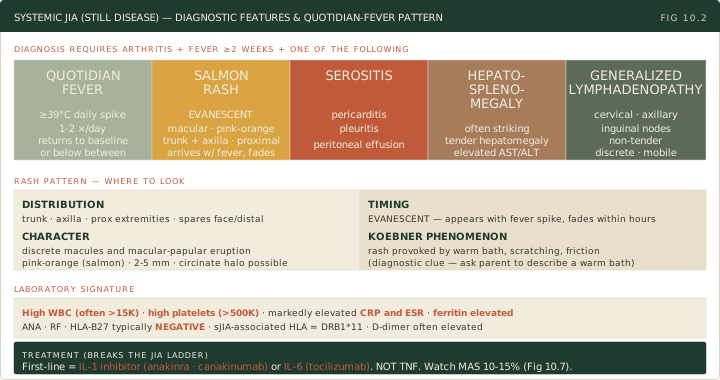
Systemic JIA (sJIA, Still disease) accounts for 10 to 15 percent of JIA and is unique among the subtypes in pathogenesis (autoinflammatory rather than autoimmune), clinical features (prominent systemic inflammation), and treatment (IL-1 and IL-6 blockade rather than TNF inhibition). Sex ratio is roughly equal, age range is broad, and the peak is 1 to 5 years. The defining clinical features form a memorable quartet: quotidian fever (one or two daily temperature spikes to 39 degrees Celsius or higher with rapid return to baseline or below, often subnormal); an evanescent salmon-colored rash that flares with fever and fades between spikes; serositis (pericarditis, pleuritis, or peritonitis); and hepatosplenomegaly with generalized lymphadenopathy. The ILAR classification rule is formal: arthritis in at least one joint with fever of at least 2 weeks that is quotidian for at least 3 days, plus at least one of evanescent rash, generalized lymphadenopathy, hepatomegaly or splenomegaly, or serositis. ANA, RF, and HLA-B27 are all typically negative; the sJIA-associated HLA is DRB1*11. Uveitis risk is very low. The hidden danger is MAS at 10 to 15 percent, addressed in Section 4.
Enthesitis-related arthritis (ERA) accounts for 5 to 10 percent of JIA and is the pediatric spondyloarthropathy. Male predominance is striking at 7:1, onset is typically after age 6 (peak 9 to 12), HLA-B27 is positive in 60 to 80 percent, and the hallmark is enthesitis (inflammation at the tendon-to-bone insertion) at the Achilles, plantar fascia, and patellar tendon. The ILAR rule is arthritis or enthesitis with at least two of: sacroiliac tenderness or inflammatory lumbosacral pain, HLA-B27 positivity, onset in a boy over age 6, acute symptomatic anterior uveitis, and HLA-B27-associated disease in a first-degree relative. Lower-extremity large-joint arthritis predominates early; sacroiliitis and axial disease develop later; many progress to ankylosing spondylitis in adulthood. The associated uveitis is acute, symptomatic anterior uveitis with a red painful eye, in stark contrast to the chronic asymptomatic uveitis of oligoarticular and polyarticular JIA. Psoriatic JIA (5 to 8 percent) shows bimodal onset reflecting two distinct phenotypes. Younger patients resemble oligoarticular JIA with female predominance, ANA positivity, small-joint involvement, and dactylitis (“sausage digit,” uniform swelling of an entire finger or toe). Older patients resemble adult psoriatic arthritis with roughly equal sex distribution, enthesitis, axial disease, and HLA-B27 positivity. Frank psoriasis is absent at presentation in roughly half of patients, and nail pitting and onycholysis appear in 50 to 80 percent. The ILAR rule is arthritis with psoriasis, or arthritis with at least two of dactylitis, nail pitting or onycholysis, and psoriasis in a first-degree relative. Undifferentiated JIA (10 to 15 percent) does not fit a single category or fits more than one.
High Yield — JIA definition and ILAR subtypes
- JIA definition: arthritis of unknown cause, onset before age 16, persisting at least 6 weeks; incidence 2-20 per 100,000 children per year.
- Pannus is the pathologic hallmark; TNF-alpha drives non-systemic subtypes; innate IL-1 / IL-6 axis drives sJIA.
- Seven mutually exclusive ILAR subtypes (Petty 2004): oligoarticular, polyarticular RF-negative, polyarticular RF-positive, sJIA, psoriatic, ERA, undifferentiated.
- Oligoarticular JIA is the most common (50-60 percent), female predominant (5:1), peak 1-5, knee most common joint, highest uveitis risk 20-30 percent.
- Polyarticular RF-positive = essentially adult RA in childhood; F:M 9:1; HLA-DR4; worst articular prognosis. Poor-prognosis markers: RF+, hip involvement, early erosions, many small joints, persistent activity, delayed treatment.
- Systemic JIA (Still) = autoinflammatory; quotidian fever + salmon rash + serositis + hepatosplenomegaly; ANA/RF/B27 all negative. ILAR rule: arthritis + fever ≥ 2 weeks (quotidian ≥ 3 days) + ≥ 1 of evanescent rash, generalized lymphadenopathy, hepatomegaly or splenomegaly, serositis.
- ERA = male-predominant (7:1) pediatric spondyloarthropathy; HLA-B27+ 60-80 percent; enthesitis at Achilles/plantar fascia/patellar tendon; acute symptomatic anterior uveitis. ILAR rule: arthritis or enthesitis + ≥ 2 of sacroiliac/inflammatory lumbosacral pain, HLA-B27, boy with onset after age 6, acute anterior uveitis, HLA-B27-associated disease in a first-degree relative.
- Psoriatic JIA = bimodal; dactylitis (sausage digit), nail pitting; psoriasis often absent at onset. ILAR rule: arthritis + psoriasis, or arthritis + ≥ 2 of dactylitis, nail pitting/onycholysis, psoriasis in a first-degree relative.
Mnemonic — “Few joints, fair-haired, fearful eye”
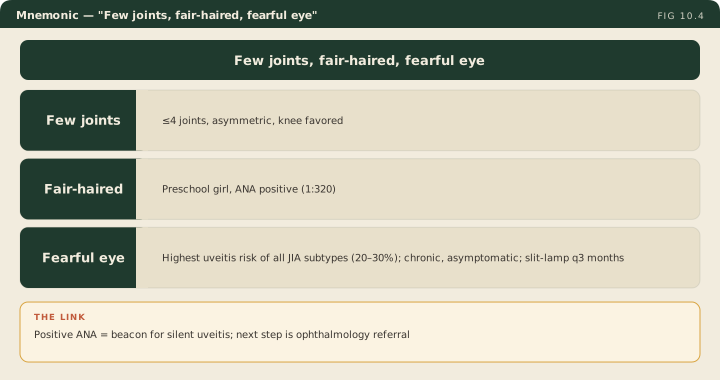
Oligoarticular JIA reads as few joints (four or fewer, asymmetric, knee favored), fair-haired (young preschool girl, ANA positive), fearful eye (highest uveitis risk in any JIA subtype, chronic and asymptomatic, slit-lamp screening every 3 months). When a board stem dangles a preschool girl with one swollen knee and a 1:320 ANA, the answer is oligoarticular JIA and the next step is an ophthalmology slit-lamp examination.
The disease profile that is kindest to the knees is the most dangerous to the eyes.
— PEDS-10 podcast, ~21:21
Once a child is oligoarticular at six months, they stay oligoarticular forever.
— PEDS-10 podcast, ~16:26
That invasion is why the disease doesn’t just make the joints stiff or painful. I mean, it actively dissolves the architecture of the joint.
— PEDS-10 podcast, ~7:23