PO · EP 03 · PROSTHETICS
Before You Listen
- Prerequisites: Part 1 of this chapter (myodesis vs myoplasty, the Burgess long posterior flap, and the Ertl osteomyoplastic technique); basic peripheral nerve anatomy of the lower extremity (sciatic, tibial, common peroneal, sural, saphenous); the difference between concentric, eccentric, and isometric contraction from PO-01; basic understanding of dressings, edema control, and contracture prevention; familiarity with the Medicare coverage framework for prosthetic components.
- Runtime: Part 2 covers the second half of the episode (approximately 22:00 through the end).
- Topic in one line: the nerve-management revolution (TMR from the Dumanian RCT; RPNI with prophylactic 0% neuroma); osseointegration as a socket alternative; postoperative dressings (RRD strongly recommended; figure-of-eight elastic wrapping; IPOP); the nine-phase rehabilitation continuum; contracture prevention rules (no pillow under the knee; prone lying); phantom limb pain mechanisms and the failure of traditional pharmacotherapy; and the four strong VA/DoD 2017 CPG recommendations (education, rigid dressings, MPK, annual transdisciplinary assessments).
Vignette. A 31-year-old previously healthy man sustains a right traumatic transtibial amputation after a motorcycle collision. The orthopedic surgeon performs a Burgess long posterior flap amputation with a 13-cm tibial length, the fibula cut 1.5 cm shorter than the tibia, the anterior tibial crest beveled, and a myoplasty closure of the gastrosoleus complex to the anterior compartment. At the time of surgery the surgeon also performs a prophylactic Targeted Muscle Reinnervation (TMR) procedure on the tibial and common peroneal nerves. A rigid removable dressing (RRD) is applied in the operating room. On postoperative day 4 the patient is transferred to your inpatient rehabilitation service. He reports moderate residual limb pain controlled with scheduled acetaminophen and a low-dose oxycodone PRN, and intermittent shooting pain in the missing right foot. On examination he has a clean, well-perfused incision under the RRD, full passive hip and knee range of motion bilaterally, and 4/5 strength in his left lower extremity and right hip. His goal is to “get back to my construction job by next year.” He asks why he cannot just have a wheelchair and avoid all of this rehabilitation.
Identify the surgical decisions and rationale (Burgess, myoplasty vs myodesis at TT, TMR, RRD over shrinker). Locate the patient in the nine-phase continuum. State the three highest-priority contracture-prevention interventions over the next 14 days. Predict K-level and Medicare implications. Address his wheelchair-only question using the energy-expenditure framework.
(Answer at the end of this chapter)
Section 2: Nerve Management Revolution — TMR, RPNI, and Osseointegration
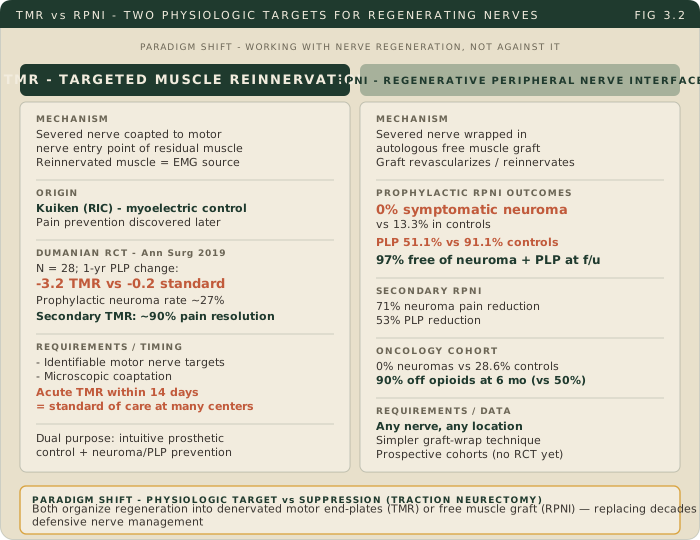
Bottom line: post-amputation neuroma and phantom limb pain are among the most challenging complications of major limb loss; traditional traction neurectomy is only modestly effective. The modern paradigm provides a physiologic target for regenerating nerves: TMR transfers nerve stumps to motor entry points in residual muscles (Dumanian RCT N=28, originally developed by Kuiken at RIC for myoelectric control); RPNI wraps each nerve in autologous free muscle graft (prophylactic 0% symptomatic neuroma vs 13.3% controls; PLP 51.1% vs 91.1%; 97% pain-free at latest follow-up). Osseointegration provides direct skeletal fixation (VA/DoD 2025 CPG suggests for eligible TF; ~32% overall infection rate, mostly superficial).
For decades, surgical nerve management at the time of amputation was essentially defensive. Traction neurectomy, the technique in which the surgeon pulls the nerve distally, cleanly transects it, and allows it to retract into proximal soft tissue away from the weight-bearing socket interface, was the standard approach. The logic was sound in its way: keep the regenerating nerve fibers out of the area where the prosthetic socket will load them. But the technique was only modestly effective, and clinicians spent decades reacting to neuroma pain and phantom limb pain in the pain clinic months or years after surgery, rather than preventing those problems at the time of amputation.
Targeted Muscle Reinnervation (TMR) changed that paradigm by giving regenerating peripheral nerves a physiologic target. The surgical principle is straightforward: severed peripheral nerve stumps are transferred to motor nerve entry points in residual muscles, and the regenerating axons find denervated motor end-plates and re-establish functional neuromuscular junctions. Because the regenerating fibers now have somewhere productive to go, they do not produce the disorganized sprouting that creates a painful neuroma. TMR was originally developed by Dr. Todd Kuiken at the Rehabilitation Institute of Chicago (now Shirley Ryan AbilityLab) for intuitive myoelectric prosthetic control in upper-limb amputees, allowing surface electrodes to detect amplified signals from the reinnervated muscle and translate them into prosthetic joint movement. The pain-prevention benefit was discovered subsequently, and nerve regeneration typically takes 3 to 6 months.
The Dumanian RCT (Ann Surg 2019, N=28) established the evidence base. TMR produced a mean PLP reduction of −3.2 points at one year compared with −0.2 for standard traction neurectomy. Prophylactic TMR at the time of amputation yielded a symptomatic neuroma rate of approximately 27%, substantially below historical rates of 50% to 80%. Secondary TMR performed for an already-established painful neuroma achieved approximately 90% near-complete pain resolution. Acute TMR within 14 days of amputation is now standard of care at many academic centers. Combined with pattern recognition algorithms, TMR enables intuitive control of multiple prosthetic joints, especially valuable in transhumeral and shoulder disarticulation amputees who would otherwise control complex devices through unnatural co-contractions.
Regenerative Peripheral Nerve Interface (RPNI) is the parallel innovation. RPNI wraps each transected nerve end in a small autologous free muscle graft, typically harvested from the same surgical field. The graft revascularizes and reinnervates, absorbing the regenerating nerve fibers into a physiologic target without requiring identification of a specific motor nerve. Prophylactic RPNI outcomes are striking: 0% symptomatic neuroma versus 13.3% in controls, PLP rates of 51.1% versus 91.1%, and 97% of prophylactic RPNI patients free of both neuroma pain and PLP at latest follow-up. Secondary RPNI for an established painful neuroma yields 71% neuroma pain reduction and 53% PLP reduction. In an oncology cohort the contrast was equally clear: 0% symptomatic neuromas with RPNI versus 28.6% in controls, and 90% of RPNI patients discontinued opioids within 6 months versus 50% of controls.
TMR versus RPNI is a technical contrast rather than a competition. TMR requires identification of motor nerve targets and microscopic coaptation; RPNI is a simpler muscle wrap that applies to any nerve in any location. TMR has one randomized trial; RPNI has prospective cohorts only. Both procedures work with the regenerating biology rather than against it, and both share the same caveats: follow-up data are still under 5 years, neither fully eliminates PLP, and optimal timing and patient selection are still being refined.
Osseointegration addresses a different problem entirely: socket intolerance. The procedure anchors a transcutaneous metal implant directly into the residual bone, typically the femur, eliminating the socket interface altogether. The biology was first described by Per-Ingvar Brånemark in dental implants. Two main designs are in clinical use: the screw-type OPRA (Osseointegrated Prostheses for the Rehabilitation of Amputees, Integrum, Sweden), which requires a two-stage operation with the abutment placed 6 to 12 months after the initial implant, and the press-fit POP (Percutaneous Osseointegrated Prosthesis), which allows faster loading. Osseointegration is indicated for socket-intolerant patients: those with recurrent skin breakdown, persistent pain, poor socket fit, very short residual limbs, or scarring and grafting that make a conventional socket impossible. The VA/DoD 2025 CPG suggests osseointegration as an option for eligible transfemoral amputees.
Outcomes after osseointegration include improvement in the 6-minute walk test, the Timed Up and Go, daily prosthetic use, quality of life, and osseoperception, the term for the proprioceptive sensory feedback transmitted directly through the implant into bone. Complications cluster around the transcutaneous interface: superficial stoma infection is most common at approximately 32% overall and is usually treatable with oral antibiotics; deep periprosthetic infection is less common and may require intravenous antibiotics or implant removal; periprosthetic fracture and implant loosening are rare.
 ::: {.callout-important}
## High Yield, TMR, RPNI, and osseointegration
::: {.callout-important}
## High Yield, TMR, RPNI, and osseointegration
- TMR = Targeted Muscle Reinnervation; nerve transferred to motor entry point in residual muscle; originally developed by Kuiken (RIC) for myoelectric control; pain prevention discovered later.
- Dumanian RCT (Ann Surg 2019, N=28): TMR > standard traction neurectomy for PLP reduction at 1 year (−3.2 vs −0.2).
- Acute TMR within 14 days of amputation = standard of care at many centers.
- RPNI = Regenerative Peripheral Nerve Interface; nerve wrapped in autologous free muscle graft.
- Prophylactic RPNI: 0% symptomatic neuroma (vs 13.3%); PLP 51.1% (vs 91.1%); 97% free of neuroma + PLP at latest follow-up.
- TMR requires motor nerve targets; RPNI applies to any nerve in any location.
- Osseointegration: transcutaneous implant in residual bone; eliminates socket; OPRA (screw-type, two-stage) and POP (press-fit) systems; Brånemark biology.
- VA/DoD 2025 CPG suggests osseointegration as option for eligible transfemoral amputees.
- Osseoperception = sensory feedback through the implant; improved proprioceptive awareness.
- Infection rate ~32% overall with osseointegration; most superficial stoma infections treatable with oral antibiotics. :::
Clinical Pearl, Working with the nerve, not against it
The pre-2010 paradigm of nerve management was suppression: cut the nerve, retract it, hope it does not form a painful neuroma. Traction neurectomy, nerve capping, and centrocentral nerve union all share this defensive logic. TMR and RPNI represent a fundamentally different conceptual approach. They provide a physiologic target so that regenerating nerve fibers can reorganize productively. TMR uses a denervated motor end-plate; RPNI uses a free muscle graft. The biology is constructive rather than suppressive, and the outcome data (90% pain resolution after secondary TMR; 97% pain-free after prophylactic RPNI) reflect this paradigm shift. The single takeaway for the boards: pain prevention starts in the operating room, not in the pain clinic six months later.