PO · EP 06 · PROSTHETICS
Before You Listen
Episode Setup
- Topic in one line: the back half of the upper-limb prosthetic decision tree — wrist units and transradial socket designs that trade self-suspension against elbow range of motion, transhumeral componentry centered on the internal-versus-external elbow choice, the four myoelectric control strategies from digital through pattern recognition, targeted muscle reinnervation (TMR) as a dual-purpose surgical multiplier for both control and phantom limb pain, the body-powered versus myoelectric showdown anchored on proprioceptive feedback through cable tension, multi-articulating hands from bebionic through the LUKE Arm, and the highest-level amputations (shoulder disarticulation and forequarter) with their highest rejection rates and the inverse relationship between proximal amputation and prosthetic acceptance.
- Prerequisites: Part 1 of PO-06 (the three terminal device categories with voluntary opening (VO) as the default and voluntary closing (VC) as the proportional alternative, hooks versus hands, the single-control Bowden cable, the dual-control fair-lead cable with “down, back, out” toggling the elbow lock, the figure-8 and figure-9 harnesses, and the chest strap option); upper-extremity gross anatomy from the glenohumeral joint to the carpus; surface electromyography (EMG) basics; and familiarity with the surgical concept of TMR from Episode 3.
- Runtime: approximately 32 minutes for Part 2.
Vignette. A 32-year-old right-hand-dominant carpenter sustained a traumatic right transhumeral amputation in a workshop accident eight months ago. The residual limb is well-healed, ends approximately 6 cm proximal to the medial epicondyle, and is fully sensate. He underwent targeted muscle reinnervation (TMR) at the time of his definitive amputation. He presents motivated to return to skilled woodwork. He needs a prosthesis that can handle a hammer and chisel in a wet shop environment, and he wants to fine-tune his grip force on delicate joinery without crushing thin wood. His wife also prefers that he have a cosmetic option for meetings with clients in their showroom.
Which body-powered terminal device type provides the proportional grip force he needs for delicate joinery, which transhumeral elbow unit is appropriate for his residual-limb length, which TMR-enabled control strategy would maximize his myoelectric options, and how would a quick-disconnect wrist unit address his wife’s request without forcing him to give up his work prosthesis?
(Answer at the end of this chapter)
Section 1: Wrist Units, Transradial Sockets, and the Self-Suspension Trade-Off
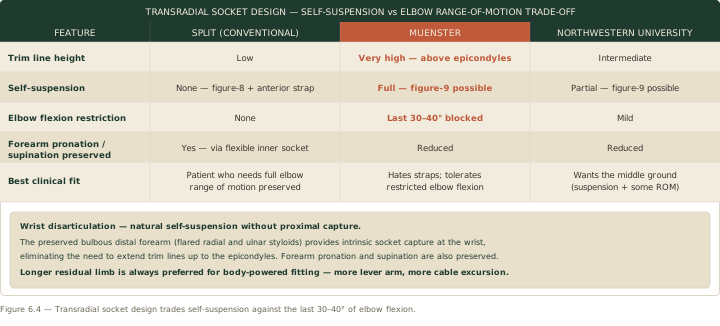
Bottom line: the wrist unit (friction for quick repositioning, locking for heavy-duty stability, flexion for midline activities, quick-disconnect for terminal device interchange) connects the terminal device to the forearm and may provide passive pronation and supination; transradial socket designs trade elbow range of motion against self-suspension, with the conventional split socket preserving full elbow flexion at the cost of requiring a full figure-8 harness, the Muenster socket achieving aggressive self-suspension via humeral epicondylar capture but restricting the last 30-40 degrees of elbow flexion, and the Northwestern University socket sitting in the middle; wrist disarticulation preserves the bulbous distal end and natural self-suspension at the wrist, and a longer transradial residual limb is always preferred because every degree of forearm rotation generates more cable excursion.
The wrist unit connects the terminal device (TD) to the forearm and may provide passive pronation and supination. The friction wrist allows manual rotation held by adjustable internal friction; quick to reposition but it can rotate under heavy load. The locking wrist uses a button-release mechanism for discrete secure positions, appropriate for heavy-duty tasks at the cost of slower repositioning. The flexion wrist adds flexion and extension for midline activities (eating, grooming) and is commonly prescribed for bilateral amputees. The quick-disconnect wrist is the workhorse for users who want to swap between TDs (a hook for shop work, a cosmetic hand for client meetings); it allows rapid interchange in seconds without removing the prosthesis.
Transradial (below-elbow) amputation is the most common upper-limb level and produces the best functional outcomes because the patient retains the anatomic elbow. Standard components are the socket on the forearm residual limb, elbow hinges (flexible Dacron straps or rigid metal hinges), an upper-arm cuff or triceps pad as proximal anchor, the harness (figure-8 or figure-9), the single-control Bowden cable, the wrist unit, and the TD. The central design tension is between a socket that grips the arm securely enough to suspend itself versus a socket that stops short of the elbow joint to preserve full biological flexion.
The conventional split socket is a two-piece design with a flexible inner socket nested inside a rigid outer frame. The flexible inner portion lets the patient retain natural forearm pronation and supination so the TD rotates with the residual limb. The drawback is zero self-suspension; the split socket mandates a full figure-8 harness with an anterior support strap.
The Muenster socket achieves total self-suspension by enclosing and locking onto the humeral epicondyles. Proximal trim lines extend above the epicondyles, deeply contour the olecranon fossa posteriorly and the antecubital space anteriorly, and physically capture the elbow joint. The patient can transition to a minimalist figure-9 harness. The unavoidable trade-off is that the high anterior trim line blocks the last 30 to 40 degrees of elbow flexion and the posterior contour blocks the last few degrees of full extension. A patient describing inability to bring the hand to the mouth in a self-suspending socket is reporting the Muenster trade-off, not a fitting error.
The Northwestern University (NU) socket is the compromise: self-suspending with slightly lower trim lines and less flexion restriction than the Muenster, at the cost of slightly less aggressive suspension under heavy load. Wrist disarticulation preserves full forearm length, preserves nearly all pronation and supination, and creates a bulbous distal end whose flared styloids provide natural self-suspension without running the socket up to the elbow.
A longer residual limb is always preferred for body-powered fitting. Every degree of biological forearm rotation and elbow flexion generates more cable excursion because the bony lever arm is longer. A short transradial limb may require supracondylar suspension or a self-suspending socket to stay on, which restricts elbow motion. A very short transradial limb may need step-up hinges that amplify excursion at the cost of greater required force, or a myoelectric fitting that eliminates the cable excursion requirement entirely.
 ::: {.callout-important}
## High Yield — Wrist Units and Transradial Sockets
::: {.callout-important}
## High Yield — Wrist Units and Transradial Sockets
- Wrist units: friction (quick repositioning), locking (heavy-duty, button release), flexion (midline activities, bilateral amputees), quick-disconnect (interchangeable TDs).
- Transradial components: socket, elbow hinges (flexible Dacron or rigid metal), triceps pad or cuff, harness, single-control Bowden cable, wrist unit, TD.
- Split socket = conventional two-piece (flexible inner, rigid outer frame); preserves forearm pronation and supination; no self-suspension; mandates full figure-8 harness.
- Muenster socket = self-suspending via humeral epicondylar capture; allows figure-9 harness; restricts the last 30-40 degrees of elbow flexion.
- Northwestern University socket = compromise; lower trim lines; less flexion restriction than Muenster; still self-suspending.
- Wrist disarticulation = bulbous distal end (flared styloids) → natural self-suspension; preserves full pronation and supination.
- Longer residual limb is always preferred for body-powered fitting (more lever arm, more cable excursion).
- Very short transradial → step-up hinges (excursion gained, force cost) OR strongly consider myoelectric. :::
Board Trap — Muenster Restricts the Last 30-40 Degrees of Elbow Flexion
A vignette describes a transradial amputee fit with a self-suspending socket who reports an inability to bring his hand fully to his mouth or to his contralateral shoulder. The trap is to suspect a fitting error or weak biceps. The actual cause is the Muenster socket’s intentional restriction of the last 30-40 degrees of elbow flexion, a known trade-off of the aggressive epicondylar capture that delivers self-suspension. The fix is either to accept the restriction (the patient gains figure-9 harnessing and reduced harness burden), or to switch to a Northwestern University socket with somewhat lower trim lines and less restriction, or to return to a conventional split socket with a figure-8 harness that preserves full elbow range of motion at the cost of the anterior support strap.