Before You Listen
- Prerequisites: functional anatomy of the foot, ankle, knee, and hip; the gait cycle and the three rockers of the foot; the concept of the ground reaction force (GRF) vector and how its position relative to a joint creates flexion or extension moments; basic familiarity with the motor functional classification (K-levels) and common neurological diagnoses (stroke, spinal cord injury, multiple sclerosis, cerebral palsy, peroneal nerve palsy, Charcot-Marie-Tooth).
- Runtime: 42 minutes.
- Topic in one line: the ankle-foot orthosis (AFO) selection algorithm built on five questions (foot drop, mediolateral instability, spasticity, crouch, recurvatum); the posterior leaf spring (PLS) versus solid AFO distinction as the highest-yield orthotic call on boards; the floor reaction orthosis (FRO/GRAFO) for crouch gait with intact quadriceps and the recurvatum contraindication; the metal double-upright AFO with the Klenzak joint for fluctuating edema and insensate skin; AFO selection by diagnosis with stroke and peroneal palsy as the prototypes; the knee-ankle-foot orthosis (KAFO) knee-mechanism trio (drop-lock, offset, stance-control) capped by the C-Brace microprocessor unit; the energy-cost hierarchy AFO < KAFO < HKAFO/RGO that explains why most thoracic spinal-cord-injury patients abandon orthotic ambulation; the shoe-modification short list (rocker bottom, metatarsal bar/pad, Thomas heels, SACH heel, lifts, wedges, steel shank); the foot-orthosis split into accommodative (soft, redistributes pressure, for rigid deformities and insensate feet) versus corrective (rigid, realigns, for flexible deformities) anchored by the UCBL for flexible flatfoot and total contact insoles for diabetic neuropathy; the Medicare Therapeutic Shoe Program coverage rules; and the FES-versus-AFO equivalence for foot drop with the mediolateral-control caveat that favors AFO.
Vignette. A 64-year-old man with a 12-year history of poorly controlled type 2 diabetes mellitus and a remote left middle cerebral artery (MCA) ischemic stroke presents to the orthotic clinic. Six months after his stroke he has a residual right hemiparesis with spastic equinovarus posturing of the foot during swing phase, scuffing the toes on the floor and rolling onto the lateral border of the foot at initial contact. Manual muscle testing shows ankle dorsiflexors graded 1/5 on the right with 3/5 evertors and a Modified Ashworth Scale (MAS) score of 3 in the gastrocsoleus complex. He has no fixed contracture and his right quadriceps test 4/5 with no recurvatum tendency on observed gait. Sensation is grossly preserved at the residual limb but absent at the toes from his diabetic neuropathy. He weighs 240 pounds and works as a high-school custodian.
Which AFO design is most appropriate for this patient, what is the single mediolateral feature in the history that rules out a posterior leaf spring, what specific construction or material consideration matters because of his weight and skin status, and what shoe modification could be added to redistribute plantar pressure given his neuropathy?
(Answer at the end of this chapter)
Section 1: AFO Selection — The Five-Question Algorithm and the Solid AFO versus PLS Decision
Bottom line: ankle-foot orthoses are the most commonly prescribed lower extremity orthoses, and selection is driven by a five-question algorithm covering foot drop, mediolateral (varus/valgus) instability, spasticity, crouch gait, and knee recurvatum; the posterior leaf spring (PLS) handles foot drop without mediolateral instability, while the solid AFO handles foot drop with mediolateral instability or severe spasticity, and this single distinction is the highest-yield orthotic call on the boards.
The ankle-foot orthosis (AFO) spans the ankle joint and extends from below the knee to the foot, controlling ankle and subtalar motion while influencing knee mechanics through the ground reaction force (GRF) vector. AFOs are the most commonly prescribed lower extremity orthoses and the highest-yield orthotic topic on the ABPMR Part I examination. Selection follows a deliberately simple five-question algorithm. Is there foot drop from weak dorsiflexors? Mediolateral instability from varus or valgus? Significant spasticity? Crouch gait (excessive knee flexion in stance)? Knee recurvatum?
The solid AFO is a single piece of rigid thermoplastic (typically polypropylene) that blocks all ankle motion in all planes. Wide posterior trim lines extending anterior to the malleoli are the defining structural characteristic, distinguishing it from the narrow-strut PLS. Total contact fit extends from tibial plateau to metatarsal heads; spastic flexed (claw) toes call for a full-length footplate with a toe strap and high toe box instead. It controls plantarflexion (PF), dorsiflexion (DF), inversion, and eversion. Trade-offs: limits push-off power at terminal stance and may increase energy expenditure. Indications: severe spasticity, foot drop with significant mediolateral instability, significant ankle/subtalar instability, flaccid paralysis with sagittal and coronal deficits.
The posterior leaf spring (PLS) is a thin, narrow-profiled plastic AFO providing dorsiflexion assist via elastic recoil. The narrow posterior strut behind the malleoli stores energy during controlled plantarflexion at heel strike and releases it to assist dorsiflexion during swing. The PLS is lighter and more cosmetic than the solid AFO and permits more normal push-off because the strut allows controlled ankle motion. Critically, the PLS does not control mediolateral stability and does not resist moderate-to-severe spasticity. Indications: mild foot drop without mediolateral instability; isolated peroneal nerve palsy (the most common prescription for that diagnosis). Contraindications: varus or valgus, moderate-to-severe spasticity, any significant mediolateral ankle instability.
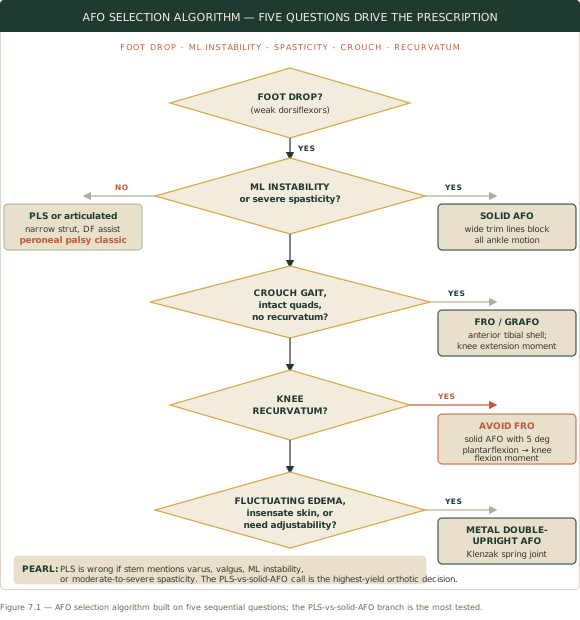
Consider an isolated common peroneal nerve palsy with intact eversion and no mediolateral instability: the PLS is correct because the sole deficit is swing-phase dorsiflexion weakness. If the same patient develops varus posturing during swing, the PLS becomes wrong because it provides no mediolateral control. The PLS-versus-solid-AFO distinction is the orthotic call most frequently tested. If a stem mentions varus, valgus, or mediolateral instability, the PLS is wrong.
High Yield — AFO selection algorithm; PLS versus solid AFO
- Five questions drive AFO selection: (1) foot drop? (2) mediolateral instability? (3) significant spasticity? (4) crouch gait? (5) knee recurvatum?
- Solid AFO = wide posterior trim lines, blocks ALL ankle motion (PF, DF, inversion, eversion); for severe spasticity, foot drop WITH mediolateral instability.
- PLS = narrow posterior strut; dorsiflexion assist via elastic recoil; for foot drop WITHOUT mediolateral instability; classic prescription for peroneal nerve palsy.
- PLS is wrong if the stem mentions varus, valgus, mediolateral instability, or moderate-to-severe spasticity.
- Highest-yield orthotic distinction on boards: PLS for foot drop without mediolateral instability; solid AFO for foot drop with mediolateral instability.
- Polypropylene is the workhorse thermoplastic for both designs.
Mnemonic — Wide trim line = wide control; narrow trim line = narrow control
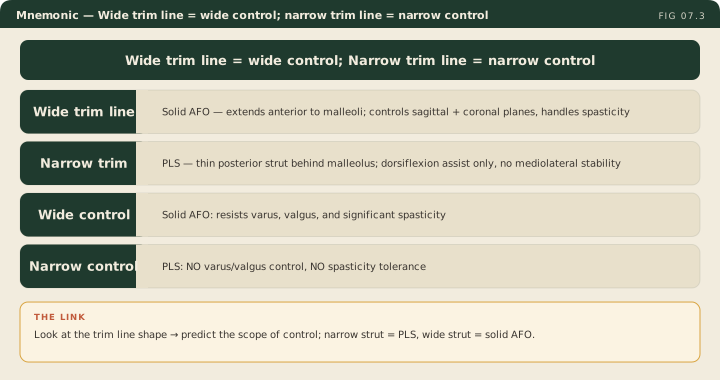
The wide posterior trim lines of the solid AFO match its wide scope of control (sagittal plus coronal plane, with or without spasticity). The narrow posterior strut of the PLS matches its narrow scope of control (dorsiflexion assist only, no mediolateral stability). Look at the trim line, predict the control. If a board stem describes a thin, narrow strut behind the malleolus, you are reading about a PLS, and the patient cannot have varus, valgus, or significant spasticity in the prompt.
The patient has to compensate with their hip flexors to pull the entire leg forward, which significantly increases energy expenditure. You are essentially forcing them to walk in a ski boot.
— PO-07 podcast, ~5:04