PO · EP 09 · ORTHOTICS
Before You Listen
- Prerequisites: the brachial plexus and the three peripheral nerves of the upper limb (radial, median, ulnar) with their motor distributions and sensory territories; the segmental motor levels of the cervical cord (C5 deltoid and biceps, C6 wrist extensors, C7 triceps, C8 finger flexors, T1 intrinsics); the tenodesis effect already introduced in Part 1 as passive finger flexion driven by wrist extension via taut long flexor tendons; the resting-hand and cock-up splint positions established in Part 1.
- Runtime: Part 2 runs approximately 30 minutes within the full 1 hour 2 minute episode.
- Topic in one line: the wrist-driven flexor hinge orthosis (WDFHO) that converts active wrist extension into mechanical pinch for the C6 tetraplegic patient; the master peripheral nerve injury–deformity–splint table with the ulnar paradox; elbow orthoses including the hinged ROM brace and the turnbuckle static-progressive splint; shoulder orthoses with the airplane splint at 80 to 90 degrees for axillary nerve injury and large rotator cuff repair and the gunslinger at 15 to 20 degrees for the flail brachial plexus arm; the Sarmiento humeral functional brace and its radial nerve association; SCI orthosis selection by cervical level; and the rheumatoid arthritis and burn splinting positions that protect the joints most at risk in each disease.
Vignette. A 19-year-old man sustains a complete C6 spinal cord injury (American Spinal Injury Association Impairment Scale [AIS] grade A) in a diving accident. Six weeks into inpatient rehabilitation, manual muscle testing shows full strength of the deltoid, biceps, brachialis, and rotator cuff bilaterally; both wrist extensors (extensor carpi radialis longus [ECRL] and extensor carpi radialis brevis [ECRB]) test 4/5; triceps and all finger flexors and intrinsic hand muscles test 0/5. He is working with the occupational therapist on transfer mechanics and beginning to use a manual wheelchair with rim modifications. The therapist reports that he has been performing aggressive passive finger flexor stretching during evening wash-out routines and that his finger flexors now feel “loose” on passive ranging. He is highly motivated and has a supportive family. He asks what orthosis would maximize his independence in feeding, grooming, and writing.
Which upper extremity orthosis is the device of choice at this neurological level, what muscles must be intact for the orthosis to function, what specific rehabilitation behavior described in the vignette could undermine the orthosis even if it is appropriately fitted, and what is the approximate pinch force this orthosis generates and what category of activities does that force support?
(Answer at the end of this chapter)
Section 2: The Tenodesis Splint and the C6 SCI Orthotic Strategy
Bottom line: the tenodesis splint, also called the wrist-driven flexor hinge orthosis (WDFHO), exploits the natural tenodesis effect to convert active wrist extension into mechanical finger flexion in C6 tetraplegia; it requires intact wrist extensors at 3+/5 or better, absent or very weak finger flexors, adequate passive range of motion, preserved tenodesis tightness, and patient motivation; the orthosis generates approximately 1 to 2 pounds of pinch force, sufficient for light activities of daily living but not heavy manipulation.
The tenodesis splint, also called the wrist-driven flexor hinge orthosis (WDFHO) or wrist-driven prehension orthosis, is the single most consequential upper limb orthotic device in spinal cord injury (SCI) rehabilitation. It is designed for C6 tetraplegia with intact wrist extensors but absent voluntary finger flexors, and it converts a patient who would otherwise be dependent on external utensil-holders into an active grasper who can feed, write, and groom independently.
The natural tenodesis effect is a purely passive anatomical phenomenon. Wrist extension produces passive finger flexion because the long finger flexor tendons (flexor digitorum profundus [FDP] and flexor digitorum superficialis [FDS]) cross the wrist and become taut whenever the wrist is dorsiflexed; wrist flexion releases tendon tension and allows the fingers to open. The WDFHO supercharges this effect through a mechanical linkage attached to the dorsum of the forearm and hand: active wrist extension powered by ECRL and ECRB, both innervated at C6, drives MCP flexion through a connecting rod, producing a three-jaw chuck pinch (thumb to index and middle finger pads) or a lateral key pinch (thumb pad against the radial side of the index finger).
The orthosis has five non-negotiable prerequisites. First, intact wrist extensors graded 3+/5 or better with at least 45 degrees of active wrist extension are required for the linkage to drive the fingers to closure. Second, absent or very weak finger flexors must be present; if the flexors are functional the orthosis is unnecessary. Third, adequate passive range of motion at the MCPs and IPs is needed so the fingers can be driven into a useful pinch without bony or capsular block. Fourth, preserved tenodesis tightness of the long finger flexors is required because slack tendons cannot transmit the wrist extensor force into a pinch. Fifth, motivation and cognitive ability to learn the coordinated grasp pattern matters, because training takes 2 to 4 weeks of structured occupational therapy and demands deliberate practice.
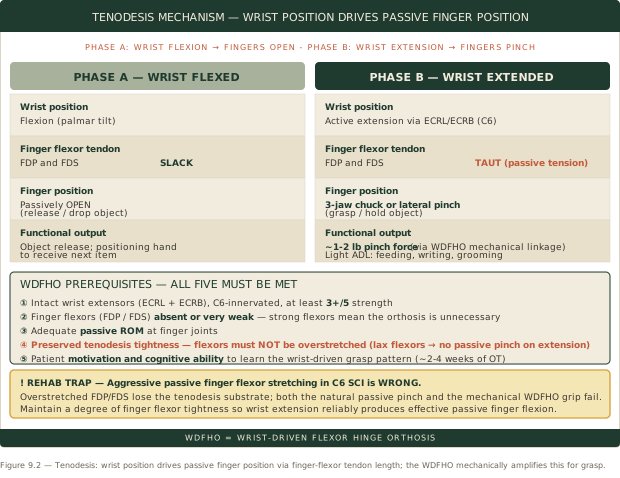
The WDFHO generates approximately 1 to 2 pounds of pinch force, enough to lift a fork, hold a pen, grip a toothbrush, manage a comb, and perform clean intermittent self-catheterization (CIC). It is not enough for heavy manipulation, lifting weighted objects, or sustained power grip. Case series document patients with complete C6 SCI returning to vocational activities including writing, computer use, and basic clerical tasks once they have been fitted and trained.
The critical rehabilitation principle attached to this orthosis is the contraindication of aggressive passive finger flexor stretching. Well-meaning therapists, nurses, or family members often stretch the paralyzed fingers fully straight while the wrist is dorsiflexed, attempting to prevent flexion contracture. In a C6 SCI patient this behavior is a disaster. Stretching the long flexor tendons in this combined position permanently lengthens them, eliminates the tenodesis substrate, and disables both the natural passive pinch and any future WDFHO. A C6 SCI hand must be allowed to remain mildly tight in the flexors so that wrist extension reliably drives passive flexion. When a board stem describes aggressive distal flexor stretching followed by failed orthotic grasp, the right answer is that overstretching has eliminated the tenodesis substrate.
You are essentially using the intact wrist as a biological lever to operate the paralyzed fingers.
— PO-09-b podcast, ~2:32
High Yield — Tenodesis splint (WDFHO) for C6 SCI
- Tenodesis effect = wrist extension produces passive finger flexion via taut long flexor tendons; wrist flexion releases tendon tension and opens the fingers.
- WDFHO mechanism = mechanical linkage converts active wrist extension (ECRL/ECRB, C6) into MCP flexion → three-jaw chuck or lateral key pinch.
- Five prerequisites: wrist extensors at least 3+/5; absent or very weak finger flexors; adequate passive ROM; preserved tenodesis tightness (the must-protect element); motivation and cognitive readiness.
- Pinch force generated: approximately 1 to 2 pounds; supports light ADL (feeding, writing, grooming, CIC), not heavy manipulation.
- Wrist extension required: at least 45 degrees of active extension for full pinch closure.
- Training: 2 to 4 weeks of structured OT for functional proficiency.
- Contraindication in C6 SCI: aggressive passive finger flexor stretching eliminates the tenodesis substrate and disables both natural and mechanical grip.
Board Trap — Aggressive finger flexor stretching in C6 SCI is wrong
A vignette describes a C6 tetraplegic patient enrolled in inpatient rehabilitation and notes that the therapist has been emphasizing aggressive passive finger flexor stretching to “prevent contracture.” The trap is to call this good rehabilitation. It is not. Overstretched finger flexors eliminate the tenodesis effect, and the patient loses both the natural passive pinch that comes with wrist extension and the ability to use a wrist-driven flexor hinge orthosis. The correct principle in C6 SCI is to maintain a degree of finger flexor tightness so that wrist extension reliably drives passive flexion. When the stem highlights distal flexor stretching followed by failed orthotic grasp, the answer is that overstretching has destroyed the tenodesis substrate.