Before You Listen
- Prerequisites: transfemoral and transtibial prosthetic basics from Episodes 4 and 5; Medicare K-level functional classification (K0 non-ambulatory through K4 high-activity/athlete); mechanical knee categories (manual locking, single-axis constant friction, polycentric, hydraulic, pneumatic) and the gait cycle terminology of stance versus swing; basic familiarity with myoelectric upper limb control, surface electromyography (EMG), and two-site flexor/extensor amplitude switching.
- Runtime: 54 minutes.
- Topic in one line: the four current microprocessor knees (MPKs), the C-Leg falls reduction data, the September 2024 Centers for Medicare and Medicaid Services (CMS) expansion of MPK coverage to K2 ambulators, the Empower powered ankle and the Power Knee, the OPRA and POP osseointegration systems with their five- and ten-year complication data, targeted muscle reinnervation (TMR) for prosthetic control and post-amputation pain (Dumanian 2019 randomized controlled trial), pattern recognition with the COAPT system, implantable myoelectric sensors (IMES), 3D printing in prosthetics and orthotics, and current sensory feedback approaches. Memorize the C-Leg fall numbers cold.
Vignette. A 67-year-old man with a unilateral transfemoral amputation from peripheral vascular disease is being evaluated for a new prosthesis. He lives at home, ambulates with a single-point cane, and walks short distances in his neighborhood (two blocks before fatigue) but does not engage in recreational activity. His current prosthesis has a single-axis constant-friction mechanical knee. Over the past year he has fallen four times, including one fall that resulted in a wrist fracture and a brief inpatient hospitalization. He has well-controlled type 2 diabetes mellitus, intact cognition, and a daughter who lives with him. He asks whether a “computerized knee” might be safer.
Which K-level does he fit, what changed in September 2024 that affects his coverage, what specific MPK feature drives the falls reduction in his population, and what four conditions must be documented before Medicare will authorize a microprocessor knee for a patient at his functional level?
(Answer at the end of this chapter)
Section 1: Microprocessor Knees and the Falls-Reduction Evidence
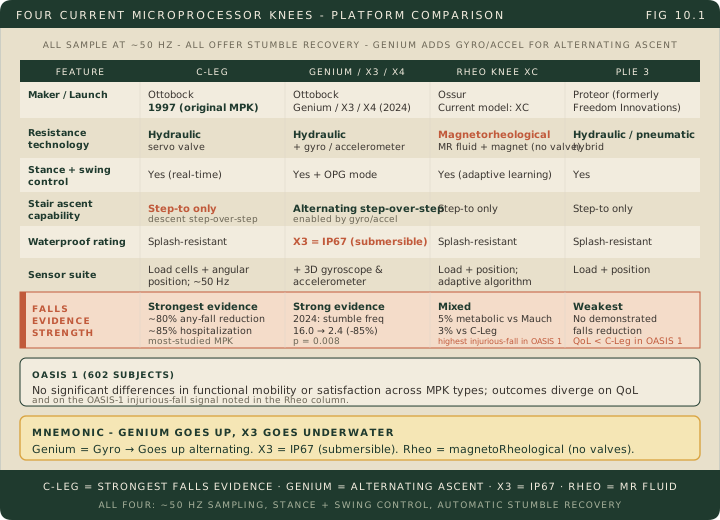
Bottom line: microprocessor knees use onboard sensors sampling at 50 hertz to modulate hydraulic or pneumatic resistance throughout the gait cycle, producing stumble recovery that drops fall incidence by roughly 80 percent and fall hospitalizations by 84 to 85 percent compared to mechanical knees; the C-Leg has the deepest evidence base, the Genium adds alternating step-over-step stair ascent through a gyroscope and accelerometer, the X3 is the waterproof variant rated IP68, and the Rheo Knee uses magnetorheological fluid instead of hydraulics.
A microprocessor knee (MPK) is a transfemoral prosthetic knee in which an onboard processor reads sensor data and adjusts joint resistance about 50 times per second. Sensor arrays include load cells, angular position sensors, and in advanced models a gyroscope and accelerometer reporting three-dimensional orientation. Real-time processing samples at 50 hertz or faster. Stance phase control modulates resistance to flexion under load, instantly increasing damping during a stumble (the stumble recovery function that defines the MPK class). Swing phase control modulates flexion and extension resistance during leg swing so the knee accommodates whatever cadence the user adopts.
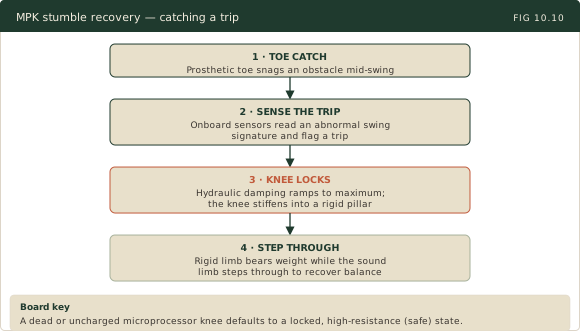
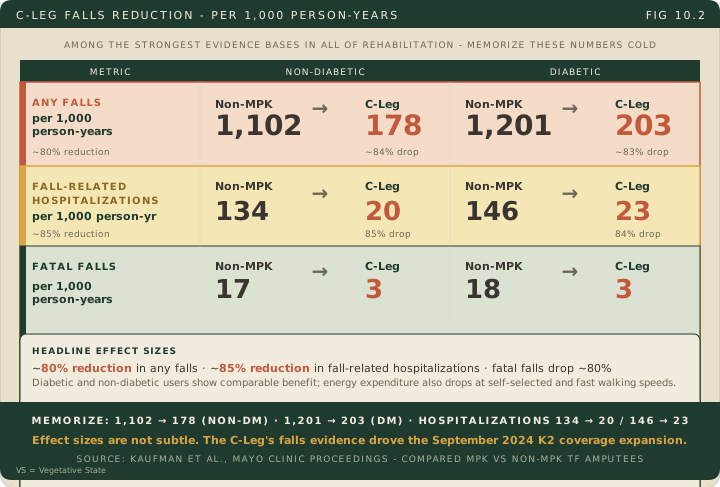
The C-Leg (Ottobock) is the original MPK, introduced in 1997, and the most extensively studied prosthetic component in the rehabilitation literature. It is hydraulic, samples at 50 hertz, and adjusts a servo valve that controls fluid flow. Key features are real-time hydraulic stance and swing control, automatic stumble recovery, controlled step-over-step stair descent (descent only; ascent is step-to, leading with the sound limb), and an automatic sitting function. The falls reduction evidence is among the strongest in rehabilitation. In a modeled cohort built from literature-derived inputs (not an observed registry), non-diabetic C-Leg users had 178 falls per 1,000 person-years versus 1,102 for non-MPK users; diabetic C-Leg users had 203 versus 1,201 (roughly 80 percent reduction). Fall-related hospitalizations dropped from 134 per 1,000 person-years to 20 in non-diabetic users (85 percent reduction) and from 146 to 23 in diabetic users (84 percent). Fatal falls dropped from 17 to 3 in non-diabetic users and from 18 to 3 in diabetic users. Energy expenditure studies show significant reductions in oxygen consumption at both self-selected and fast walking speeds.
Board answer vs. current evidence — The C-Leg reduces fall-related hospitalizations by 85 percent in non-diabetic users compared to non-MPK users — this is likely the board-tested answer, but more recent evidence (PMID 31897813) indicates microprocessor knees significantly reduce falls and near-falls compared to non-microprocessor knees, though the 85% fall-hospitalization reduction figure specific to non-diabetic C-Leg users has not been independently confirmed. Answer the board-canonical version on the test.
Board answer vs. current evidence — The C-Leg reduced falls by roughly 80 percent in both diabetic and non-diabetic users — this is likely the board-tested answer, but more recent evidence (PMID 31897813) indicates microprocessor knees significantly reduce falls compared to non-microprocessor knees (standardized mean difference −0.59), though the exact percentage varies by study. Answer the board-canonical version on the test.
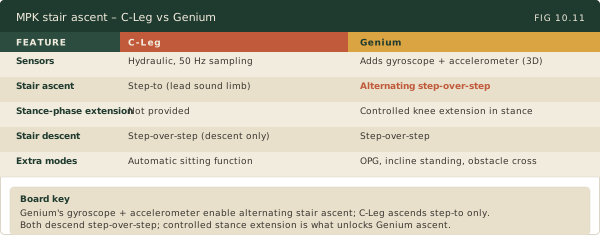
The Genium (Ottobock) is the next-generation platform. The defining additions over the C-Leg are a gyroscope and accelerometer reporting three-dimensional limb orientation, which unlocks alternating (step-over-step) stair ascent. The Genium provides controlled knee extension during stance phase on the prosthetic side, so for the first time on a passive MPK the user can climb stairs lead-leg alternating rather than always leading with the sound limb. It also adds an Optimized Physiological Gait (OPG) mode, intuitive standing on inclines, and obstacle crossing. Systematic reviews show the Genium produces a more physiological gait pattern with more equal loading and improved quality of life versus the C-Leg. A 2024 study found stumble frequency dropped by 85 percent (16.0 to 2.4 stumbles, p = 0.008), with reductions in residual limb pain and back pain. The X3 is the waterproof Genium variant, rated IP68 (submersible; the standard Genium is IP67), built for military and active users. The X4 is the 2024 iteration with incremental refinements.
The Rheo Knee (Ossur) uses magnetorheological (MR) fluid: microscopic iron particles suspended in a carrier fluid that align in chain-like structures when a magnetic field is applied, dramatically increasing apparent viscosity. By varying field strength, the processor adjusts resistance instantaneously without any moving valve. The current model is the Rheo Knee XC. Advantages include very fast response time, smooth continuous resistance modulation, no mechanical valves to wear or fail, and adaptive learning algorithms. The Rheo Knee produces a 5 percent metabolic reduction versus the Mauch Knee and 3 percent versus the C-Leg. The OASIS 1 comparative study (602 subjects across C-Leg, Rheo Knee, Orion, and Plie) found no significant differences in functional mobility or satisfaction across MPK types, but Rheo Knee users reported the highest percentage of injurious falls among the four devices.
The Plie 3 (Proteor, formerly Freedom Innovations) uses a hybrid hydraulic-pneumatic mechanism. In OASIS 1, functional mobility and satisfaction were comparable to other MPKs, but quality of life was significantly lower than the C-Leg, the Plie did not demonstrate falls reduction; functional declines with advancing age were seen in both C-Leg and Plie users, not the Plie alone.
High Yield — MPK platforms and falls evidence
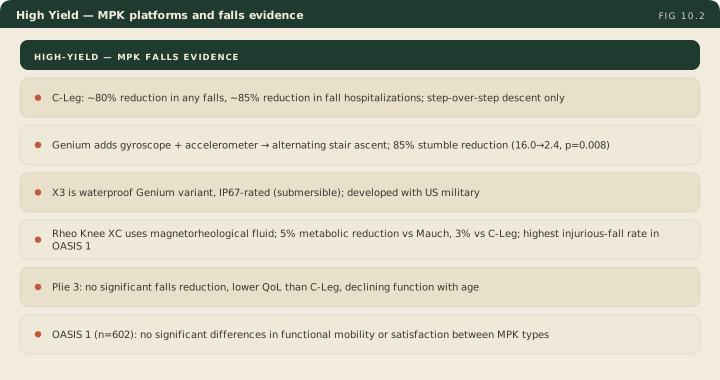
- All MPKs = onboard sensors + microprocessor adjusting hydraulic, pneumatic, or magnetorheological resistance in real time; sample at ~50 Hz; provide stance + swing control + stumble recovery.
- C-Leg (Ottobock, 1997): hydraulic, most studied MPK; ~80% reduction in any falls, ~85% reduction in fall hospitalizations, step-over-step descent only (step-to ascent).
- Genium (Ottobock): adds gyroscope + accelerometer → alternating step-over-step stair ascent, OPG mode, obstacle crossing; 85% stumble frequency reduction (16.0 → 2.4, p = 0.008).
- X3 (Ottobock): waterproof variant of Genium, IP68-rated (submersible; standard Genium IP67); built with US military.
- X4: latest Ottobock iteration (2024), incremental refinements.
- Rheo Knee XC (Ossur): magnetorheological fluid (iron particles + magnetic field); not hydraulic; 5% metabolic reduction vs Mauch, 3% vs C-Leg; OASIS 1 noted highest injurious-fall rate among the four MPKs.
- Plie 3 (Proteor): hydraulic/pneumatic; lower QoL outcomes than C-Leg in OASIS 1, no significant falls reduction; declining function with age (a decline shared with the C-Leg in OASIS 1, not unique to the Plie).
- OASIS 1: 602 subjects, no significant differences in functional mobility/satisfaction between MPK types.
Mnemonic — “Genium Goes Up, X3 Goes Underwater”
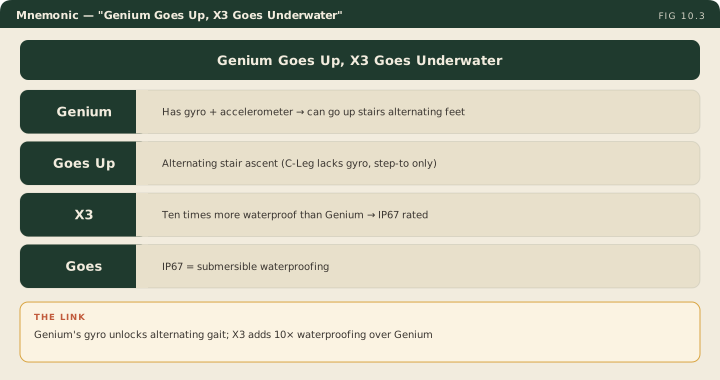
Genium = Gyro and accelerometer → Goes up stairs alternating. The C-Leg has no gyro and only goes up step-to. X3 = the waterproof Genium; IP68 means dust-tight and submersible beyond one meter (the standard Genium’s IP67 is splash-and-brief-immersion). Rheo = magnetorheological fluid (no hydraulic valves). Plie = “place last”; lower QoL data, no proven falls reduction; declining function with age (a decline also seen in C-Leg users in OASIS 1, not Plie-specific).
However, when they looked specifically at the safety data, Rheo Knee users actually had the highest percentage of injurious falls among all the devices studied.
— PO-10 podcast, ~16:38
That anti-lock brake analogy is arguably the best way to conceptualize the entire class of microprocessor knees. Just really smart brakes.
— PO-10 podcast, ~5:22