Before You Listen
- Prerequisites: transtibial socket anatomy from Episode 4 (pressure-tolerant areas: patellar tendon, medial tibial flare, popliteal fossa, gastrocnemius bulk; pressure-sensitive areas: tibial crest, fibular head with the common peroneal nerve, distal tibia, hamstring tendons); the difference between a metal double-upright AFO and a thermoplastic AFO; basic familiarity with prosthetic socket lamination, suction suspension, and the role of liners.
- Runtime: 1 hour 15 minutes.
- Topic in one line: the thermoplastic versus thermoset distinction (reversible softening versus irreversible cross-linking), low-temperature versus high-temperature thermoplastics with polypropylene as the workhorse for definitive ankle-foot orthoses (AFOs), knee-ankle-foot orthoses (KAFOs), and thoracolumbosacral orthoses (TLSOs); thermoset resins (acrylic, polyester, epoxy) used in lamination; the steel / aluminum / titanium comparison with titanium having the best strength-to-weight ratio and being the standard for osseointegration implants; carbon fiber with the highest strength-to-weight ratio of all P&O materials and a brittle failure mode versus the ductile failure mode of metals; soft materials including silicone, urethane gel, thermoplastic elastomer (TPE), Pelite, and Plastazote (closed-cell foams that do NOT absorb moisture); the material science vocabulary of stress, strain, creep, fatigue, yield point, and viscoelasticity; and the traditional fabrication workflow of casting → rectification → draping/vacuum forming or lamination → check socket evaluation, plus the digital alternatives of computer-aided design / computer-aided manufacturing (CAD/CAM) and 3D printing.
Vignette. A 58-year-old man with a 6-month-old transtibial amputation from peripheral vascular disease returns for fitting evaluation. He is wearing a clear thermoplastic check socket over a silicone gel liner. While he stands and bears weight, you observe a clearly visible white blanched area in the skin overlying the lateral aspect of the proximal residual limb at the level of the fibular head. Distally, the socket appears to have a small but obvious gap over the cut bone end. The patient reports burning pins-and-needles pain over the proximal lateral residual limb on the prosthetic side after walking for several minutes, referred distally into the phantom dorsolateral aspect of his absent foot.
What does the blanched area indicate, what specific peripheral nerve is at risk and why can this not present as a classic foot drop, what plaster modification is needed and on which model is it performed, and what is the appropriate definitive socket fabrication method once the fit is correct?
(Answer at the end of this chapter)
Section 1: Thermoplastics and Thermosets — The Reversibility Distinction
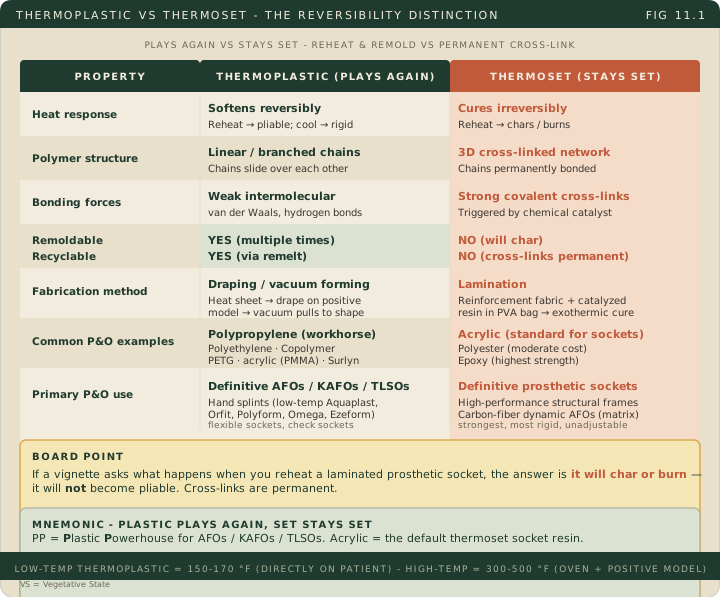
Bottom line: thermoplastics consist of linear or branched polymer chains held together by weak intermolecular forces, soften when heated, harden when cooled, and can be reheated and remolded multiple times (the process is reversible); thermosets undergo irreversible chemical cross-linking during curing and cannot be remolded once cured; polypropylene is the workhorse high-temperature thermoplastic for definitive ankle-foot orthoses (AFOs), knee-ankle-foot orthoses (KAFOs), and thoracolumbosacral orthoses (TLSOs); low-temperature thermoplastics like Aquaplast and Orfit are molded directly on the patient at 150-170 degrees Fahrenheit; thermoset resins (acrylic, polyester, epoxy) are used in prosthetic socket lamination.
A thermoplastic softens when heated and hardens when cooled. The process is reversible. Thermoplastics consist of linear or branched polymer chains held by weak intermolecular forces (van der Waals, hydrogen bonds). Heat breaks those weak bonds, the chains slide past one another, the material becomes pliable; on cooling the bonds re-form and the material rigidifies. No chemical bonds are broken or formed; chains remain intact. That reversibility is why a thermoplastic AFO can be reheated and adjusted after fabrication and a thermoset socket cannot.
Low-temperature thermoplastics soften at 150-170 degrees Fahrenheit (65-77 °C), safe for direct skin contact. They are molded directly on the patient, eliminating plaster casting. They soften in a warm water bath or heat gun, set within minutes, and can be reheated and readjusted multiple times. Four key working properties: memory (tendency to return to the original flat sheet shape when reheated), conformability/drapability (how easily the heated material flows over contours), self-bonding (whether warm material adheres to itself for overlap fusion), and resistance to stretch (how much the heated material resists thinning over convexities). Common products: Aquaplast, Orfit, Polyform, Omega, Ezeform. Applications include hand and wrist splints (resting hand, cock-up, thumb spica, finger splints), custom orthotic inserts, temporary protective devices, and serial casting alternatives. They tolerate only low stress: they are not suitable where loading will be high, as in spasticity or in most lower limb applications, so their main role is upper limb orthoses.
High-temperature thermoplastics require 300-500 degrees Fahrenheit (150-260 °C) and cannot be molded directly on the patient. They must be heated in an industrial oven and formed over a positive model using vacuum forming. Polypropylene (PP) is the workhorse, the most commonly used material for definitive AFOs, KAFOs, and TLSOs. Thickness controls flexibility (thinner = more flexible). Polyethylene (PE) is softer and more flexible, used for flexible-wall sockets and some flexible AFOs. Copolymer is a PP/PE blend for semi-flexible AFOs. PETG and acrylic (PMMA, polymethyl methacrylate) are transparent for diagnostic / check sockets. Surlyn is impact-resistant for protective covers.
Thermosets undergo an irreversible chemical reaction during curing that creates permanent cross-linked covalent bonds between polymer chains, forming a three-dimensional network rather than the linear or branched chains of a thermoplastic. A chemical catalyst triggers covalent bond formation. Covalent cross-links are stronger than intermolecular forces, so thermosets are generally stronger and more rigid, but they cannot be remolded once cured, are harder to work, and cause more skin irritation and allergic reactions than thermoplastics. The three common P&O thermoset resins are acrylic (clear, rigid, good impact resistance, the standard for socket lamination), polyester (strong, moderate cost, amber), and epoxy (highest strength, excellent adhesion, for high-performance applications).
Thermoset resins are applied through lamination (Section 5): reinforcement fabric (fiberglass, carbon fiber, nylon) wrapped over a positive model, enclosed in a sealed polyvinyl alcohol (PVA) bag (an inner PVA bag over the model acts as the release and moisture barrier, and the resin is drawn through the layers between the two), saturated with catalyzed resin, cured exothermically into a rigid composite. Properties depend on resin type, reinforcement, the layup schedule (number and sequence of fabric layers), and curing conditions.
High Yield — Thermoplastics and thermosets
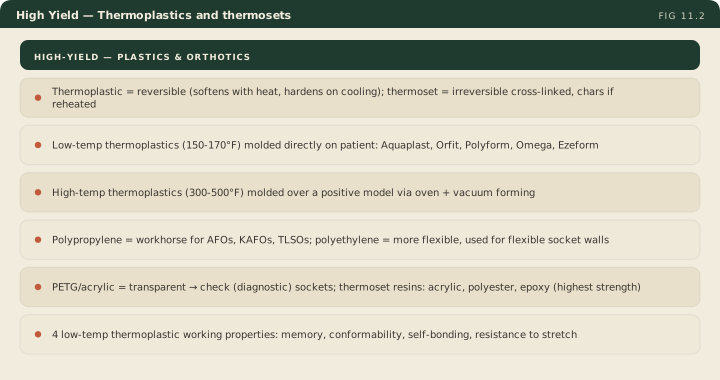
- Thermoplastic = softens with heat, hardens on cooling, reversible (can be remolded).
- Thermoset = irreversible cross-linked network on curing; cannot be remolded and will char if reheated.
- Low-temperature thermoplastics (150-170 °F): molded directly on the patient; products = Aquaplast, Orfit, Polyform, Omega, Ezeform; low stress only (not for spasticity or most lower limb use), so mainly upper limb hand/wrist splints.
- High-temperature thermoplastics (300-500 °F): molded over a positive model via oven + vacuum forming.
- Polypropylene (PP) = workhorse material for definitive AFOs, KAFOs, TLSOs.
- Polyethylene (PE) = more flexible than PP; flexible socket walls and flexible AFOs.
- PETG / acrylic = transparent; used for check (diagnostic) sockets.
- Thermoset resins: acrylic (standard socket lamination), polyester (moderate cost), epoxy (highest strength).
- Lamination = reinforcement fabric + catalyzed resin in a PVA (polyvinyl alcohol) bag; exothermic cure; irreversible.
- Four low-temperature thermoplastic working properties: memory, conformability, self-bonding, resistance to stretch.
Mnemonic; “Plastic Plays Again, Set Stays Set”
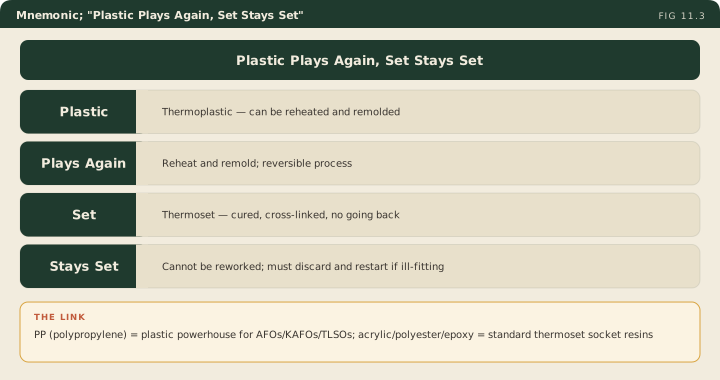
Plastic = thermoplastic = plays again (reheat and remold). Set = thermoset = stays set (cured, cross-linked, no going back). Polypropylene = PP = Plastic Powerhouse for AFOs / KAFOs / TLSOs. Acrylic / polyester / epoxy = the three thermoset socket resins; if you cannot pick one, acrylic is the standard.
You can take a block of wax, melt it down until it’s entirely liquid, pour it into a mold and let it cool. And when the temperature drops, those weak intermolecular forces reestablish themselves exactly as they were.
— PO-11 podcast, ~5:15