PO · EP 17 · COMPLICATIONS
Before You Listen
Episode Setup
- Topic in one line: the second half of the consolidated complications playbook — bone and contracture complications (heterotopic ossification by mechanism, distal bony spurs, the adult-versus-pediatric terminal bony overgrowth distinction with joint disarticulation as the canonical prevention, contractures including plantar-flexion equinus after Chopart), the systemic complications that dominate long-term outcomes (falls at ~50% annual incidence with MPK fall reduction of 60-80%, contralateral knee OA at 41-63% in transfemoral, 5-year mortality of 60-65% pooled after major dysvascular LE amputation, depression 20-35%, PTSD 23-65% in trauma amputees, VTE 9-13% perioperatively with LMWH prophylaxis), and device-specific and iatrogenic complications (osseointegration with OPRA 67% superficial / 22% deep versus POP 77% / 5% infection rates, powered-prosthesis battery and water exposure with the Ottobock X3 and X4 as the waterproof MPK platforms, orthotic complications including the halo vest cluster, wheelchair pressure injuries with posture-driven anatomic distribution, and the FDA MedWatch / sentinel-event / root-cause-analysis adverse-event reporting framework).
- Prerequisites: Part 1 of PO-17 (skin complications, phantom pain, symptomatic neuroma); the surgical principles framework from PO-03 (myodesis vs myoplasty, TMR/RPNI primary technique); transfemoral adductor myodesis from PO-05; the advanced-technology overview from PO-10 (MPK, OPRA/POP, TMR); pediatric terminal bony overgrowth from PO-12; K-level and energy-expenditure framework from PO-14; wheelchair propulsion biomechanics from PO-15.
- Runtime: ~32 minutes (Part 2 of a 1:05:00 episode).
- Series position: Final episode of the PO series. Up Next opens the REHAB pain block.
Vignette. A 58-year-old man is 8 months out from a right transtibial amputation for dysvascular complications of type 2 diabetes (HbA1c 8.4%, ABI 0.42 pre-amputation). He has been wearing a PTB socket with a silicone gel liner and one cotton sock layer for 4 months. He presents to your clinic with a 3-week history of a deep, dull aching pain at the very distal end of his residual limb that is worst at the end of the day, accompanied by visible distal swelling that he describes as “puffy and discolored.” On examination the distal residual limb shows pitting edema with a peau-d’orange skin texture and several small papillomatous lesions over the most distal 2 cm. Proximally his socket leaves a clear ring impression around the patellar tendon and tibial tuberosity. He has also had two falls in the past month, both occurring when his foot felt “loose” during community ambulation. He asks why his foot keeps slipping inside the socket.
Identify the residual-limb complication producing the distal pitting edema and papillomatous lesions, explain the underlying socket mechanism responsible, describe the canonical first-line treatment principle, classify his socket-fit symptom (foot loose in the socket during ambulation), discuss his annual fall risk and how a microprocessor-controlled component would affect it if he were a transfemoral patient, and identify one cardiovascular risk-stratification step that should occur given his amputation etiology.
(Answer at the end of this chapter)
Section 3: Bone, Soft-Tissue, and Contracture Complications
Bottom line: heterotopic ossification (HO) of the residual limb is dramatically more common in combat injury (60-91%) than civilian trauma (20-40%) or dysvascular amputation (5-10%); diagnosis is alkaline phosphatase plus triple-phase bone scan early and plain radiograph later, with treatment ranging from socket modification through indomethacin or etidronate prophylaxis to surgical excision after maturation. Distal bony spurs and prominences in adults are managed first by socket reshaping, then replacement, with bony revision reserved for failure. Terminal bony overgrowth is a pediatric phenomenon (skeletally immature, diaphyseal cuts); the canonical pediatric prevention is joint disarticulation when feasible. Contractures are level-specific: hip flexion in transfemoral (the most common preventable complication overall), knee flexion in transtibial (>15° renders the prosthesis unusable), and plantar-flexion (equinus) contracture after Chopart from loss of dorsiflexor (tibialis anterior, EHL, EDL) insertions while the Achilles tendon is preserved.
Heterotopic ossification (HO) of the residual limb is the formation of mature lamellar bone in the soft tissues of the residual limb, distinct from distal bony spurs. The incidence varies dramatically with mechanism. Combat-related (blast) amputation produces HO in 60-91%, the highest rate in the literature, driven by traumatic muscle injury, hematoma, and the systemic inflammatory response. Civilian traumatic amputation produces HO in 20-40%. Dysvascular (atraumatic) amputation produces HO in only 5-10%.
Clinical presentation is swelling, warmth, decreased range of motion, and pain that limits prosthetic wear. The earliest laboratory marker is elevated alkaline phosphatase, reflecting active osteoblastic activity. The triple-phase bone scan is the most sensitive imaging early and turns positive within 2-4 weeks. Plain radiographs lag by 4-6 weeks. Prophylaxis in high-risk populations uses indomethacin (inhibits prostaglandin-mediated osteoblast differentiation) or etidronate (a bisphosphonate inhibiting hydroxyapatite crystal growth); both are most effective when started early after surgery. Surgical excision is reserved for HO that produces persistent functional impairment and is delayed until the bone is mature and metabolically quiescent, typically 12-18 months after onset, confirmed by normalizing alkaline phosphatase and a cold bone scan. Operating on metabolically active HO carries a high recurrence rate.
Distal bone spurs and bony prominences in adult residual limbs are managed by a stepped surgical-conservative approach. First-line is socket reshaping: the prosthetist grinds or pads the socket’s inner wall to relieve focal pressure over the prominence. Adding padding outside the prominence is generally not helpful because it creates additional pressure rather than relieving it. If reshaping fails, the next step is socket replacement with relief built into the new fabrication. Surgical revision (bony shaving or stump revision) is reserved for failure of socket modification.
Terminal bony overgrowth (TBO) is fundamentally a pediatric phenomenon. True appositional TBO occurs in skeletally immature patients with diaphyseal transections of the humerus, fibula, or tibia (not the femur). Skeletally mature amputees do not develop TBO; what may appear similar is usually a distal callus or spur (handled as above). The pediatric prevention principle is testable: perform a joint disarticulation rather than a diaphyseal amputation when the injury permits. A joint disarticulation preserves the epiphysis and avoids the cut diaphyseal bone surface that drives appositional overgrowth. See PO-12 §12.7 for the pediatric framework in full.
Stump revision is considered when the residual limb has a complication that socket modification cannot fix: refractory symptomatic neuroma despite TMR or RPNI options, painful HO interfering with fit, chronic non-healing distal ulcer, redundant soft tissue, scar contracture limiting prosthetic fit, or an excessively long residual limb that cannot accept the prosthetic componentry (especially long transtibial limbs that cannot accept a microprocessor knee).
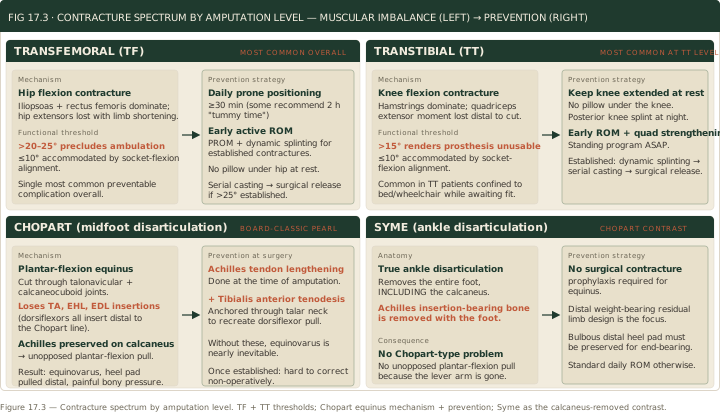
Contractures are the most common preventable functional complication and are level-specific. The hip flexion contracture in transfemoral amputees is the single most common preventable complication overall (see PO-03 §3.7). The thresholds matter: hip flexion contracture >20-25° may preclude functional ambulation with a TF prosthesis; knee flexion contracture >15° renders most transtibial prostheses unusable. Smaller contractures (≤10° hip, ≤10° knee) can usually be accommodated by socket-flexion alignment. Prevention is daily prone positioning (at least 30 minutes, with some sources recommending 2 hours of “tummy time”), no pillow under the knee at rest, and early active range of motion. Management of established contractures progresses from passive range of motion and dynamic splinting to serial casting to surgical release.
The boards specifically test the Chopart amputation plantar-flexion (equinus) contracture. The mechanism is unambiguous and testable. A Chopart amputation transects the midfoot through the talonavicular and calcaneocuboid joints. This removes the dorsiflexor tendon insertions (tibialis anterior, extensor hallucis longus, and extensor digitorum longus all insert distal to the Chopart line) while the Achilles tendon insertion on the calcaneus remains intact. The result is unopposed plantar-flexion pull producing fixed equinovarus deformity, often with the residual heel pad pulled distally and the bony calcaneus pressing painfully against the inferior tip of the prosthetic shoe. Prevention requires Achilles tendon lengthening at the time of amputation, sometimes combined with tibialis anterior tenodesis through the talar neck to recreate dorsiflexor pull. The Syme amputation (true ankle disarticulation distal to Chopart) does not have this problem because the entire foot is removed, including the Achilles insertion-bearing calcaneus.
 ::: {.callout-important}
## High Yield — Bone and contracture complications
::: {.callout-important}
## High Yield — Bone and contracture complications
- HO incidence: combat 60-91% > civilian trauma 20-40% > dysvascular 5-10%. Alkaline phosphatase plus triple-phase bone scan for diagnosis; indomethacin or etidronate for prophylaxis; surgical excision delayed 12-18 months until alkaline phosphatase normalizes.
- Distal bony spurs (adult): socket reshape first, then replace, then revise bone.
- Terminal bony overgrowth = pediatric (diaphyseal cuts in immature humerus, tibia, fibula); joint disarticulation prevents it.
- Stump revision indications: refractory neuroma despite TMR or RPNI, painful HO, chronic distal ulcer, redundant soft tissue, scar contracture, or residual limb too long for componentry.
- Hip flexion contracture (TF) = most common preventable complication overall; >20-25° precludes ambulation. Daily prone positioning plus early ROM prevent it.
- Knee flexion contracture (TT) = most common at TT level; >15° renders TT prosthesis unusable.
- Chopart plantar-flexion equinus from loss of dorsiflexor insertions (TA, EHL, EDL) while Achilles is preserved produces unopposed PF pull. Prevention = Achilles lengthening plus or minus tibialis anterior tenodesis at the time of amputation. :::
Board Trap — Excision is NOT the treatment for verrucous hyperplasia
A vignette describes a patient with warty papillomatous skin at the distal residual limb 8 weeks after starting prosthetic ambulation, with associated distal swelling and dependent discoloration. The trap is to treat the lesion dermatologically (cryotherapy, excision, salicylic acid); the wart-like appearance invites a wart-like treatment. The correct answer is to restore total contact between the socket and the distal residual limb (new socket with full distal contact, distal-cushion liner, elastic bandaging). The mechanical cause (distal venous obstruction) must be reversed for the dermatologic lesion to regress. Excision in this setting often makes the problem worse by adding scar tissue without fixing the underlying socket fit.
“The epidemiology is the most heavily tested aspect of heterotopic ossification. You must memorize these stark contrasts in incidence. In the combat injury population, the incidence of heterotopic ossification is a staggering 60 to 91 percent. In dysvascular amputations, the incidence plummets to just five to ten percent. That variance from 91 percent in combat to five percent in dysvascular perfectly highlights how the mechanism of injury dictates the complication profile.”
— PO-17-b podcast, ~32:39