Before You Listen
- Prerequisites: basic neuroanatomy of the cerebral hemispheres and brainstem; the motor and sensory homunculi; the principle of tract-specific crossings and the typical ipsilateral cranial nerve findings in brainstem lesions; familiarity with the Glasgow Coma Scale (GCS) and basic exam terms (hemiparesis, dysarthria, aphasia, neglect).
- Runtime: 28 minutes.
- Topic in one line: the Circle of Willis and its two most-tested aneurysm sites, the middle cerebral artery (MCA) face-and-arm pattern with dominant-hemisphere aphasias and non-dominant hemispatial neglect, the anterior cerebral artery (ACA) leg-weakness-plus-abulia syndrome, the posterior cerebral artery (PCA) homonymous hemianopia with macular sparing and the alexia-without-agraphia disconnection, the brainstem crossed-findings rule anchored by Wallenberg lateral medullary syndrome, the midbrain Weber-vs-Benedikt distinction, locked-in syndrome from basilar occlusion, the five classic lacunar syndromes from lipohyalinosis of small penetrators, and the man-in-a-barrel watershed pattern. Memorize them cold.
Vignette. A 68-year-old right-handed woman with poorly controlled hypertension is brought to the emergency department after collapsing at her kitchen sink. She is alert but mute. Her right face droops, her right arm hangs flaccid, and her right leg moves only weakly against gravity. Both eyes are forced into a hard left gaze. She follows no commands and produces no recognizable speech. Computed tomography (CT) of the head is unremarkable in the first hour; CT angiography shows occlusion of the proximal left middle cerebral artery (MCA) at the M1 segment.
Where is the lesion in three-dimensional anatomy, what is the named eye-deviation sign and how does it differ from the gaze deviation of a seizure, what is the specific aphasia syndrome you would expect from the superior versus inferior division involvement, and which deep nuclei are at risk because of the proximal location of the occlusion?
(Answer at the end of this chapter)
Section 1: The Circle of Willis and the Two Tested Aneurysm Sites
Bottom line: the Circle of Willis is a ferocious arterial roundabout that exists for collateral flow; 30 to 40% of internal carotid artery (ICA) occlusions are silent because of it; the anterior communicating artery (ACom) is the number-one aneurysm site, and the posterior communicating artery (PCom) is the number-two site with a classic painful third-nerve palsy that includes pupillary involvement.
The Circle of Willis is the arterial ring at the base of the brain that ties the front and back blood supplies together. Every component exists for a single purpose: collateral flow. If a feeding vessel chokes off, the ring provides a backup route so downstream tissue does not die. The anterior circulation begins as the paired internal carotid arteries (ICAs), each climbing through the neck, entering the skull through the carotid canal, and bifurcating into a middle cerebral artery (MCA) that turns laterally into the Sylvian fissure and an anterior cerebral artery (ACA) that sweeps medially over the corpus callosum. The anterior communicating artery (ACom) bridges the two ACAs. The posterior circulation begins as the paired vertebral arteries that ascend through the transverse foramina, enter the foramen magnum, and fuse at the pontomedullary junction to form a single basilar artery. The basilar runs along the ventral pons and splits into two posterior cerebral arteries (PCAs) at the top, and each PCA reaches back to the ipsilateral ICA through a posterior communicating artery (PCom).
The full ring, listed from front to back: two ACAs, one ACom, the terminal segments of two ICAs, two PComs, and two PCAs. The basilar feeds the ring but is not technically part of it. The clinical payoff is staggering. Roughly 30 to 40% of all ICA occlusions are completely silent.
When the carotid does announce itself, the warning is often ocular rather than hemispheric. Amaurosis fugax is transient monocular vision loss — classically described as a curtain or shade descending over one eye — lasting seconds to minutes and clearing completely. The mechanism is retinal hypoperfusion, usually from a platelet-fibrin or cholesterol embolus travelling up the ophthalmic artery, the first intracranial branch of the ICA. It is a retinal TIA, and it is ipsilateral to the diseased carotid while any hemispheric symptoms are contralateral — a pairing that localizes the lesion in one step.
Two things make it high yield. First, it is a warning: transient monocular blindness precedes stroke in a substantial minority of ICA occlusions, so it demands urgent carotid imaging and consideration of revascularization rather than reassurance. Second, it must be separated from central retinal artery occlusion, which is the same embolic mechanism that did not resolve — painless, sudden, and persistent monocular blindness with a cherry-red spot on fundoscopy. Transient means amaurosis fugax; permanent means CRAO. A patient walks into clinic with one of the largest cerebrovascular pipes totally blocked and has no neurological deficit because collateral flow keeps the territory perfused. When a stem describes an incidental ICA occlusion in an asymptomatic patient, the explanation is a complete, functional Circle of Willis providing adequate collateral.
The Circle has two heavily tested aneurysm sites. The ACom is the most common location of intracranial aneurysm. When a stem describes a sudden thunderclap headache and subarachnoid hemorrhage, the answer is the ACom. Rupture with vasospasm involving both ACAs can produce bilateral medial hemispheric infarction, presenting as paraplegia, severe abulia, and urinary incontinence. The PCom is the second most common site and produces one of the most classic board presentations in all of neurology: a PCom aneurysm compresses cranial nerve three (the oculomotor nerve) as it exits the midbrain. The result is a triad of ptosis, a fixed and dilated blown pupil, and an eye in a down-and-out position because the only intact extraocular muscles are the lateral rectus (cranial nerve six) and the superior oblique (cranial nerve four).
The pupil-involved versus pupil-spared distinction lives or dies on the anatomy of the third nerve. Parasympathetic fibers run on the outer surface of cranial nerve three. External compression from an expanding aneurysm hits those superficial fibers first, producing a blown pupil within hours. A diabetic third nerve palsy is caused by ischemia of the vasa nervorum, which damages the interior motor fibers but spares the superficial parasympathetic fibers. So a typical microvascular diabetic third nerve palsy presents with ptosis and a down-and-out eye but a normally reactive pupil. A patient with a new severe headache, ptosis, a down-and-out eye, and a fixed dilated pupil needs urgent vascular imaging to exclude a PCom aneurysm compressing cranial nerve three. That is a neurosurgical emergency. Keep this classic pupil distinction for board localization, but pupil sparing alone cannot exclude aneurysm, especially in a partial palsy.
The most important anatomical variant is the fetal-origin posterior cerebral artery, present in roughly 20 to 25% of the population. The PCA in this variant draws its supply primarily from the ICA through a large persistent PCom rather than from the basilar. An ICA occlusion in such a patient can knock out anterior and posterior territories simultaneously, producing combined MCA and PCA deficits from a single carotid lesion. A second tested variant is the azygos ACA, in which both ACAs arise from a single trunk; occlusion produces bilateral medial hemispheric infarction with paraplegia, akinetic mutism, and urinary incontinence (the same syndrome as ACom-aneurysm vasospasm).
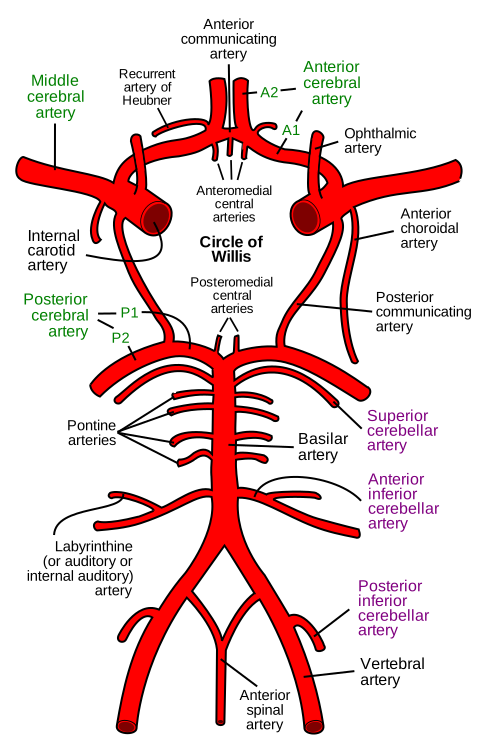
Source: Rhcastilhos (original 2007), updated by Pereoptic (2022), “Circle of Willis en.svg”, via Wikimedia Commons, Public Domain. https://commons.wikimedia.org/wiki/File:Circle_of_Willis_en.svg
High Yield — Circle of Willis and aneurysm sites
- Anterior circulation = paired ICAs → terminal MCA + ACA; bridged by ACom.
- Posterior circulation = paired vertebrals → single basilar → paired PCAs; bridged to ICAs by PComs.
- 30-40% of ICA occlusions are silent because of intact Circle of Willis collateral.
- Number-one aneurysm site = ACom; rupture/vasospasm can infarct both ACAs → paraplegia + abulia + incontinence.
- Number-two aneurysm site = PCom; compresses cranial nerve three → ptosis + blown pupil + down-and-out eye.
- Classic compressive third nerve palsy = pupil involved; typical microvascular diabetic palsy = pupil spared (ischemia of vasa nervorum spares superficial parasympathetic fibers).
- Fetal-origin PCA in 20-25% of population: ICA occlusion can knock out anterior + posterior territories simultaneously.
- Azygos ACA: single shared trunk → bilateral medial hemispheric infarction = paraplegia + akinetic mutism + incontinence.
Mnemonic — A-Com is on top of the list, P-Com gives you the blown pupil
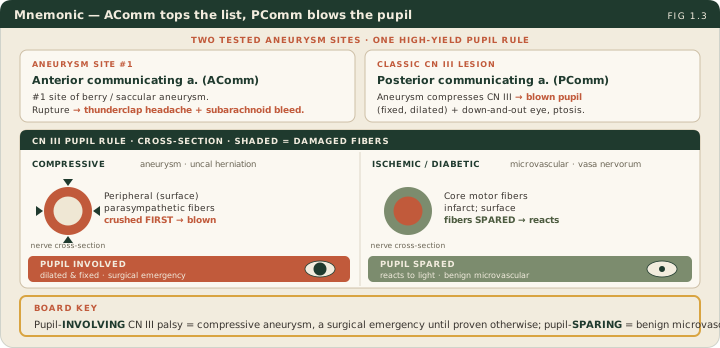
ACom is #1 (ACom = #1 aneurysm site). PCom gives you the Pupil (PCom compresses CN III externally → parasympathetic fibers crushed first → blown pupil). The classic diabetic palsy spares the pupil and the classic aneurysmal palsy involves it, but new third-nerve palsy requires urgent assessment rather than reassurance from pupil sparing alone.
Pupil involved means compression, which means you have a neurosurgical emergency on your hands. Pupil spared means ischemia.
— CVA-01 podcast, ~7:40