Before You Listen
Episode Setup
- Topic in one line: the epidemiology of chronic pain, the foundational pain taxonomy and lexicon, the four-stage pain neuroanatomy, dorsal horn laminae and gate control theory, descending inhibition, central sensitization, and the full analgesic pharmacology toolkit — nonsteroidal anti-inflammatory drugs (NSAIDs), acetaminophen, gabapentinoids, tricyclic antidepressants (TCAs), serotonin-norepinephrine reuptake inhibitors (SNRIs), opioids, and local anesthetics — that every physiatrist needs cold on the American Board of Physical Medicine and Rehabilitation (ABPMR) Part I examination.
- Prerequisites: basic peripheral and central neuroanatomy, the spinothalamic tract, pre- and postsynaptic membrane physiology, voltage-gated calcium and sodium channels, and glucuronide versus oxidative drug metabolism.
Vignette. A 58-year-old woman with a 5-year history of painful diabetic peripheral neuropathy returns to clinic. She describes constant burning in both feet at rest, intolerance of bedsheets brushing her toes, and a sharp shooting jolt that travels up her calf when she steps onto a cold tile floor. Her current regimen is acetaminophen 1 gram every 6 hours and oxycodone 10 mg three times daily; she still rates her pain 7 out of 10 and has gained 4 kg from inactivity. Glycated hemoglobin is 7.4 percent. Estimated glomerular filtration rate (eGFR) is 38 mL/min/1.73 m². On exam light touch on the dorsum of the foot is reported as painful, pinprick produces an exaggerated and prolonged response, and ankle reflexes are absent.
What is the mechanism-based pain category, which two terminology terms apply to her exam findings, what three first-line non-opioid agents target the underlying mechanism, and which currently prescribed agent should be tapered first and why?
(Answer at the end of this chapter)
Section 1: Pain Epidemiology, Acute Versus Chronic Pain, and the Pain Lexicon
Bottom line: chronic pain affects roughly 20–21% of US adults with high-impact pain (limiting daily activity) in 7–8%, total economic cost in the $560–635 billion range when lost productivity is included; sex skew is striking in selected conditions (fibromyalgia female-to-male ratio ~7:1); the rehabilitation problem set sits atop this pain backbone — globally ~12 million people live with spasticity, ~15 million with dysphagia, ~2.5 million with pressure injuries, and ~14 million falls per year in older US adults, placing pain at the center of every PM&R subspecialty. Pain divides temporally into acute (less than 3 months, a symptom of tissue injury) and chronic (greater than 3 months, the disease itself), and mechanistically into nociceptive (somatic, well-localized; or visceral, diffuse with viscerosomatic referral) versus neuropathic (peripheral or central nervous system damage; burning, electric, shooting); the high-yield lexicon distinguishes allodynia (pain from a normally non-painful stimulus), hyperalgesia (exaggerated response to a normally painful stimulus), hyperpathia (raised threshold but explosive, prolonged, summating response once breached), dysesthesia (unpleasant abnormal sensation), and paresthesia (abnormal sensation, neutral quality); and chronic pain disability follows a steep work-loss gradient of 50 percent return at 6 months off work, 25 percent at 1 year, and less than 5 percent at 2 years.
Chronic pain is a population-level disease. The CDC’s most recent NHIS analysis estimates 20.9% of US adults met criteria for chronic pain (pain on most days or every day for the past 3 months) and 7.4% met criteria for high-impact chronic pain (chronic pain that limits life or work activities). Translated to prevalence, that is approximately 51.6 million Americans with chronic pain and 17.1 million with high-impact pain at any point in time — a population larger than diabetes, heart disease, or cancer prevalence in the same cohort.
Economic burden. Total annual cost of chronic pain in the United States is conservatively estimated at $560 billion to $635 billion, including direct medical spending plus lost productivity. This makes chronic pain the costliest condition in US healthcare by population, exceeding the combined cost of cardiovascular disease and cancer.
Sex distribution. Chronic pain prevalence is higher in women across nearly every diagnosis tested. Fibromyalgia has the most striking skew at roughly 7:1 female-to-male ratio in clinical series (population-based 2010 ACR criteria narrow this closer to 2–3:1, but the clinical population remains overwhelmingly female). Migraine, temporomandibular dysfunction, complex regional pain syndrome (CRPS), and irritable bowel syndrome all show 2–4× female predominance. The neurobiologic basis (estrogen modulation of nociception, sex differences in microglial activation, differential descending inhibition) is active research; for the boards, the direction of the sex skew is what is tested.
Pain anchors the rehabilitation problem set. Three companion epidemiology numbers worth memorizing in parallel: globally an estimated ~12 million people live with spasticity (the leading post-stroke, SCI, MS, and cerebral palsy sequela), ~15 million with dysphagia (post-stroke, neurodegenerative, head-and-neck cancer), and ~2.5 million pressure injuries are managed annually in US inpatient care alone. Falls in older adults account for ~14 million reported falls per year in the United States with downstream consequences including TBI, hip fracture, and the fear-of-falling cycle. Each of these endpoints carries pain as a primary symptom, secondary driver, or rehabilitation barrier — which is why PM&R training centers pain expertise as a horizontal skill across every body system.
High Yield — Pain epidemiology numbers worth memorizing
- US adults with chronic pain ≈ 21% (≈ 52 million people); high-impact chronic pain ≈ 7.4% (≈ 17 million).
- Annual US economic cost ≈ $560–635 billion — the costliest single condition by population.
- Fibromyalgia F:M ≈ 7:1 in clinical series; 2–3:1 with strict ACR 2010 criteria.
- Migraine, TMD, CRPS, IBS all 2–4× female-predominant.
- Spasticity ≈ 12 million globally; dysphagia ≈ 15 million; pressure injuries ≈ 2.5 million/year US inpatient; falls ≈ 14 million/year US older adults.
Board answer vs. current evidence — Migraine, temporomandibular dysfunction, CRPS, and IBS all show 2–4× female predominance — this is likely the board-tested answer, but more recent evidence (PMID 32702295) indicates the female-to-male odds ratio for IBS is approximately 1.5–2.0, lower than the 2–4× figure cited for the group as a whole. Answer the board-canonical version on the test.
Acute pain lasts less than 3 months, signals tissue damage, and resolves as the injury heals; it is a symptom of a disease. Chronic pain persists beyond 3 months and has transformed: it is no longer a symptom but the disease itself, sustained by central sensitization and neuroplastic changes long after tissue healing. Acute pain responds to tissue-directed therapy (rest, NSAIDs, brief opioids, immobilization); chronic pain requires a biopsychosocial approach addressing the nervous system, psychological comorbidities, and functional restoration. The therapeutic implication is enormous. Treating chronic pain as if it were a prolonged acute injury, escalating peripheral analgesics to subdue a tissue source that no longer exists, locks the patient into iatrogenic disability.
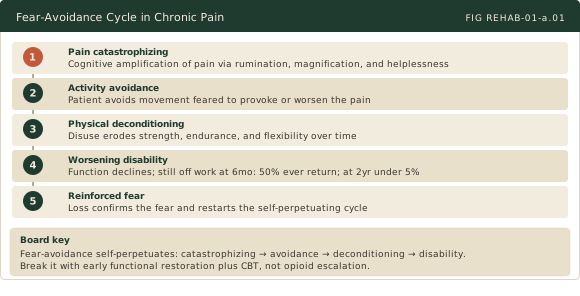
The fear-avoidance model describes how patients develop catastrophic thinking, avoid activity, decondition physically, and worsen disability in a self-perpetuating cycle. Pain catastrophizing is the cognitive amplification of pain through rumination, magnification, and helplessness, and motivates combining cognitive behavioral therapy with physical therapy in interdisciplinary pain programs. The work-loss gradient is one of the most sobering statistics in physiatry: at 6 months off work for back pain, 50 percent return; at 1 year, 25 percent; at 2 years, fewer than 5 percent. The trajectory is not a gradual decline but a steep cliff, which is why early aggressive functional restoration (not opioid escalation) is the standard of care.
The mechanism-based classification divides pain into nociceptive and neuropathic categories. Nociceptive pain arises from activation of intact peripheral nociceptors by tissue damage and subdivides into somatic and visceral types. Somatic nociceptive pain is well localized, sharp or aching, and arises from skin, bone, muscle, or connective tissue; the patient who points precisely to the lateral epicondyle and says “it hurts right here” is describing somatic pain. Visceral nociceptive pain arises from internal organs and travels through sympathetic afferent fibers; it is diffuse, poorly localized, deep, crampy, and often accompanied by autonomic features such as nausea, diaphoresis, and pallor. Visceral pain frequently presents as referred pain, projecting to a somatic distribution distant from the affected organ; left arm and jaw pain during myocardial infarction is the textbook example. The mechanism is viscerosomatic convergence: visceral and somatic afferents converge onto the same second-order neurons in the dorsal horn, and the brain attributes the pain to the more commonly stimulated somatic territory.
Neuropathic pain results from damage to or dysfunction of the nervous system itself. It subdivides into peripheral neuropathic pain (lesions of peripheral nerves; diabetic polyneuropathy, post-herpetic neuralgia, carpal tunnel syndrome) and central neuropathic pain (lesions within the central nervous system; thalamic pain syndrome after stroke, pain below the level of injury in spinal cord injury (SCI), trigeminal neuralgia from microvascular compression). The descriptors are stereotyped: burning, electric, shooting, lancinating, or stimulus-independent paroxysmal sensations. When a board question describes burning pain in both feet of a diabetic patient, the diagnosis is peripheral neuropathic pain and first-line agents are gabapentinoids, TCAs, or duloxetine.
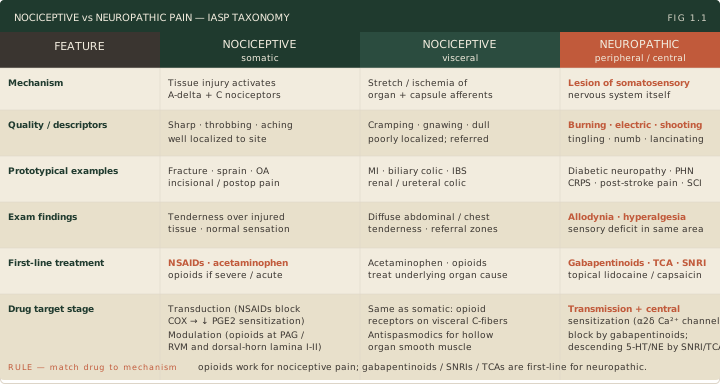
The pain lexicon contains five terms tested in nearly every board cycle. Allodynia is pain produced by a stimulus that does not normally provoke pain (the bedsheet brushing the leg, a cool breeze, light touch on intact skin). The stimulus is not noxious; the nervous system has reinterpreted an innocuous signal as painful. Allodynia is a hallmark of central sensitization and appears in complex regional pain syndrome, fibromyalgia, and post-herpetic neuralgia. Hyperalgesia is an exaggerated response to a normally painful stimulus, where pinprick produces excruciating, disproportionate pain. Primary hyperalgesia occurs at the site of tissue injury via peripheral sensitization; secondary hyperalgesia occurs in surrounding uninjured tissue and reflects central sensitization at the dorsal horn.
Hyperpathia is the most nuanced term and the highest-yield trap. Hyperpathia features a raised threshold for pain detection (the patient initially does not feel mild stimuli), but once the threshold is exceeded the response is explosive, exaggerated, and prolonged with a summation component in which repeated stimuli build cumulatively. The examiner is lulled by apparent hyposensitivity and then confronted by overwhelming pain on a stimulus that should have been trivial. Dysesthesia is an unpleasant abnormal sensation, spontaneous or evoked; the defining feature is unpleasantness. Paresthesia is an abnormal sensation that is not necessarily unpleasant (the classic pins-and-needles of a limb falling asleep). The single-word distinction between dysesthesia and paresthesia is “unpleasant.” Hypoalgesia is diminished sensitivity to a normally painful stimulus, and analgesia is the complete absence of pain perception in response to one.
High Yield — Pain taxonomy and lexicon
- Acute < 3 months = symptom of tissue injury; chronic > 3 months = the pain is the disease.
- Work-loss gradient (chance of ever returning for a worker still off work): 50% at 6 months, 25% at 1 year, <5% at 2 years.
- Nociceptive somatic = sharp, well-localized; nociceptive visceral = diffuse, crampy, autonomic, viscerosomatic referral via sympathetic afferents.
- Neuropathic = burning, electric, shooting, lancinating; central or peripheral nervous system damage.
- Allodynia = pain from non-painful stimulus.
- Hyperalgesia = exaggerated response to painful stimulus (primary peripheral, secondary central).
- Hyperpathia = raised threshold + explosive, prolonged, summating response once breached.
- Dysesthesia = unpleasant abnormal sensation; paresthesia = abnormal but not unpleasant.
Mnemonic — “ALL-light, HYPER-prick, HYPER-summate” for the three “pain” terms
ALLodynia = ALL stimuli hurt, even light touch. HYPERalgesia = HYPER-response to pinprick. HYPERpathia = HYPER-response only after threshold breached, with summation and prolonged after-discharge. The three terms differ on what stimulus triggers the abnormal response.
In hyperpathia, the patient actually presents with a raised detection threshold. When you first test their sensation with a mild or moderate stimulus, they might seem numb or entirely insensitive.
— REHAB-01 podcast, ~12:53
If a patient is out of work for six months, that yields a 50% return rate. By one year, that drops to 25%. By two years, fewer than 5% of patients ever return to work.
— REHAB-01 podcast, ~7:26