Before You Listen
Episode Setup
- Topic in one line: the mechanics under the seat and the diagnosis-specific prescription, anchored by the rear axle position trade-off (anterior makes the chair easier to push but tippier and is the active-user setting; posterior is the bilateral-amputee answer because limb loss shifts center of gravity backward), the three frame weight classes (standard 40-65 lb, lightweight 30-35 lb, ultralight <30 lb, with rigid frames preferred over folding), pneumatic versus solid tires, the camber range (2-4 degrees everyday, up to about 5; 15-20 degrees sport, ~18 best-performing) with biomechanical and ergonomic benefits, the propulsion stroke patterns (semicircular pattern most efficient, single-loop, double-loop, and arc), the asymmetric postural challenges (pelvic obliquity, pelvic rotation, kyphoscoliosis), the SCI-by-level prescription map (C1-C3 sip-and-puff, C4 head array, C5 power with biceps-driven joystick, C6 transition with tenodesis grasp, C7 ultralight manual unlocked by triceps), the Healthcare Common Procedure Coding System (HCPCS) K-codes, the safety accessories (anti-tippers, brake extensions, grade aids), and the long-term repetitive strain injury prevention.
- Prerequisites: the four critical seat measurements, hammocking effect, cushion types, and tilt-versus-recline distinction from REHAB-10; SCI motor levels (C5 deltoid/biceps, C6 wrist extensors, C7 triceps); and the basic biomechanics of the seated pelvis.
- Runtime: 55 minutes.
Vignette. A 52-year-old man with bilateral transtibial amputations from peripheral vascular disease (status post surgical revision of both transtibial residual limbs five years prior, no current prosthesis use due to chronic stump wounds) is referred to your seating clinic because his standard-frame manual wheelchair “keeps tipping over backward.” On observation he can independently propel on level surfaces using both upper extremities (4+/5 strength bilaterally), and on a slight uphill incline he successfully tips backward and is caught by the anti-tippers. He has good static and dynamic sitting balance and lives alone in an apartment with a roll-in shower.
What is the biomechanical reason for backward tipping in this patient, what specific axle modification corrects it, what frame class would be most appropriate for this active patient, what cambering decision would you consider, and what other safety accessory should you confirm is in place?
(Answer at the end of this chapter)
Section 1: Rear Axle Position, Frame Class, and Tires
Bottom line: rear axle position governs the trade-off between propulsion efficiency and stability, with anterior axle positioning shifting weight toward the rear wheels for easier propulsion but greater backward tipping risk and posterior positioning increasing stability at the cost of increased rolling resistance; the bilateral lower-extremity amputee requires posterior axle positioning because limb loss shifts the center of gravity posteriorly; frame weight classes run standard (40-65 lb), lightweight (<35 lb), and ultralight (<30 lb), with rigid frames more efficient than folding because no cross-brace energy absorption; and pneumatic tires offer the lightest weight and smoothest ride at the cost of inflation maintenance and puncture risk, while solid (flat-free) tires require no maintenance but are heavier with greater rolling resistance.
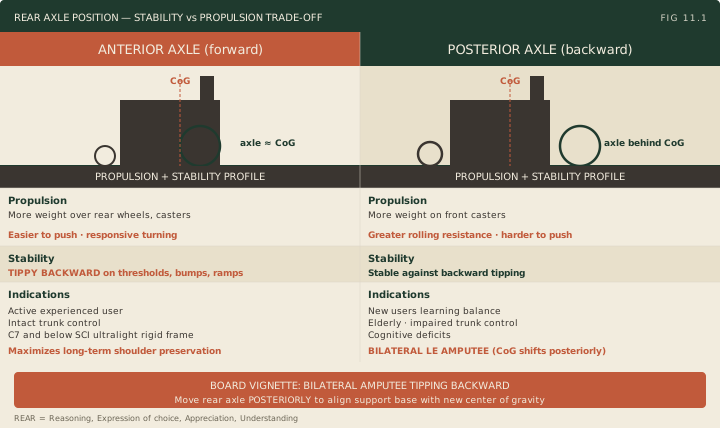
The position of the rear axle relative to the user’s center of gravity is one of the most important and most tested mechanical principles in wheelchair design. This single variable determines how easy the chair is to push, how responsive it is to direction change, and how stable it is against tipping.
When the rear axle is positioned anteriorly (forward relative to the user’s center of gravity), the wheelchair becomes easier to push. A greater proportion of body weight is positioned over or behind the rear wheels, which bear more weight; the front casters bear less weight and lift off the ground more easily. With the casters lightly loaded, the chair turns more responsively, rolls more efficiently, and requires less energy to propel. For active, experienced users, an anterior axle position maximizes propulsion efficiency, reduces push strokes per distance, and decreases the repetitive strain on shoulders that is the leading cause of long-term musculoskeletal injury in manual wheelchair users.
The trade-off is stability. An anterior axle position makes the wheelchair more prone to tipping backward. Because the rear wheels are positioned closer to or in front of the user’s center of gravity, a relatively small backward force (rolling over a threshold, hitting a small bump, pushing uphill) can cause the chair to tip over. For experienced users with the trunk control to manage a dynamic balance point, this tippiness is acceptable and even desirable for wheelchair skills like wheelies and curb negotiation. For new wheelchair users, elderly patients, or individuals with impaired trunk control, balance deficits, or cognitive limitations, an anterior axle position is dangerous.
When the rear axle is posterior (behind the user’s center of gravity), the chair becomes more stable against backward tipping but harder to push because more weight loads the front casters, increasing rolling resistance.
The most clinically important application of posterior axle positioning is the bilateral lower-extremity amputee. When both legs are amputated above or below the knee, the patient’s center of gravity shifts posteriorly because leg mass has been removed from the front of the body. Placing a bilateral amputee in a standard wheelchair with a standard axle position can cause backward tipping. The solution is to move the rear axle posteriorly, shifting the support base behind the new center of gravity. This is one of the most reliably tested wheelchair facts on the boards.
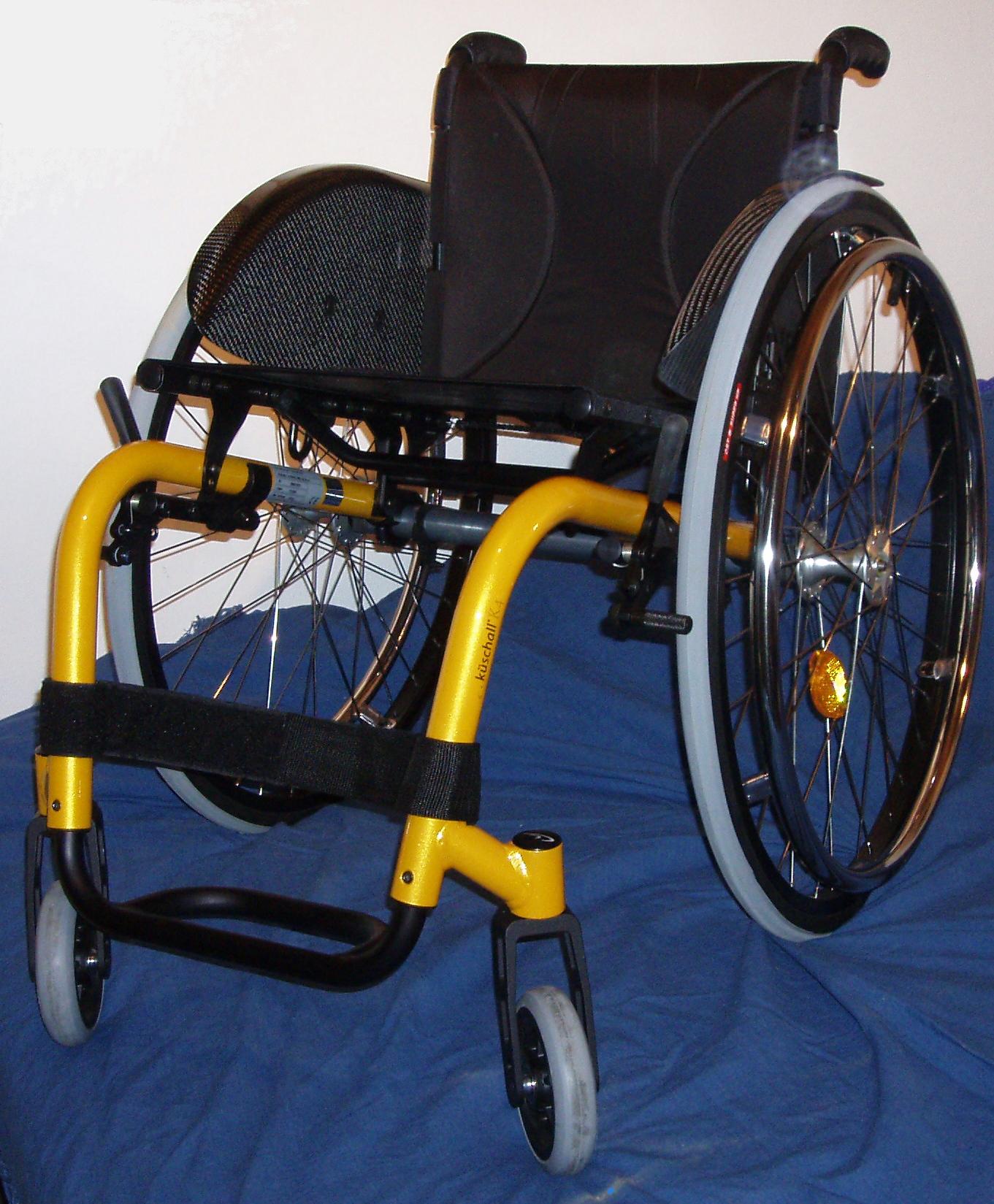
Source: Xocolatl, Wikimedia Commons, public domain

Frame weight classes correspond directly to user functional level, activity demands, and reimbursement justification. Standard-weight wheelchairs weigh approximately 40 to 65 pounds, are constructed of heavy-gauge steel, and are the institutional chairs in hospitals and nursing facilities. They are appropriate for short-term use, transport within a facility, or caregiver-pushed users. They are not appropriate for active self-propulsion. Lightweight wheelchairs weigh approximately 30 to 35 pounds through aluminum or lighter steel alloys; appropriate for limited functional demands such as household ambulation. Ultralight wheelchairs weigh under 30 pounds, with high-performance models as light as 15 to 20 pounds, constructed from aircraft-grade aluminum, titanium, or carbon fiber. Ultralight chairs feature adjustable axle positions, rigid frames, ergonomic seating geometry, and customizable components. They are designed for active full-time wheelchair users; the reduced weight dramatically decreases propulsion energy cost and reduces upper extremity repetitive strain.
The rigid frame versus folding frame distinction is closely related. Rigid frames are constructed as a single unit with the wheels removed for transport. They are lighter and more efficient than folding frames because there are no cross-braces or folding mechanisms to add weight or flex. When force is applied to the push rim of a rigid frame, energy transfers directly to forward motion. Folding frames absorb some energy in the frame and folding mechanism, reducing efficiency. For active users, rigid frames are strongly preferred. Folding frames are needed when the user must fold the chair for car transport without the ability to disassemble a rigid frame.
Pneumatic tires (air-filled, like bicycle tires) provide the lightest weight, smoothest ride, and lowest rolling resistance. Air absorbs vibration and surface irregularities, improving comfort and reducing jarring forces to the spine. The disadvantages are inflation maintenance and puncture vulnerability. Carpeting raises rolling resistance about fourfold, which is why pneumatic tires are favored where carpet predominates. Solid tires (also called flat-free), made of solid rubber or polyurethane, cannot go flat and require no inflation; the trade-off is greater weight and harsher ride. Semi-pneumatic and foam-filled tires are compromises, offering some vibration absorption without flat risk but at intermediate weight and rolling resistance. Spoke wheels are lighter and provide some shock absorption (spokes flex slightly) and can be trued; they are more fragile than mag wheels (one-piece molded), which are heavier but more durable.
High Yield — Axle position, frame, and tires
- Anterior axle: easier to push, more responsive, tippy backward; active experienced user setting.
- Posterior axle: more stable, harder to push; bilateral lower-extremity amputee answer (CoG shifts posteriorly with limb loss).
- Standard frame: 40-65 lb, institutional, caregiver-pushed; not for active propulsion.
- Lightweight: <35 lb (often 30-35 lb).
- Ultralight: <30 lb (15-30 lb), aluminum/titanium/carbon, adjustable axle, rigid frame; full-time active user.
- Rigid frame is more efficient than folding (no cross-brace energy absorption).
- Pneumatic tires: lightest, smoothest, lowest rolling resistance; inflation maintenance and puncture risk.
- Solid tires: maintenance-free, heavier, harsher ride.
If the chair were completely stable, they wouldn’t have the leverage to lift the front end, and they would basically be trapped by a two-inch curb.
— REHAB-11 podcast, ~6:04