Before You Listen
Episode Setup
- Topic in one line: the structure of Current Procedural Terminology (CPT) and International Classification of Diseases, 10th revision (ICD-10) coding for outpatient and inpatient physiatric practice; the 2021 evaluation and management (E/M) revision that replaced history and physical examination as code-level determinants with either Medical Decision Making (MDM) complexity or total time on the date of the encounter; the high-yield procedure codes (joint injection by joint size, trigger point by muscle count, electromyography (EMG)/nerve conduction study (NCS), chemodenervation); important modifiers (twenty-five, fifty-nine, twenty-six, seventy-six, seventy-seven); the 8-minute rule for therapy unit billing; and the inpatient rehabilitation facility (IRF) admission framework anchored by the 60 percent rule, the 13 qualifying conditions, the 3-hour therapy rule, and the IRF Patient Assessment Instrument (IRF-PAI).
- Prerequisites: familiarity with the outpatient physiatric encounter, the basic structure of a Medicare claim, and the post-acute care continuum from the IRF down through the skilled nursing facility (SNF), long-term care hospital (LTCH), home health agency (HHA), and outpatient therapy.
- Runtime: 58 minutes.
Vignette. A 58-year-old established patient with chronic low back pain returns to your outpatient clinic for follow-up. She reports a new right L5 radiculopathy that began 10 days ago. You spend 35 minutes of qualifying E/M time, excluding the separately reported procedure, reviewing an outside lumbar magnetic resonance imaging (MRI) study, calling the radiologist to clarify a finding, counseling her on epidural steroid injection (ESI) versus continued physical therapy versus surgical referral, and starting a new gabapentinoid with routine follow-up. During the same visit you also perform a right knee corticosteroid injection without ultrasound guidance for a pre-existing osteoarthritis flare. The therapy department logs 35 minutes of one-on-one therapeutic exercise (97110) for her later that afternoon.
Which outpatient established-patient E/M code is supported by Medical Decision Making, which is supported by qualifying E/M time, what modifier must be appended to the E/M to permit billing alongside the knee injection, what CPT code applies to the knee injection, and how many therapy units may be billed for the 35-minute therapeutic exercise session?
(Answer at the end of this chapter)
Section 1: Code Families and the E/M Hierarchy
Bottom line: CPT describes what was done, ICD-10-CM describes why, and HCPCS Level II covers equipment and supplies (including K-codes for wheelchairs); CPT is itself HCPCS Level I. Outpatient new patient codes are 99202-99205 (99201 deleted); established are 99211-99215. 99211 is the one office E/M code that does not require the physician to personally perform the encounter, and incident-to supervision rules still apply. Inpatient: 99221-99223 initial, 99231-99233 subsequent, 99238/99239 discharge. New patient = no qualifying face-to-face professional service from the same physician or the same specialty/subspecialty in the same group within 3 years; interpretation-only work does not establish the patient.
Three code sets travel together on a claim, and each answers a different question. CPT, maintained by the American Medical Association (AMA), describes the service performed: an office visit, a joint injection, an electrodiagnostic study, a chemodenervation procedure (e.g., 99214 for moderate E/M, 97110 for therapeutic exercise, 95860 for needle EMG, and 97161 for an untimed therapy evaluation). ICD-10-CM, the United States diagnosis classification based on World Health Organization ICD-10, describes diagnoses and reasons for care (e.g., G82.22 for incomplete paraplegia, I69.351 for hemiplegia from cerebral infarction, M54.50 for low back pain). HCPCS Level I is CPT; Level II identifies additional services and products: durable medical equipment (DME), supplies, ambulance transport, certain injectable drugs (e.g., K0005 for ultralightweight wheelchair, L5301 for transtibial prosthesis, J0696 for ceftriaxone injection 250 mg), and the K-codes for wheelchairs and accessories.
The CPT family that dominates physiatric billing is E/M. The outpatient office hierarchy splits into two ladders: new patient codes 99202-99205 (99201 was deleted in the 2021 revision) and established patient codes 99211-99215. The distinction turns on a single rule: a new patient has not received a qualifying face-to-face professional service from the billing physician, or from another physician of the exact same specialty and subspecialty in the same group practice, within the preceding 3 years. Two qualifications sit inside that rule. Interpretation-only work, such as reading a study without seeing the patient, does not establish the patient. And CPT specifies exact subspecialty while Medicare applies its same-specialty rule, so the two can classify the same encounter differently. A patient last seen by your group’s neurology partner two years ago is irrelevant to your physiatry billing because the specialty differs. A patient last seen by your physiatry partner two years ago for a different problem is established.
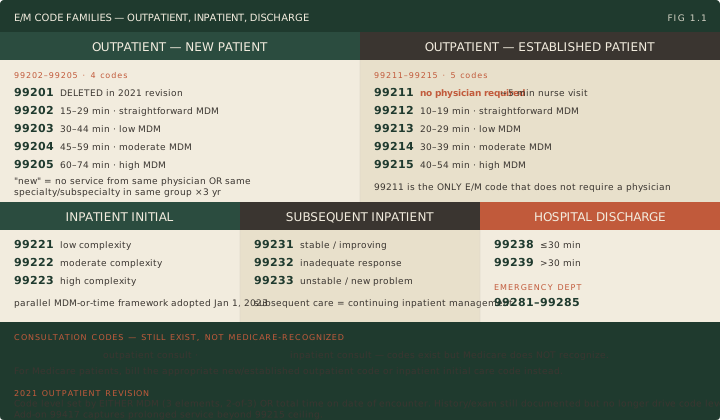
Code 99211 is the one office E/M code that does not require the physician or other qualified healthcare professional to personally perform the encounter. Clinical staff can furnish it, typically under incident-to provisions, and it is the only office E/M code with no MDM or time selection threshold. Every other office E/M code requires a physician, physician assistant (PA), or nurse practitioner (NP). Two limits on the classic examples: incident-to supervision and the rest of Medicare’s coverage conditions still apply, and a blood-pressure check or suture removal is not automatically separately payable just because it happened.
The inpatient hierarchy parallels the outpatient one. Initial hospital care is 99221-99223. Subsequent hospital care is 99231-99233. Hospital discharge splits into 99238 (30 min or less) and 99239 (over 30 min). Emergency department services are 99281-99285.
Consultation codes still exist in CPT but are no longer recognized by Medicare. Note the 2023 CPT edition deleted the lowest code in each family, so the surviving ranges are 99242-99245 (outpatient) and 99252-99255 (inpatient); 99241 and 99251 are gone. For Medicare patients, bill the appropriate new or established outpatient code or inpatient initial care code instead.
High Yield — Code families and E/M structure
- CPT (= HCPCS Level I) = what was done; ICD-10-CM = why; HCPCS Level II = equipment, supplies, transport, K-codes for wheelchairs.
- Outpatient new patient: 99202-99205 (99201 deleted). Established: 99211-99215.
- 99211 is the only office E/M code that does NOT require the physician to personally perform the encounter, and the only one with no MDM or time threshold. Incident-to supervision still applies.
- New patient definition: no qualifying face-to-face professional service from the same physician or same specialty/subspecialty in the same group within 3 years; interpretation-only work does not establish the patient.
- Inpatient initial: 99221-99223. Subsequent: 99231-99233. Discharge: 99238 (30 min or less) / 99239 (greater than 30 min).
- Consultation codes still exist in CPT (99242-99245 outpatient, 99252-99255 inpatient; 99241 and 99251 deleted in 2023) but are NOT recognized by Medicare.
Mnemonic — “New gets four, Established gets five, Eleven needs no doctor alive”
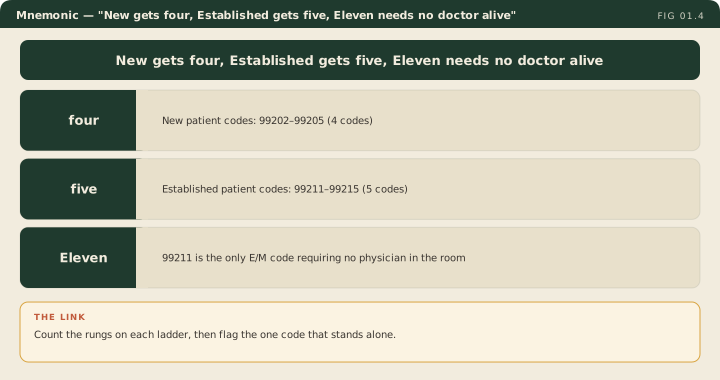
The new patient ladder has four codes (99202-99205); the established ladder has five (99211-99215). The lone code at the bottom of the established ladder, 99211, is the one where no physician needs to be in the room; supervision requirements still apply. Memorize the count and the exception, and the rest of the ladder falls into place.
A new patient is an individual who has not received any professional service from you or from another physician of the exact same specialty and subspecialty who belongs to your exact same group practice within the preceding three years.
— ADMIN-01 podcast, ~6:46