Before You Listen
Episode Setup
- Topic in one line: the central nervous system anatomy that anchors PM&R board questions, organized around one rule (the motor and sensory homunculi run with face and hand laterally on the cortex and the leg medially in the interhemispheric fissure) and the subsystems that rule explains — the cerebral cortex with its Brodmann areas and language regions; the basal ganglia with the direct and indirect pathways and three classic movement disorders; the thalamus with its board-tested relay nuclei; the brainstem with all twelve cranial nerves and the classic clinical traps; the cerebellum with its three functional zones and the rule that cerebellar signs are ipsilateral; the three spinal cord long tracts (lateral corticospinal, spinothalamic, dorsal column–medial lemniscal) and the crossing patterns that predict Brown-Séquard and anterior cord syndromes plus the clinical arm-greater-than-leg pattern that identifies central cord syndrome; the Circle of Willis with the ACA / MCA / PCA cortical territories and spinal cord vascular supply; the blood-brain barrier and the circumventricular organs that intentionally lack it; and the cerebrospinal fluid circulation pathway with the Hakim triad of normal pressure hydrocephalus.
- Prerequisites: a working sense of the cerebral hemispheres and ventricular system from medical-school neuroanatomy. Reflex root levels, ISNCSCI key muscles, dermatomes, brachial and lumbosacral plexus anatomy, and the autonomic nervous system are covered in BASIC-11 and are intentionally out of scope here.
- Runtime: approximately 56 minutes.
Vignette. A 68-year-old right-handed man arrives in the emergency department with sudden right-sided weakness and difficulty speaking. On exam, his speech is non-fluent and effortful with short telegraphic utterances, but he appears to understand simple commands and is visibly frustrated. He has a right facial droop sparing the forehead and right arm weakness greater than right leg weakness. There is no hemineglect. A non-contrast head CT shows no hemorrhage.
Which arterial territory and which Brodmann areas are most likely involved, and why does the face and arm weakness exceed the leg weakness?
(Answer at the end of this chapter)
Section 1: Cerebral Cortex — Lobes, Brodmann Areas, and Language Regions
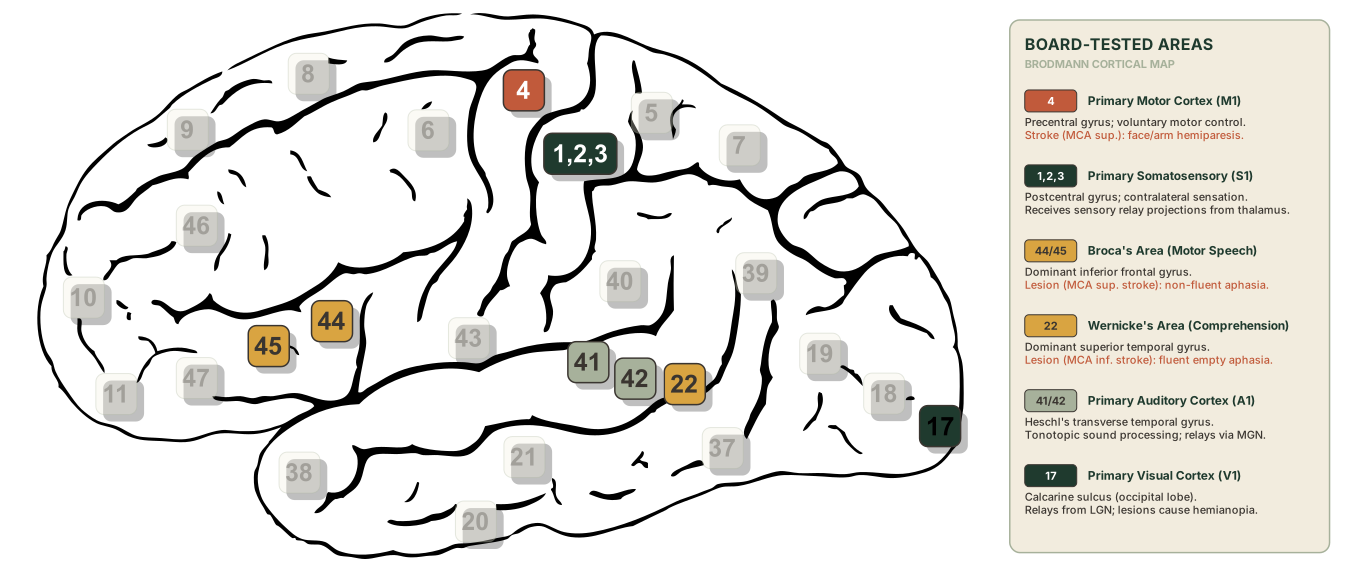
Bottom line: the cerebral cortex is divided into four lobes by three landmark sulci. The central sulcus separates frontal from parietal; the lateral (Sylvian) sulcus separates temporal from frontal and parietal above; the parieto-occipital sulcus separates parietal from occipital. The high-yield Brodmann areas distill to seven: area 4 is primary motor cortex (M1) on the precentral gyrus; areas 1, 2, 3 are primary somatosensory cortex (S1) on the postcentral gyrus; area 17 is primary visual cortex (V1) on the calcarine sulcus; areas 41, 42 are auditory cortex; primary auditory cortex (A1) is centered on area 41 in Heschl gyrus; areas 44, 45 are Broca area in the dominant inferior frontal gyrus; area 22 is Wernicke area in the dominant posterior superior temporal gyrus. The motor and sensory homunculi run with face and hand laterally on the cortex and the leg draped over the medial surface into the interhemispheric fissure — the single rule that drives every cortical stroke vignette.
The cerebral cortex is the convoluted outer mantle of gray matter that covers the cerebral hemispheres. Its surface folds into gyri, the ridges, and sulci, the grooves, an arrangement that accommodates a large cortical surface area within the cranial vault. Three landmark sulci divide each hemisphere into four lobes. The central sulcus separates the frontal lobe from the parietal lobe. The lateral or Sylvian sulcus separates the temporal lobe from the frontal and parietal lobes above. The parieto-occipital sulcus separates the parietal lobe from the occipital lobe.
The frontal lobe occupies everything anterior to the central sulcus and superior to the lateral sulcus. It contains the primary motor cortex, often called M1, which is Brodmann area 4, located on the precentral gyrus immediately anterior to the central sulcus. Anterior to M1 sit the supplementary motor area and the premotor cortex, which handle movement planning and sequencing. The frontal lobe also contains the frontal eye fields at Brodmann area 8, which control contralateral horizontal saccades; the prefrontal cortex for executive function; and Broca area at Brodmann areas 44 and 45 in the inferior frontal gyrus of the dominant hemisphere. The dominant hemisphere is the left side in approximately 95 percent of right-handed people.
The parietal lobe sits between the central sulcus and the parieto-occipital sulcus. It contains the primary somatosensory cortex, S1, at Brodmann areas 1, 2, and 3, located on the postcentral gyrus. The parietal lobe also contains the somatosensory association cortex posteriorly and the parietal association areas for spatial attention. Lesions of the non-dominant parietal lobe, typically the right side, produce hemispatial neglect of the contralateral world. Dominant parietal lesions can produce Gerstmann syndrome, which is acalculia, agraphia, finger agnosia, and left-right confusion.
The temporal lobe lies inferior to the lateral sulcus. It contains auditory cortex at Brodmann areas 41 and 42, with primary auditory cortex centered on area 41 in Heschl transverse gyrus deep within the lateral sulcus; Wernicke area at Brodmann area 22 in the posterior superior temporal gyrus of the dominant hemisphere; and the medial temporal structures, including the hippocampus for forming declarative memories and the amygdala for emotional learning.
The occipital lobe is dedicated to vision. The primary visual cortex, V1, at Brodmann area 17, lines the calcarine sulcus on the medial occipital surface. Visual association cortex at Brodmann areas 18 and 19 wraps around V1 and processes form, motion, and color.
The motor and sensory homunculi run along M1 and S1 respectively, and they share the same somatotopy: face and hand laterally, trunk and arm in the middle, leg and foot draped over the medial surface and into the interhemispheric fissure. This medial-leg arrangement is the single most useful bedside vascular localization in stroke neurology. The leg representation is supplied by the anterior cerebral artery, which runs along the medial hemisphere. The arm and face representations are supplied by the middle cerebral artery, which runs along the lateral hemisphere. As a result, anterior cerebral artery strokes produce contralateral leg weakness greater than arm weakness, while middle cerebral artery strokes produce contralateral arm and face weakness greater than leg weakness. Internalize that one rule and dozens of stroke vignettes pivot from confusing to obvious.
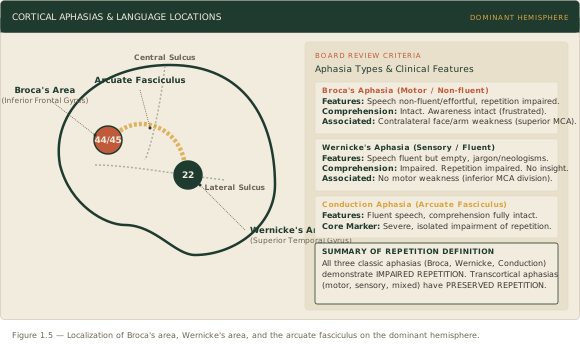
Broca aphasia results from injury to Brodmann areas 44 and 45 in the dominant inferior frontal gyrus, typically from a left middle cerebral artery superior division stroke. Speech is non-fluent and effortful, with telegraphic short utterances, agrammatism, impaired repetition, and relatively preserved comprehension. Patients are usually aware of and frustrated by their deficit. Because Broca area sits adjacent to the lateral motor cortex serving the face and hand, Broca aphasia is commonly accompanied by right facial weakness and right arm hemiparesis.
Wernicke aphasia results from injury to Brodmann area 22 in the dominant posterior superior temporal gyrus, typically from a left middle cerebral artery inferior division stroke. Speech is fluent but empty, with normal prosody and rate but paraphasic errors and made-up words. Comprehension is impaired, repetition is impaired, and patients are typically unaware of their deficit. Because Wernicke area sits below the lateral sulcus and away from the motor strip, Wernicke aphasia is often unaccompanied by hemiparesis. Repetition is typically impaired in both Broca and Wernicke aphasia. Conduction aphasia, fluent speech with preserved comprehension and disproportionately impaired repetition, localizes to the arcuate fasciculus, the white-matter tract deep to the supramarginal gyrus and insula that joins Wernicke and Broca areas; that is the board answer, and modern tractography adds that repetition also recruits the surrounding perisylvian network.
Mnemonic — Broca broken, Wernicke wordy
Broca equals broken. Telegraphic, non-fluent, frustrated, comprehension relatively preserved, Brodmann 44 and 45, often with right face and arm weakness because the superior MCA division also feeds the lateral motor strip. Wernicke equals wordy and empty. Fluent paraphasic speech, comprehension impaired, no insight, Brodmann 22, usually without hemiparesis because the inferior MCA division spares the motor strip. Both typically impair repetition; fluent speech with preserved comprehension and disproportionately impaired repetition is conduction aphasia, which localizes to the arcuate fasciculus.
High Yield — Cortical map and language
- Three sulci, four lobes. Central sulcus = frontal/parietal; lateral (Sylvian) sulcus = temporal/frontal-parietal; parieto-occipital sulcus = parietal/occipital.
- Seven board-tested Brodmann areas. 4 = M1 (precentral gyrus); 1, 2, 3 = S1 (postcentral gyrus); 17 = V1 (calcarine sulcus); 41, 42 = auditory cortex; A1 centered on 41 (Heschl gyrus); 44, 45 = Broca (dominant inferior frontal); 22 = Wernicke (dominant posterior superior temporal).
- Homunculus rule. Face and hand laterally (MCA territory); leg medially in the interhemispheric fissure (ACA territory).
- Dominant hemisphere = left in ~95 percent of right-handers.
- Non-dominant parietal lesion → contralateral hemispatial neglect. Dominant parietal lesion → Gerstmann syndrome (acalculia, agraphia, finger agnosia, left-right confusion).
- Broca aphasia: non-fluent, comprehension relatively preserved, often with right face/arm weakness, left superior-division MCA stroke. Wernicke aphasia: fluent paraphasic, comprehension impaired, no insight, often without hemiparesis, left inferior-division MCA stroke. Both typically impair repetition.
To repeat a phrase, you have to hear and comprehend it in Wernicke’s area. Send that signal to Broca’s area and then speak it.
— BASIC-01 podcast, ~10:00