Before You Listen
Episode Setup
- Topic in one line: the architecture of normal walking — the gait cycle (60 percent stance and 40 percent swing per cycle, from one initial contact to the next initial contact of the same foot), the eight Rancho Los Amigos subphases (initial contact, loading response, mid-stance, terminal stance, pre-swing in stance; initial swing, mid-swing, terminal swing in swing) with their older synonymous traditional terms (heel strike, foot flat, mid-stance, heel off, toe off, acceleration, mid-swing, deceleration), double limb support (20 percent of the cycle total, decreasing with speed and replaced by a float phase in running), the muscular choreography of gait built around concentric (accelerator) and eccentric (brake) contractions, the three rockers of stance phase (heel, ankle, and forefoot rockers), the ground reaction force (GRF) vector and its relationship to joint moments, the standard quantitative parameters (cadence 110-120 steps per minute, walking velocity 1.2-1.4 m/s, stride length 1.4-1.6 m, step length 0.7-0.8 m, step width 7-9 cm, toe-out angle ~7 degrees), the Saunders six determinants of gait that reduce vertical center-of-mass excursion from 10 cm to 5 cm, the major pathological gait patterns (Trendelenburg, gluteus maximus, steppage, antalgic, circumduction, vaulting, quadriceps avoidance, scissoring, waddling, ataxic, Parkinsonian), and the energy cost of normal walking (~12 mL O2/kg/min), which rises predictably with amputation level and with stroke.
- Prerequisites: familiarity with lower extremity anatomy (hip, knee, ankle, foot), the major lower extremity muscles, the cardinal planes of motion, and the concept of eccentric versus concentric muscle contractions.
- Runtime: 57 minutes.
Vignette. A 56-year-old man presents 3 months after an L4-L5 disc herniation with right ankle dorsiflexor weakness. He reports that his right foot “slaps” when it hits the ground, and he must lift his right knee higher than his left to clear the foot during swing. Manual muscle testing shows tibialis anterior strength of 2 out of 5 on the right with normal strength elsewhere. Observational gait analysis confirms an audible foot slap at right initial contact, increased right hip and knee flexion during right swing phase, and shortened right stance time.
Which Rancho Los Amigos subphase deficits explain the foot slap and the increased hip and knee flexion, which of the three rockers is lost, and what is the named gait pattern?
(Answer at the end of this chapter)
Section 1: The Gait Cycle and the Eight Rancho Los Amigos Subphases
Bottom line: one gait cycle (one stride) extends from initial contact of one foot to the next initial contact of the same foot, divided into stance phase (60 percent of the cycle, foot on the ground) and swing phase (40 percent, foot in the air); the cycle is subdivided into eight Rancho Los Amigos subphases, five in stance (initial contact at 0 percent, loading response 0-10 percent, mid-stance 10-30 percent, terminal stance 30-50 percent, pre-swing 50-60 percent) and three in swing (initial swing 60-73 percent, mid-swing 73-87 percent, terminal swing 87-100 percent), and the older traditional terminology (heel strike, foot flat, mid-stance, heel off, toe off, acceleration, mid-swing, deceleration) is used interchangeably on the boards.
The gait cycle is defined as the period from initial contact of one foot to the next initial contact of the same foot. One complete gait cycle equals one stride. The cycle divides into two major phases: stance phase, approximately 60 percent of the cycle during which the foot is in contact with the ground and the limb bears the body’s weight, and swing phase, approximately 40 percent of the cycle during which the foot is off the ground and the limb advances forward in preparation for the next step. These percentages, 60 percent stance and 40 percent swing, are among the most frequently tested numbers in all of gait analysis. If a board question asks how much of the cycle is spent in stance, the answer is 60 percent. They describe comfortable adult walking: stance shrinks and swing grows as speed rises, and the split shifts again with age and pathology.
The cycle is further subdivided into eight subphases: five in stance and three in swing. Modern Rancho Los Amigos terminology, developed at the Rancho Los Amigos National Rehabilitation Center, has replaced older traditional terms. Both naming systems appear on board examinations, so both must be known cold.
Initial contact (traditional: heel strike) occurs at 0 percent of the gait cycle. This is the moment the foot first touches the ground. In normal gait, the heel contacts the ground first. The ankle is in neutral dorsiflexion, the knee is in full extension or very slight flexion, and the hip is in approximately 30 degrees of flexion.
Loading response (traditional: foot flat) spans 0 to approximately 10 percent of the gait cycle. This is the period of initial double limb support. Body weight transfers onto the stance limb. The foot progresses from heel contact to full ground contact as the ankle plantarflexes in a controlled manner. The knee flexes approximately 15 degrees for shock absorption — hold onto that 15 degrees, because it returns twice more in this chapter, once as an eccentric quadriceps job and once as one of the six Saunders determinants of gait.
Mid-stance spans approximately 10 to 30 percent of the gait cycle. This is the first period of single limb support. The entire body weight is supported by the stance limb while the opposite limb swings forward. The body’s center of gravity passes directly over the supporting foot. The ankle progresses from plantarflexion to neutral as the tibia advances over the stationary foot. The knee extends from its initial loading response flexion. The hip extends toward neutral.
Terminal stance (traditional: heel off) spans approximately 30 to 50 percent of the gait cycle. The heel rises off the ground as the body advances forward over the forefoot. The ankle moves into dorsiflexion as the tibia continues to advance, and then the heel lifts as the gastrocnemius-soleus complex generates the push-off force. The knee is in full extension. The hip extends to approximately 10 to 20 degrees past neutral, reaching maximum hip extension for the entire cycle.
Pre-swing (traditional: toe off) spans approximately 50 to 60 percent of the gait cycle. This is the second period of double limb support. The opposite foot has now contacted the ground for its initial contact, and both feet are on the ground simultaneously. The stance limb rapidly unloads. The ankle plantarflexes rapidly as the toes push off. The knee begins rapid flexion. The hip begins flexion. Pre-swing ends when the toes leave the ground, marking the transition from stance to swing.
Initial swing (traditional: acceleration) spans 60 to approximately 73 percent of the gait cycle. The foot clears the ground and the limb begins to swing forward. The ankle dorsiflexes to clear the foot. The knee flexes to approximately 60 degrees, the peak knee flexion of the entire gait cycle. The hip flexes to advance the limb. Mid-swing spans approximately 73 to 87 percent. The swinging limb passes directly beneath the body. The ankle maintains dorsiflexion for foot clearance, the knee extends from peak flexion, and the hip continues flexion. Terminal swing (traditional: deceleration) spans approximately 87 to 100 percent. The limb decelerates in preparation for ground contact. The ankle holds neutral dorsiflexion, the knee reaches full extension, the hip sits at approximately 30 degrees of flexion, and the hamstrings contract eccentrically to decelerate the forward-swinging leg and prevent knee hyperextension.
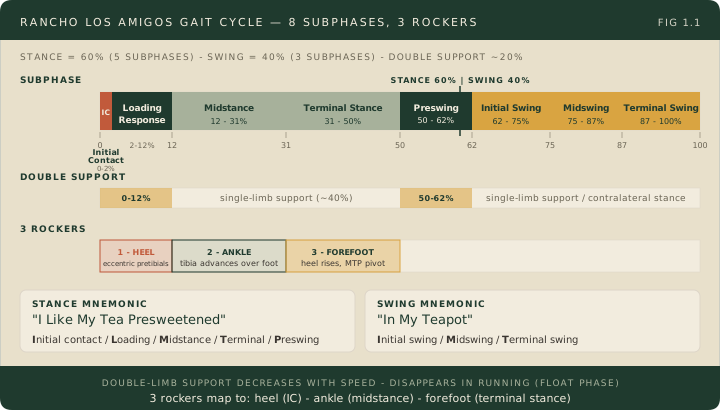
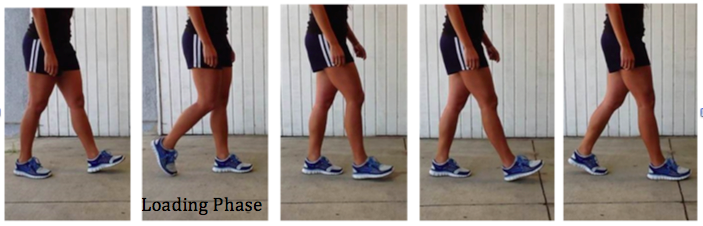
Double limb support is the period when both feet are simultaneously in contact with the ground. It occurs twice during each gait cycle: once during loading response at the beginning of stance, and once during pre-swing at the end of stance. Each period of double limb support lasts approximately 10 percent of the gait cycle, for a total of approximately 20 percent. Single limb support therefore accounts for the remaining 80 percent of the cycle, split as 40 percent on the left and 40 percent on the right, and corresponds to the swing phase of the opposite limb.
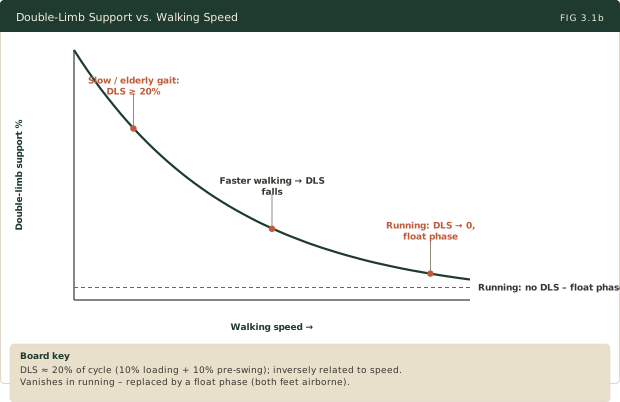
The relationship between double limb support and walking speed is a critical board concept. As walking speed increases, double limb support decreases. As walking speed decreases, double limb support increases. In running, double limb support disappears entirely and is replaced by a float phase, a period when neither foot is on the ground. The presence of a float phase is what distinguishes running from walking. The two also invert mechanically: in walking the center of mass is highest near mid-stance, while in running it is lowest near mid-stance and rises through the flight phase. Running stance takes up a smaller fraction of the cycle than swing, and the exact proportions move with speed rather than sitting at a fixed 40/60. In elderly or pathological gait, walking speed typically decreases and double limb support increases as a stability strategy. The central nervous system is essentially saying it does not trust its balance during single limb support, so it maximizes the percentage of the cycle with two contact points on the floor.
High Yield — Gait cycle and subphases
- Stance equals 60 percent of the cycle; swing equals 40 percent.
- Five stance subphases: initial contact (0 percent), loading response (0-10 percent), mid-stance (10-30 percent), terminal stance (30-50 percent), pre-swing (50-60 percent).
- Three swing subphases: initial swing (60-73 percent), mid-swing (73-87 percent), terminal swing (87-100 percent).
- Traditional terms (synonymous): heel strike, foot flat, mid-stance, heel off, toe off, acceleration, mid-swing, deceleration.
- Double limb support: 20 percent total (10 percent at loading response plus 10 percent at pre-swing); decreases with faster walking, absent in running (replaced by float phase).
- Peak knee flexion of approximately 60 degrees occurs at initial swing.
- Maximum hip extension of 10 to 20 degrees past neutral occurs at terminal stance.