Before You Listen
Episode Setup
- Topic in one line: the pharmacology spine of ABPMR Part 1 — the three opioid receptors (mu, kappa, delta) and the equianalgesic conversion table anchored on 30 milligrams of oral morphine, the 3-to-1 oral-to-intravenous morphine ratio, the 25-to-50 percent dose reduction applied during opioid rotation for incomplete cross-tolerance with methadone and transdermal fentanyl as the two protocol exceptions, the 50 morphine milligram equivalent per day reassessment point and risk-factor-driven naloxone (the old 90 per day ceiling having been dropped in 2022), methadone’s non-linear 4-to-1 up to 20-to-1 conversion ratio with N-methyl-D-aspartate (NMDA) receptor activity and an 8-to-59 hour half-life, tramadol’s dual mu-agonist plus serotonin-norepinephrine reuptake inhibitor mechanism with the serotonin syndrome and seizure-threshold traps, the gabapentinoid alpha-2-delta calcium channel mechanism with gabapentin’s saturable absorption versus pregabalin’s linear kinetics, tricyclic antidepressants (amitriptyline, nortriptyline, desipramine) with their anticholinergic-antihistaminic-alpha-1-sodium-channel burden, duloxetine’s pain indications and off-label venlafaxine pain use, topical lidocaine and capsaicin, the cyclooxygenase-1 versus cyclooxygenase-2 split with COX-1 protecting gastric mucosa and renal afferent dilation and platelet thromboxane A2 and COX-2 driving inflammation and endothelial prostacyclin, the celecoxib cardiovascular paradox, aspirin’s irreversible COX-1 acetylation with a 7-to-10-day platelet pool turnover and an approximately 4-day perioperative recovery interval, clopidogrel’s irreversible P2Y12 receptor blockade, acetaminophen’s central cyclooxygenase inhibition with a 3-to-4-gram daily ceiling and N-acetyl-p-benzoquinone imine (NAPQI) hepatotoxicity, the anticoagulant cascade (warfarin, unfractionated and low-molecular-weight heparin, direct oral anticoagulants) with the specific reversal-agent matches (idarucizumab for dabigatran; andexanet alfa for apixaban and rivaroxaban, never edoxaban, with US sales ended in December 2025), venous thromboembolism prophylaxis by rehabilitation population, the traumatic brain injury (TBI) neuropsychiatric kit anchored by amantadine and the Giacino et al. 2012 New England Journal of Medicine trial, the particulate versus non-particulate corticosteroid distinction for cervical transforaminal injections and the local anesthetic amide-versus-ester rule, bone-health agents (bisphosphonates, denosumab, teriparatide) with the drug-holiday logic, the four oral spasticity agents (baclofen, tizanidine, dantrolene, diazepam) plus intrathecal baclofen pump physiology and chemical neurolysis, and the four pillars of bioethics framing informed consent and advance directives.
- Prerequisites: comfort with absorption-distribution-metabolism-excretion (ADME), first-pass hepatic metabolism, half-life and steady state, cytochrome P450 (CYP450) inducer/inhibitor pairings and narrow-therapeutic-index drugs, basic receptor pharmacology, the difference between competitive and irreversible enzyme inhibition, the international normalized ratio (INR) for warfarin monitoring, the Modified Ashworth Scale and the upper-motor-neuron versus lower-motor-neuron distinction, and the standard PM&R approach to acute and chronic pain.
- Runtime: 40 minutes.
Vignette. A 62-year-old man with severe chronic low back pain from multilevel lumbar stenosis is taking morphine extended-release 100 milligrams orally every twelve hours (total 200 oral morphine milligram equivalents per day) plus oxycodone 10 milligrams orally every four hours as needed for breakthrough pain. He has poor pain control and developed myoclonic jerks at the higher end of his dosing. The team decides to rotate him to methadone for a unique receptor profile that may help his neuropathic component. The covering physician calculates the conversion using a standard 4-to-1 ratio, prescribes 50 milligrams of methadone daily, and the patient is found unresponsive with pinpoint pupils and a respiratory rate of 6 on hospital day 2.
Why did the standard 4-to-1 conversion ratio overdose this patient, what is the correct equianalgesic logic for methadone rotation at his daily oral morphine milligram equivalent dose, what additional pharmacokinetic property of methadone explains why the respiratory depression worsened on day 2 rather than appearing immediately, and what dose-reduction safety margin should have been applied during the rotation?
(Answer at the end of this chapter)
Section 1: Opioid Receptors, the Equianalgesic Map, and the Rotation Rule
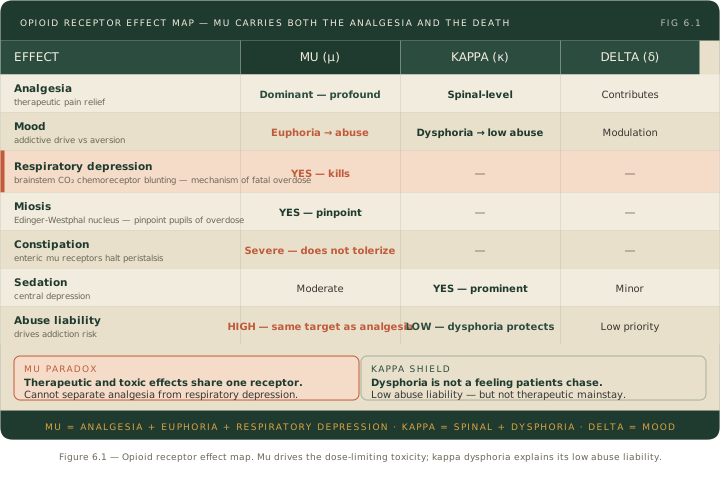
Bottom line: opioids act through three G-protein-coupled receptors, mu, kappa, and delta. The mu receptor does almost all the clinical work: profound analgesia bundled with euphoria (driven by mesolimbic dopamine release), respiratory depression through brainstem suppression of the carbon-dioxide chemoreceptor response, miosis through the Edinger-Westphal nucleus, severe constipation through enteric mu receptors that halt peristalsis, and physical dependence. Kappa activation produces spinal-level analgesia along with sedation and dysphoria, not euphoria, which is why kappa agonists have little abuse potential. Delta contributes to analgesia and mood modulation but is a distant third. The conventional single-dose equianalgesic table is anchored on 30 milligrams of oral morphine, which equals 10 mg of IV morphine (the 3-to-1 oral-to-IV ratio from first-pass hepatic metabolism), 6 to 7.5 mg of oral hydromorphone (7.5 mg on the conventional 4-to-1 table, 6 mg on the 5-to-1 convention), 1.5 mg of IV hydromorphone, and 20 mg of oral oxycodone. That table is a rotation aid, and the CDC morphine milligram equivalent (MME) factors are a separate risk-assessment framework; do not calculate a rotation with them. On rotation, cut the calculated equianalgesic dose by 25 to 50 percent for incomplete cross-tolerance, then titrate to response. Methadone and transdermal fentanyl are the two exceptions, each with its own conversion protocol. Offer naloxone to any patient with an overdose risk factor, including a total daily dose at or above 50 MME.
Opioids are the foundational analgesic class for moderate-to-severe pain, and PM&R residents need both the receptor map and the conversion math cold. Three receptor subtypes carry the analgesic and adverse-effect signal: mu, kappa, and delta.
All three are G-protein-coupled receptors. When an opioid binds, it closes voltage-gated calcium channels on the presynaptic terminal (reducing release of pain neurotransmitters such as substance P and glutamate) and opens potassium channels on the postsynaptic membrane, hyperpolarizing the receiving neuron and silencing the nociceptive signal. Transmission is shut down at two levels at once.
The mu receptor is the dominant analgesic target and is responsible for essentially everything people fear about opioids. Mu activation produces profound analgesia, euphoria (the addictive drive, mediated by mesolimbic dopamine release), respiratory depression, miosis, constipation, and physical dependence. The respiratory depression is the mechanism of fatal overdose: mu receptors in the brainstem medulla blunt the carbon-dioxide chemoreceptor response, so the brain stops sensing rising carbon dioxide and forgets to trigger the next breath. Miosis acts through a different brainstem nucleus, the Edinger-Westphal nucleus, and explains the pinpoint pupils of opioid overdose. Constipation is driven by a dense population of mu receptors in the enteric nervous system that bring peristalsis to a near-halt, which is why bowel regimens are non-negotiable on chronic opioids. The therapeutic and toxic effects share the same receptor, which is why the analgesic dose cannot be cleanly separated from the dose that depresses breathing — the entire reason opioid stewardship exists.
The kappa receptor produces analgesia (largely at the spinal cord level) plus sedation and the classic dysphoria of kappa agonism — a state of unease, dissatisfaction, and sometimes hallucinations, not the euphoria of mu. Because dysphoria is not a feeling patients want to repeat, kappa agonists have very low abuse liability. The delta receptor contributes to analgesia and mood modulation and is a third-tier board focus behind mu and kappa. On this exam, any opioid adverse effect should map straight back to mu.
Equianalgesic dosing — the universal map. Oral morphine is the reference standard, and everything is pinned to a single anchor. 30 milligrams of oral morphine is approximately equivalent to 10 milligrams of intravenous morphine — the 3-to-1 oral-to-IV ratio, driven entirely by first-pass hepatic metabolism, which drops oral morphine bioavailability to roughly 25 to 30 percent. Hydromorphone is approximately four to five times more potent than morphine on a milligram basis, and the published tables sit at different points inside that band, which is the single most common source of confusion here. The conventional single-dose teaching table uses 4-to-1 and gives 7.5 milligrams of oral hydromorphone for the 30-milligram anchor; a widely used 5-to-1 convention gives 6 milligrams, and the National Cancer Institute’s opioid tables publish the oral hydromorphone equivalent as a range of 6 to 7.5 milligrams rather than a single number. Both endpoints are defensible published values and neither is an error, so learn the band and the anchor rather than one memorized digit, and name the table you are working from whenever you convert. Oxycodone is approximately 1.5 times more potent than oral morphine, so 20 milligrams of oral oxycodone equals 30 milligrams of oral morphine. Fentanyl operates on a completely different scale because it is highly lipophilic and crosses the blood-brain barrier rapidly; a 25 microgram per hour transdermal fentanyl patch delivers approximately the equivalent of 60 milligrams of oral morphine per day, one of the most tested single facts in this chapter.
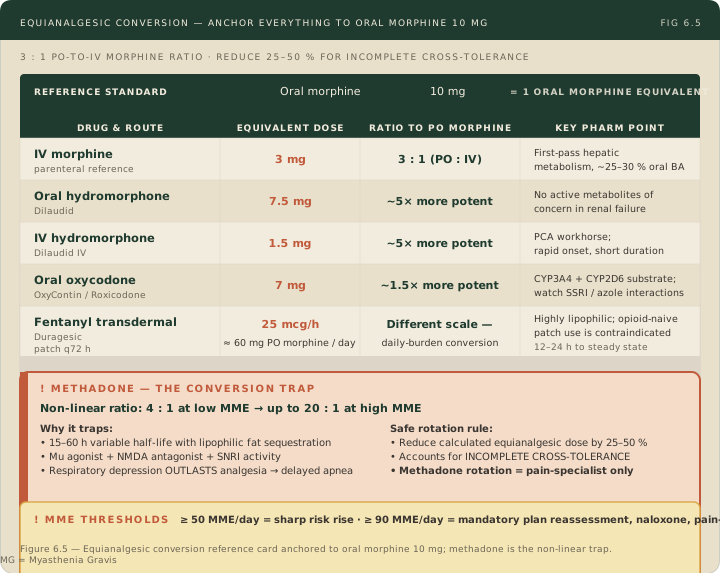
The 25-to-50 percent rotation rule. When you rotate from one opioid to another, calculate the equianalgesic dose, reduce it by 25 to 50 percent, and only then titrate back up to clinical response. That reduction exists because of incomplete cross-tolerance: the patient is fully tolerant to the old drug but only partly tolerant to the new one. Methadone and transdermal fentanyl are the two exceptions. Each has its own conversion protocol, and those protocols already build in their own conservatism, so applying the generic 25 to 50 percent cut on top of one double-counts the reduction.
A separate and more dangerous form of tolerance loss happens with time off the drug, not with a change of drug. Tolerance to respiratory depression is lost within roughly one to two weeks of abstinence, and it is lost faster than tolerance to analgesia. A patient who has been off their opioid for two or three weeks — an interruption in a prescription, an inpatient stay, incarceration, or a period of withdrawal — is no longer tolerant to the dose they were previously stable on. Restarting that dose can be fatal.
The vignette shape is consistent: a patient on a high stable dose for months stops for a few weeks, goes through withdrawal, restarts their usual dose, and is found unresponsive. Restart at a substantially reduced dose and re-titrate, exactly as if the patient were opioid-naive. This is the same physiology behind the well-documented overdose spike after release from incarceration or discharge from detoxification, and it is why naloxone co-prescription matters most at re-initiation. Although every opioid acts at the mu receptor, the three-dimensional binding profile differs slightly between agents; a patient fully tolerant to the old drug is not fully tolerant to the new one, and the new agent hits with greater effect than the equianalgesic math predicts. Skipping that safety margin is how a routine rotation becomes an overdose.
Morphine milligram equivalents (MME) express total daily opioid burden as a single number comparable across drugs. Before going to 50 MME per day or more, the 2022 CDC guideline asks for a deliberate reassessment of benefit against risk, and above that exposure it asks for closer follow-up and overdose-prevention education for the patient and the household. Naloxone co-prescription is risk-factor driven rather than dose-gated: offer it to any patient on opioids who carries prior overdose, substance use disorder, sleep-disordered breathing, concurrent benzodiazepine use, loss of tolerance during a taper or an interruption, or a total daily dose at or above 50 MME. The older 90 MME per day hard ceiling was dropped by the 2022 guideline in favour of individualized judgment, so an answer option that makes 90 MME the naloxone trigger is quoting a superseded number, and neither number licenses an abrupt taper. One more separation to hold: the CDC MME factors are a risk-assessment tool and not a rotation table. Its oral hydromorphone factor of 5 is a different quantity from the 6 to 7.5 mg equianalgesic band above, and mixing the two will produce a dangerous dose.
Mnemonic — “Anchor at thirty, drop by half”
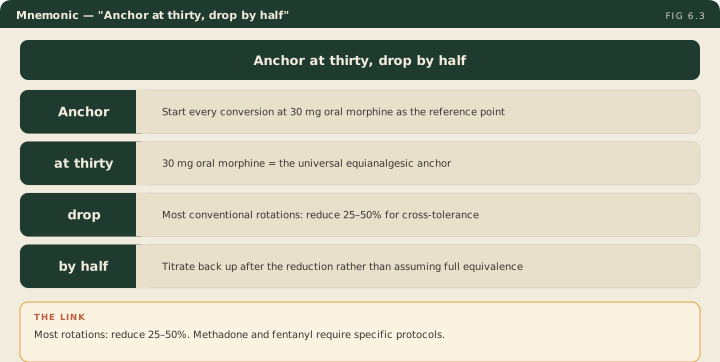
Every conversion table anchors on 30 milligrams of oral morphine. From the anchor: oral-to-IV morphine, divide by 3, giving IV morphine 10 mg; oral morphine to oral hydromorphone, divide by 4 on the conventional single-dose table, giving 7.5 mg (a 5-to-1 table gives 6 mg, and the published band is 6 to 7.5 mg), and to IV hydromorphone 1.5 mg; oral morphine to oral oxycodone, divide by 1.5, giving 20 mg. A fentanyl patch at 25 micrograms per hour corresponds to about 60 MME per day for comparing exposure, but starting a patch requires the manufacturer’s conversion instructions and an already opioid-tolerant patient. Then drop by 25 to 50 percent for cross-tolerance and titrate up, with methadone and transdermal fentanyl going to their own protocols instead.
High Yield — Opioid receptors and the equianalgesic map
- Opioid receptors: mu drives analgesia, euphoria (mesolimbic dopamine), respiratory depression, miosis, constipation, and dependence; kappa adds spinal analgesia plus dysphoria and sedation; delta is minor.
- Equianalgesic anchors (all against oral morphine 30 mg): IV morphine 10 mg (3-to-1 oral-to-IV); oral hydromorphone 6 to 7.5 mg (7.5 mg on the conventional 4-to-1 single-dose table, 6 mg on the 5-to-1 convention, and 6 to 7.5 mg as the published range); oral oxycodone 20 mg; fentanyl patch 25 micrograms per hour = oral morphine 60 mg per day.
- Rotation rule: reduce the calculated equianalgesic dose by 25 to 50 percent for incomplete cross-tolerance, then titrate to response. Methadone and transdermal fentanyl use their own protocols.
- MME thresholds: reassess benefit versus risk before going to 50 per day or more, and add closer follow-up above it. Naloxone attaches to risk factors, not to a dose ceiling; the 2022 guideline dropped the old 90-per-day ceiling. CDC MME factors are for risk assessment, not for calculating a rotation.
So you’re basically starving the synapse of neurotransmitters on one side and numbing the receiving neuron on the other.
— BASIC-06 podcast, ~5:34