Before You Listen
Episode Setup
- Topic in one line: the molecular, cortical, and prescriptive foundation of central nervous system (CNS) recovery: Hebbian learning, the N-methyl-D-aspartate (NMDA) receptor as a molecular coincidence detector, long-term potentiation (LTP) and long-term depression (LTD), the three patterns of cortical reorganization (perilesional, contralesional, unmasking), diaschisis, the three phases of recovery and the 3-to-6-month critical period, learned non-use, the Kleim and Jones ten principles of experience-dependent plasticity, constraint-induced movement therapy (CIMT) and the EXCITE trial, the rest of the plasticity-driving toolkit, the pharmacology that enhances recovery (amantadine, methylphenidate, modafinil) versus the pharmacology that impairs it (benzodiazepines, typical antipsychotics, chronic phenytoin), motor learning principles, mirror therapy, and the maladaptive plasticity that drives phantom limb pain, central neuropathic pain, and spasticity.
- Prerequisites: familiarity with stroke and traumatic brain injury (TBI) recovery curves, the corticospinal tract and the major motor cortex maps, glutamatergic synaptic transmission, the role of dopamine in motivation and reward, the Brunnstrom stages of motor recovery, and the Modified Ashworth Scale.
- Runtime: 1 hour 12 minutes.
Vignette. A 58-year-old right-handed woman is 6 weeks out from a left middle cerebral artery (MCA) ischemic stroke that left her with right hemiparesis. She has 15 degrees of active wrist extension, 25 degrees of active finger extension, and Modified Ashworth Scale 1+ in the wrist flexors. She is independent with bed mobility and stand-pivot transfers. Her speech is fluent. She is highly motivated and has good family support. Her prior medications include lisinopril, atorvastatin, aspirin, and clopidogrel. The inpatient rehabilitation team is considering constraint-induced movement therapy (CIMT), debating how aggressively to push session intensity given her exhaustion at the end of each day, and discussing whether a benzodiazepine should be added for situational anxiety and whether a selective serotonin reuptake inhibitor (SSRI) is indicated to enhance her recovery.
Does she meet the upper extremity criteria for CIMT, what is the standard CIMT protocol, why is the 6-week mark a window the team should not squander, why are benzodiazepines specifically problematic during that window, what does the most recent evidence (FLAME versus FOCUS, AFFINITY, and EFFECTS) say about prescribing fluoxetine for motor recovery alone, what can experimental and observed repetition counts tell us about rehabilitation dosing, and what is the cellular mechanism that connects the patient’s daily practice to a physically larger cortical hand map?
(Answer at the end of this chapter)
Section 1: Hebbian Learning, the NMDA Coincidence Detector, and the Rehabilitation Dose Gap
Bottom line: Hebb’s 1949 principle (paraphrased as “neurons that fire together wire together”) is the cellular substrate for motor learning and recovery. Long-term potentiation (LTP) is the canonical mechanism: the NMDA receptor acts as a molecular coincidence detector that requires both glutamate binding and post-synaptic depolarization to relieve a magnesium block, allowing calcium influx that activates intracellular kinases and inserts AMPA receptors into the post-synaptic membrane. Long-term depression (LTD) is the inverse low-frequency process that weakens unused synapses and physically shrinks unused cortical maps. The animal protocols that drove cortical reorganization used 400 to 600 movements per day, while Lang observed about 32 functional upper-limb movements per conventional session. That practice-dose gap is why intensive protocols raise the dose deliberately.
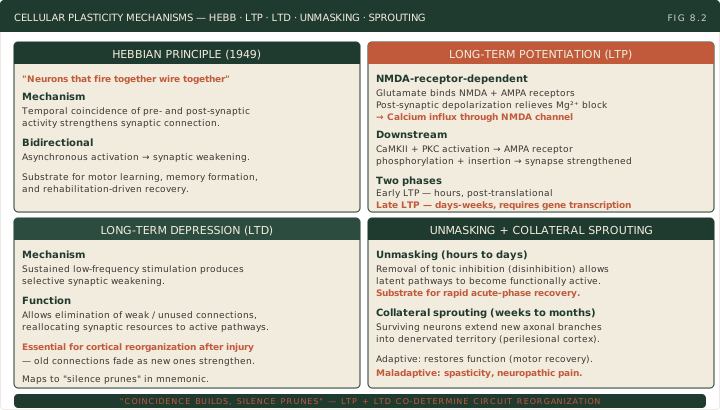
Donald Hebb proposed in 1949 that when a presynaptic neuron repeatedly and persistently takes part in firing a postsynaptic neuron, a physical metabolic change occurs that increases the efficiency of their connection. The popular paraphrase, “neurons that fire together wire together,” understates the requirement: Hebb’s rule demands strict temporal coincidence and massive repetition, not just activity in the same hour but firing repeatedly in the same millisecond window.
The cellular mechanism is long-term potentiation (LTP), the persistent strengthening of synaptic transmission following correlated activity. It was first described in the hippocampus by Bliss and Lomo (1973) and is now recognized as the canonical substrate of learning and memory throughout the cortex.
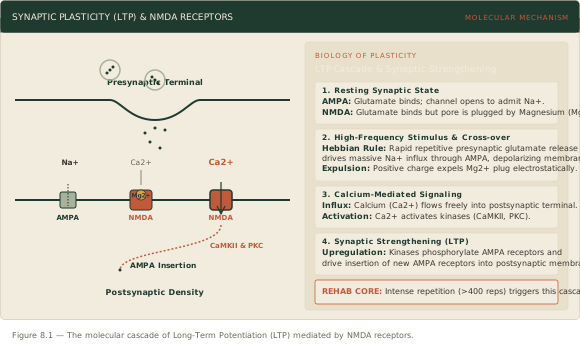
The molecular machinery centers on the N-methyl-D-aspartate (NMDA) receptor, a glutamate-gated ion channel that sits on the postsynaptic membrane and functions as a chemical coincidence detector. The NMDA receptor is an “and-gate” requiring two simultaneous events to open. Glycine or D-serine must also occupy the co-agonist site. With that requirement satisfied, first the presynaptic neuron must release glutamate, which binds to the receptor. Second, the postsynaptic membrane must be sufficiently depolarized. Glutamate binding alone does nothing, because at resting membrane potential the NMDA channel pore is physically plugged by a magnesium ion.
The mechanism for the second event is elegant. Released glutamate also binds the simpler alpha-amino-3-hydroxy-5-methyl-4-isoxazolepropionic acid (AMPA) receptor, a straightforward ligand-gated cation channel permeable to sodium and potassium (and, in GluA2-lacking receptors, to calcium). When glutamate binds, AMPA receptors open and sodium rushes in, depolarizing the postsynaptic cell. If enough adjacent synapses fire together, the depolarization is sufficient to physically repel the positively charged magnesium ion out of the NMDA pore. The molecular and-gate has been satisfied: glutamate is bound and the cell is depolarized.
What follows is the actual substrate of learning. With the magnesium plug ejected, calcium flows through the NMDA channel into the postsynaptic neuron. Calcium binds calmodulin and activates intracellular kinases including calcium-calmodulin-dependent protein kinase II (CaMKII) and protein kinase C (PKC). These kinases phosphorylate existing AMPA receptors, increasing their conductance, and trigger the physical insertion of additional AMPA receptors into the postsynaptic membrane. The next time glutamate is released, more receptors are waiting to catch it. The synapse has been persistently upgraded.
LTP has two phases. Early LTP lasts hours and depends on post-translational modification of existing proteins. Late LTP lasts days to weeks and requires new gene transcription and protein synthesis; late LTP is the substrate for long-term memory and permanent motor learning, not a transient improvement within a single session.
Neuroplasticity is bidirectional. Long-term depression (LTD) is the persistent weakening of synaptic transmission caused by low-frequency, asynchronous, or poorly correlated activity. Without the high-frequency calcium surge that drives LTP, the postsynaptic calcium signal sits in a lower range that activates phosphatases instead of kinases. AMPA receptors are dephosphorylated, internalized, and removed. A cortical map representing a limb that has not been used for weeks does not just sit dormant. It physically shrinks.
The animal training protocols that drove measurable cortical reorganization used 400 to 600 movements per day. Lang and colleagues (2009) observed 312 rehabilitation sessions at seven sites: functional upper-limb practice occurred in 51 percent of sessions and averaged 32 movements per session (95 percent confidence interval, 20 to 44). That is the practice-dose gap, and it is the reason intensive protocols such as CIMT shaping raise the dose deliberately: observed movement counts are the clinical dose, and the calcium signaling of the LTP cascade is the mechanism that dose engages. Choose meaningful, challenging practice and measure function and tolerability as well as repetitions.
High Yield — Hebbian learning and cellular plasticity
- Hebb (1949): temporal coincidence of presynaptic and postsynaptic activity strengthens synapses; “neurons that fire together wire together.”
- NMDA receptor = molecular coincidence detector (“and-gate”): glutamate binding plus postsynaptic depolarization required; depolarization (driven by AMPA-receptor sodium influx) electrostatically expels the magnesium plug.
- LTP cascade: calcium flows through open NMDA channel, activates calmodulin, CaMKII and PKC, phosphorylates and inserts AMPA receptors, synapse strengthened. First described in hippocampus by Bliss and Lomo (1973).
- Early LTP: hours, post-translational. Late LTP: days to weeks, requires new gene transcription and protein synthesis.
- LTD: low-frequency activity, low-amplitude calcium, phosphatases, AMPA receptor removal, synaptic weakening and pruning.
- The dose gap: the animal protocols that drove cortical reorganization used 400 to 600 movements per day; Lang (2009) observed a mean of 32 functional upper-limb movements per conventional session, which is why intensive protocols raise the dose deliberately.
Mnemonic — “Two keys, calcium, build”
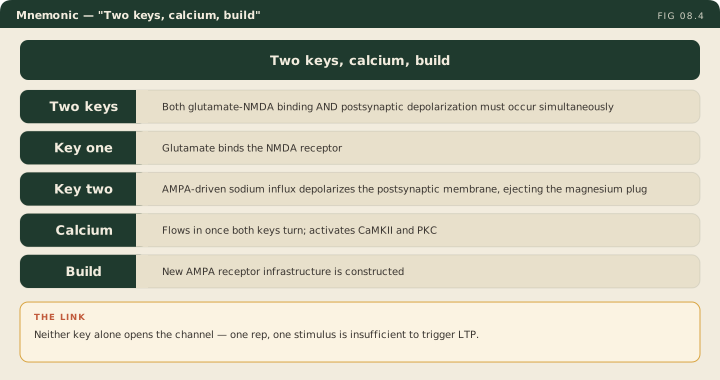
LTP is a two-key nuclear launch system. Key one is glutamate binding the NMDA receptor. Key two is postsynaptic depolarization, driven by AMPA sodium influx, that ejects the magnesium plug. Only when both keys turn simultaneously does calcium flow in, activate CaMKII and PKC, and build new AMPA infrastructure. This mnemonic assumes glycine or D-serine co-agonist availability; the practice dose is what turns both keys again and again.
Glutamate alone accomplishes absolutely nothing at the NMDA receptor when the cell is sitting at its resting membrane potential.
— BASIC-08 podcast, ~4:19