Before You Listen
Episode Setup
- Topic in one line: the neuromuscular junction (NMJ) physiology that underlies every electrodiagnostic and pharmacologic question about myasthenia gravis (MG), Lambert-Eaton myasthenic syndrome (LEMS), botulism, and congenital myasthenic syndromes (CMS) — acetylcholine (ACh) synthesis from choline and acetyl coenzyme A by choline acetyltransferase (ChAT), vesicular packaging by the vesicular ACh transporter (VAChT), P/Q-type voltage-gated calcium channel triggered exocytosis through the SNARE complex (synaptobrevin/VAMP, SNAP-25, syntaxin), clearance of the cleft by acetylcholinesterase (AChE), the pentameric nicotinic ACh receptor (nAChR) with its adult versus fetal subunit composition, the safety factor concept that explains why decremental and incremental responses appear the way they do on repetitive nerve stimulation (RNS) and why single-fiber EMG (SFEMG) jitter is the most sensitive test, the depolarizing and nondepolarizing neuromuscular blocking agents (NMBAs) and their reversal, and the therapeutic use of botulinum toxin in PM&R.
- Prerequisites: comfort with action potential generation and propagation, voltage-gated ion channels, vesicular neurotransmitter release at central synapses, the standard electrodiagnostic terminology of EDX-13 (compound muscle action potential (CMAP), repetitive nerve stimulation (RNS), single-fiber EMG (SFEMG)), and the cross-cutting pharmacology framework of BASIC-06 (cholinesterase inhibitors, depolarizing versus nondepolarizing block).
- Runtime: 1 hour 3 minutes.
Vignette. A 38-year-old woman presents with 3 months of progressive fatigable weakness, beginning with intermittent diplopia and ptosis worse at the end of the day, now with proximal limb weakness and difficulty climbing stairs. On examination, ptosis worsens with sustained upward gaze and improves after a brief ice pack is applied to the closed lid. Repetitive nerve stimulation at 3 Hz of the spinal accessory nerve recording over the trapezius produces a 22 percent decrement in CMAP amplitude between the first and fifth response. Single-fiber EMG of the orbicularis oculi shows increased jitter and intermittent blocking. Acetylcholine receptor antibodies are positive at high titer. Computed tomography of the chest shows a 4 cm anterior mediastinal mass.
What is the diagnosis, what is the molecular target and synaptic location of the autoantibody (presynaptic vs postsynaptic), what is the safety factor concept and how does it explain why the decrement appears between the first and fifth stimulation rather than from baseline alone, what does single-fiber EMG measure with the term “jitter,” what does the chest mass likely represent and how does its management affect the disease course, and how would the electrodiagnostic and clinical pattern differ if she had Lambert-Eaton myasthenic syndrome (LEMS) instead?
(Answer at the end of this chapter)
Section 1: Acetylcholine Synthesis, Quantal Packaging, and Calcium-Triggered Release
Bottom line: the NMJ is a three-zone chemical synapse (presynaptic motor terminal, synaptic cleft, postsynaptic motor end plate). ACh is built from choline (imported by the rate-limiting high-affinity choline uptake transporter) and acetyl coenzyme A (locally produced by mitochondria) under choline acetyltransferase (ChAT), then packaged by the vesicular ACh transporter (VAChT) into vesicles at a quantal load of approximately 5,000-10,000 molecules each. When an action potential reaches the terminal, P/Q-type voltage-gated calcium channels open at the active zone, calcium binds synaptotagmin on the vesicle, and the SNARE complex (synaptobrevin/VAMP on the vesicle plus SNAP-25 and syntaxin on the plasma membrane) zippers tight, fusing the vesicle and releasing approximately 100-200 quanta into the cleft. Acetylcholinesterase, anchored in the cleft by a collagen tail (COLQ), hydrolyzes ACh within milliseconds, and the same high-affinity transporter recycles the choline back into the terminal.
The neuromuscular junction (NMJ) is a specialized chemical synapse between a motor axon and a skeletal muscle fiber. It has three zones. The presynaptic motor axon terminal holds the synthesis, storage, and release machinery. The synaptic cleft is a 50-100 nm gap whose basal lamina anchors acetylcholinesterase (AChE). The postsynaptic motor end plate is a folded specialization of the muscle membrane: nicotinic ACh receptors (nAChRs) cluster at the crests of the junctional folds, while voltage-gated sodium channels concentrate at the depths to amplify the depolarization once the threshold is reached. Active zones on the presynaptic membrane sit directly across from the densest postsynaptic receptor patches, so released ACh has only a microscopic distance to travel to find its target.
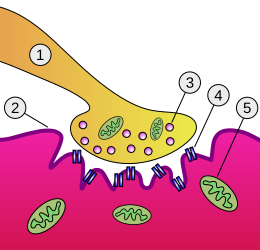
Source: Base diagram: Mrmw (vectorisation), “Neuromuscular junction detailed view”, via Wikimedia Commons, CC BY-SA 4.0. https://commons.wikimedia.org/wiki/File:Neuromuscular_junction_detailed_view.svg Key panel added by Reflex — derivative shared under CC BY-SA 4.0.
Acetylcholine synthesis. Two precursors feed the line: choline and acetyl coenzyme A (acetyl-CoA). Acetyl-CoA is produced locally by the dense population of mitochondria in the nerve terminal through normal oxidative metabolism, and the supply is essentially unlimited. Choline is the constrained substrate. The nerve terminal cannot synthesize choline itself; it must scavenge it from the extracellular fluid using a dedicated active-transport pump called the high-affinity choline uptake transporter (ChT/CHT1). Because that transporter is the only entry point, choline import is the rate-limiting step in ACh synthesis. The biological logic is regulatory: by gating the whole line at the front door, the body prevents runaway overproduction of the transmitter. Once choline is inside, the cytoplasmic enzyme choline acetyltransferase (ChAT) combines choline and acetyl-CoA to produce ACh.
Vesicular packaging. Free ACh in the cytoplasm is useless. It must be loaded into synaptic vesicles for triggered release. That job belongs to the vesicular acetylcholine transporter (VAChT), which uses a proton gradient (generated by a vesicular V-type ATPase) to pump ACh into the vesicle lumen. The packaging is rigidly standardized: every vesicle ends up holding approximately 5,000 to 10,000 ACh molecules, the unit called a quantum. Standardization matters. If vesicles held random amounts, the muscle could not interpret an incoming signal; a weak depolarization could mean a barely firing nerve or a half-empty container. By fixing the quantum, the system makes the math of transmission predictable.
Calcium-triggered exocytosis. Loaded vesicles migrate to the active zones at the very edge of the terminal, pointing across the cleft at the receptor patches. When an action potential travels down the motor axon and arrives at the terminal, it depolarizes the membrane and opens P/Q-type voltage-gated calcium channels. The letter matters: the heart uses L-type channels, and central synapses use a mix, but the motor terminal at the NMJ relies almost exclusively on P/Q-type channels, which is exactly why autoantibodies against this channel produce LEMS. Calcium pours in down its concentration gradient and floods the microdomain around the active zone.
The fusion machinery is the SNARE complex, a molecular winch built from three proteins. Synaptobrevin (also called vesicle-associated membrane protein, VAMP) is embedded in the vesicle membrane and is therefore a v-SNARE. SNAP-25 (synaptosomal-associated protein 25) and syntaxin sit on the plasma membrane and are t-SNAREs. The vesicle also carries the calcium sensor synaptotagmin. A vesicle is a lipid bubble resting against a plasma membrane that is also a sheet of lipids, and because both carry the same negative charge they naturally repel each other. When calcium binds synaptotagmin, the SNARE proteins twist around each other into a tight coiled-coil that physically pulls the two membranes together, overcoming that repulsion and ripping a fusion pore through which the entire quantum of ACh explodes into the cleft. At a healthy NMJ, a single nerve action potential triggers the synchronized fusion of approximately 100-200 vesicles, the parameter called quantal content.
Clearing the cleft. Acetylcholinesterase (AChE) is anchored to the basal lamina in the synaptic cleft by a collagen tail (the COLQ protein) and hydrolyzes ACh to choline plus acetate within milliseconds of release. The hydrolysis terminates the end-plate signal, resets the receptor for the next impulse, and keeps the synapse temporally precise. The choline product is recovered by the high-affinity choline transporter on the presynaptic terminal and re-incorporated into new ACh by ChAT — a closed recycling loop. Block the enzyme and ACh action in the cleft is prolonged, boosting the end-plate signal: that is exactly what the reversible cholinesterase inhibitors pyridostigmine, neostigmine, and edrophonium do. It is the basis of pyridostigmine as first-line symptomatic treatment in MG and of neostigmine as a reversal agent for nondepolarizing neuromuscular block (given with glycopyrrolate or atropine to suppress muscarinic side effects).
High Yield — NMJ anatomy, ACh release, and cleft clearance
- Three NMJ zones: presynaptic terminal, synaptic cleft (AChE anchored to basal lamina), postsynaptic motor end plate (junctional folds with nAChRs at crests, sodium channels at depths).
- ACh synthesis: choline plus acetyl-CoA combined by choline acetyltransferase (ChAT); high-affinity choline uptake transporter is rate-limiting.
- ACh storage: vesicles loaded by VAChT (proton-gradient driven); each vesicle holds approximately 5,000-10,000 ACh molecules = one quantum.
- Trigger: action potential opens P/Q-type voltage-gated calcium channels at the active zone (target of LEMS antibodies).
- Fusion: calcium binds synaptotagmin, then the SNARE complex (synaptobrevin/VAMP on the vesicle plus SNAP-25 and syntaxin on the plasma membrane) zippers and fuses the vesicle.
- Quantal content: approximately 100-200 vesicles released per nerve action potential at a healthy NMJ.
- Termination: AChE, anchored by the COLQ collagen tail, hydrolyzes ACh in milliseconds; choline is recycled by the high-affinity transporter. Pyridostigmine, neostigmine, edrophonium reversibly inhibit AChE and prolong ACh action.
Mnemonic — “ChAT makes it, VAChT packs it, P/Q calcium triggers SNARE to release it”
The presynaptic supply chain has four named steps. ChAT builds ACh from choline and acetyl-CoA. VAChT packs ACh into vesicles in 5,000-10,000 molecule quanta. The action potential opens P/Q-type calcium channels, calcium binds synaptotagmin, and the SNARE complex (synaptobrevin plus SNAP-25 plus syntaxin) fuses the vesicle. AChE then clears the cleft. Disrupt any step and the disorders fall out: a ChAT mutation produces a congenital myasthenic syndrome; P/Q calcium channel autoantibodies produce LEMS; botulinum toxin cleaves SNARE proteins and produces botulism; a COLQ mutation strands AChE out of the cleft.
By removing the ability to make choline, the body turns that external pump, the high affinity choline uptake transporter, into the strict rate limiting step for the entire synthesis pathway.
— BASIC-10 podcast, ~5:41