Before You Listen
Episode Setup
- Topic in one line: the macroscopic organization of the spinal cord, cranial nerves, and peripheral nervous system (PNS) including reflex root levels (biceps C5-C6 musculocutaneous, brachioradialis C5-C6 radial, triceps C7 radial, patellar L3-L4 femoral, Achilles S1-S2 tibial, bulbocavernosus S2-S4 pudendal), the ten ISNCSCI key muscles, sensory dermatome landmarks (C6 thumb, C7 middle finger, C8 little finger, T4 nipple, T6 xiphoid, T10 umbilicus, T12 inguinal ligament, L4 medial malleolus, L5 dorsum third MTP, S1 lateral heel), the twelve cranial nerves with high-yield clinical traps (CN I post-traumatic anosmia, CN IV longest dorsal exit, CN VI false-localizing ICP sign, CN VII typical cortical forehead sparing vs whole-face LMN-pattern weakness; forehead involvement does not exclude stroke, CN X uvula AWAY, CN XI sternocleidomastoid (SCM) contralateral head turn, CN XII tongue TOWARD lesion), the brachial plexus with the “Robert Taylor Drinks Cold Beer” organization and Erb-Duchenne vs Klumpke syndromes, the lumbosacral plexus with femoral, obturator, superior and inferior gluteal, sciatic, and pudendal nerves, the autonomic nervous system (sympathetic T1-L2 thoracolumbar vs parasympathetic craniosacral CN III/VII/IX/X plus S2-S4), Horner syndrome, the major spinal cord long tracts (lateral corticospinal, spinothalamic, dorsal column-medial lemniscal (DCML)), and the spinal cord vascular supply with the artery of Adamkiewicz and anterior spinal artery syndrome.
- Prerequisites: the brain neuroanatomy content covered in BASIC-01 (cortex, basal ganglia, thalamus, brainstem cranial nerve nuclei, cerebellum, vascular supply, BBB, CSF); basic familiarity with the gross divisions of the spinal cord (cervical, thoracic, lumbar, sacral) and the difference between upper and lower motor neuron signs.
- Runtime: 47 minutes.
Vignette. A 24-year-old man is admitted after a penetrating back injury sustained in a motorcycle collision, with MRI localizing damage to the right hemicord at the T6 spinal cord segment. On examination he has 2/5 strength in the right lower extremity with brisk right-sided reflexes below T6. Vibration and joint position sense are absent in the right great toe but normal on the left. Pinprick and temperature sensation are diminished on the left side of the body beginning at approximately the T8 dermatome and extending down through the left leg; pinprick is intact on the right. Deep anal pressure is preserved, establishing sacral sensory sparing. The bulbocavernosus reflex is present.
Name this incomplete spinal cord syndrome, explain each finding using the crossing pattern of the involved tract, and state why the presence of the bulbocavernosus reflex is clinically important.
(Answer at the end of this chapter)
Section 1: Reflex Root Levels and ISNCSCI Key Muscles
Bottom line: every board examination tests the reflex root levels and the ten ISNCSCI key muscles cold. The high-yield reflex list is biceps (C5-C6, musculocutaneous nerve), brachioradialis (C5-C6, radial nerve), triceps (C7, radial nerve), finger flexor / Hoffman sign (C8-T1, median), patellar (L3-L4, femoral), Achilles (S1-S2, tibial), bulbocavernosus (S2-S4, pudendal — traditional marker of the end of spinal shock), anal wink (S2-S4, pudendal), cremasteric (L1-L2, genitofemoral), and superficial abdominal (T8-T12). The ten ISNCSCI key muscles map one-to-one to motor levels: C5 elbow flexion (biceps/brachialis, musculocutaneous), C6 wrist extension (ECRL/ECRB, radial), C7 elbow extension (triceps, radial), C8 finger flexion (FDP to middle finger, median/AIN), T1 small finger abduction (ADM, ulnar), L2 hip flexion (iliopsoas: iliacus via femoral; psoas via direct lumbar ventral branches), L3 knee extension (quadriceps, femoral), L4 ankle dorsiflexion (tibialis anterior, deep peroneal), L5 long toe extension (EHL, deep peroneal), and S1 ankle plantarflexion (gastroc/soleus, tibial).
The myotatic (deep tendon) reflexes are the bedside backbone of every spinal cord injury (SCI) and radiculopathy exam, and the board expects rapid root-level recall. Biceps reflex is C5 and C6 through the musculocutaneous nerve. Brachioradialis reflex is also C5 and C6, with an additional C7 contribution, but through the radial nerve; because brachioradialis draws on C7 as well as C5-C6, an absent biceps reflex with a preserved brachioradialis reflex points toward a musculocutaneous nerve or C5-predominant lesion, and strength, sensory distribution, and electrodiagnostic testing confirm the level. Triceps reflex is C7 through the radial nerve. C7 is the cervical root most commonly involved in cervical radiculopathy, which makes the triceps reflex a high-yield component of the radiculopathy exam. The finger flexor reflex / Hoffman sign is C8 through T1; a positive Hoffman (involuntary thumb and index flexion when the distal phalanx of the middle finger is flicked) signals upper motor neuron pathology when unilateral or asymmetric.
In the lower extremity, the patellar reflex (knee jerk) is L3 and L4 through the femoral nerve, and the Achilles reflex (ankle jerk) is S1 and S2 through the tibial nerve. The Achilles reflex is the most commonly lost reflex in S1 radiculopathy from an L5-S1 disc herniation.
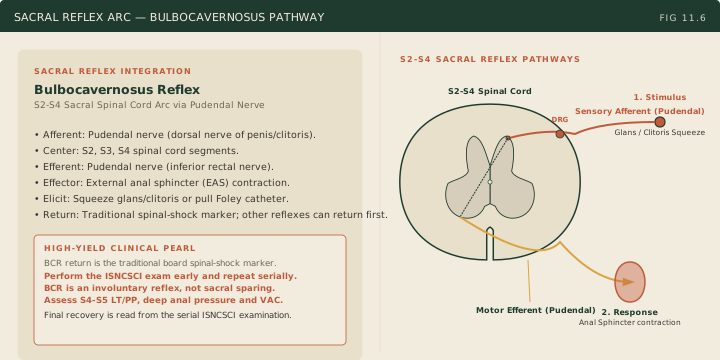
Two sacral reflexes are board-mandatory. The bulbocavernosus reflex (squeeze the glans or clitoris and watch for anal sphincter contraction) and the anal wink (stroke the perianal skin and watch for sphincter contraction) are both S2 through S4 via the pudendal nerve. Return of the bulbocavernosus reflex is the traditional board marker for the end of spinal shock. Other reflexes, such as the delayed plantar response, can return before it. A present reflex establishes an intact sacral reflex arc; the permanent deficit is read from the serial ISNCSCI examination, and sacral sparing is tested directly. The cremasteric reflex (stroke the medial thigh and watch for ipsilateral testicular elevation) is L1 and L2 through the genitofemoral nerve. The superficial abdominal reflexes span T8 through T12 (upper abdominals T8-T10, lower T10-T12); loss can be an early sign of upper motor neuron lesion in multiple sclerosis (MS).
The International Standards for Neurological Classification of Spinal Cord Injury (ISNCSCI) defines ten key muscles — five upper extremity (UE), five lower extremity (LE) — used to assign the motor level in SCI. Every muscle is required board content along with its peripheral nerve. In the UE: C5 elbow flexion (biceps/brachialis, musculocutaneous nerve); C6 wrist extension (extensor carpi radialis longus and brevis, ECRL/ECRB, radial nerve); C7 elbow extension (triceps, radial nerve); C8 finger flexion of the distal phalanx of the middle finger (flexor digitorum profundus, FDP, anterior interosseous branch of median nerve); T1 small finger abduction (abductor digiti minimi, ADM, ulnar nerve). In the LE: L2 hip flexion (iliopsoas: iliacus via femoral nerve; psoas via direct lumbar ventral branches); L3 knee extension (quadriceps femoris, femoral nerve); L4 ankle dorsiflexion (tibialis anterior, deep peroneal nerve); L5 long toe extension (extensor hallucis longus, EHL, deep peroneal nerve); S1 ankle plantarflexion (gastrocnemius and soleus, tibial nerve).
Determine the motor level separately on each side: the most caudal key muscle graded at least 3/5, with all key muscles represented by more rostral segments graded 5/5. In regions without a testable key muscle (C1-C4, T2-L1, S2-S5), infer the motor level from the sensory level when testable motor function above is normal. For example, normal C5 elbow flexion and C6 wrist extension, absent C7 elbow extension, and normal rostral sensory function establish a C6 motor level on that side.
High Yield — Reflexes and ISNCSCI key muscles
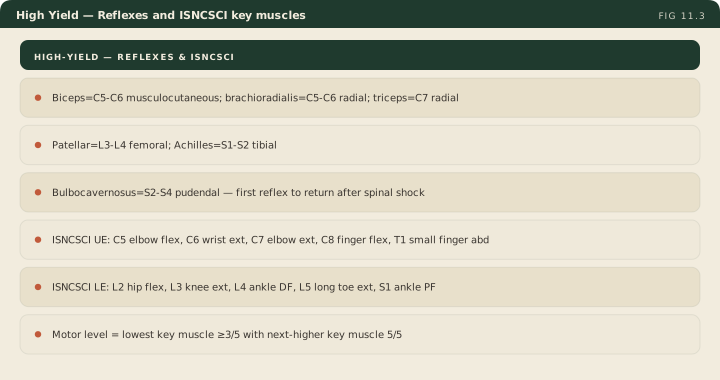
- Biceps = C5-C6 musculocutaneous; brachioradialis = C5-C6 radial; triceps = C7 radial.
- Patellar = L3-L4 femoral; Achilles = S1-S2 tibial.
- Bulbocavernosus = S2-S4 pudendal — traditional marker of the end of spinal shock.
- ISNCSCI UE: C5 elbow flex (musculocutaneous), C6 wrist ext (radial), C7 elbow ext (radial), C8 finger flex (median/AIN), T1 small finger abd (ulnar).
- ISNCSCI LE: L2 hip flex (iliacus: femoral; psoas: lumbar ventral branches), L3 knee ext (femoral), L4 ankle DF (deep peroneal), L5 long toe ext (deep peroneal), S1 ankle PF (tibial).
- Motor level = most caudal key muscle ≥ 3/5 with all rostral key muscles 5/5; determine each side separately.
Mnemonic — “Bulbo back” as the traditional spinal-shock marker
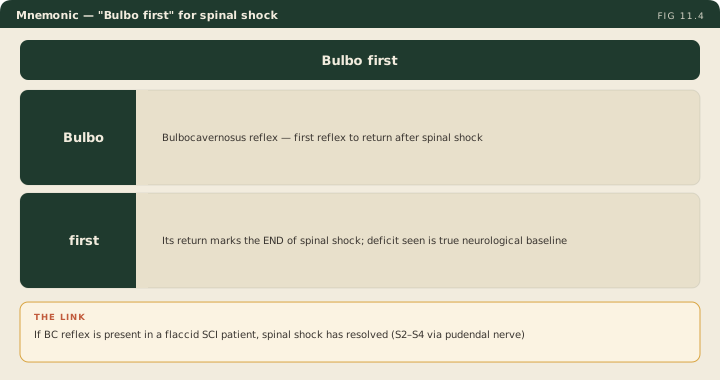
The bulbocavernosus reflex, mediated by S2 through S4 via the pudendal nerve, is the traditional board marker for the end of spinal shock. Other reflexes can return before it. Perform and document the neurological examination early, then repeat it serially: the final neurological outcome is read from the serial ISNCSCI examination, and sacral sparing is tested directly.
Because of the specific anatomy of the descending nerve roots in the lumbar canal, a posterolateral herniation at the L5 to S1 disc level typically impinges the traversing S1 root. And that causes a classic S1 radiculopathy.
— BASIC-11 podcast, ~6:06