Before You Listen
- Prerequisites: alteplase eligibility windows and dosing from CVA-02; mechanical thrombectomy criteria including the DAWN and DEFUSE 3 trials; basic vascular anatomy of the middle cerebral artery (MCA) and the lenticulostriate territory; the difference between cytotoxic and vasogenic edema.
- Runtime: 1 hour 6 minutes.
- Topic in one line: hemorrhage-first CT; DWI/ADC and DWI–FLAIR interpretation; core/penumbra selection; reperfusion-specific BP targets; titratable IV antihypertensives; post-alteplase aspirin timing; short-course DAPT; AF anticoagulation; and safe early rehabilitation.
Vignette. A 68-year-old right-handed man with poorly controlled hypertension and atrial fibrillation is brought to the emergency department 90 minutes after sudden right-sided weakness and expressive aphasia. His blood pressure on arrival is 198/108. Non-contrast head CT shows no hemorrhage, with subtle loss of the left insular ribbon. CT perfusion shows a 12 mL ischemic core in the left lentiform nucleus and a 95 mL penumbra spanning the left MCA territory with delayed time-to-maximum and preserved cerebral blood volume. National Institutes of Health Stroke Scale (NIHSS) is 14. He has not received any reperfusion therapy yet, and the team is preparing intravenous alteplase.
What is his core-penumbra status, what blood pressure threshold must be reached before alteplase, what intravenous antihypertensive is preferred and which is generally avoided, when can aspirin be started after alteplase, and when can full-dose anticoagulation for atrial fibrillation be safely resumed?
(Answer at the end of this chapter)
Section 1: Non-Contrast CT, DWI/ADC, and the WAKE-UP Mismatch
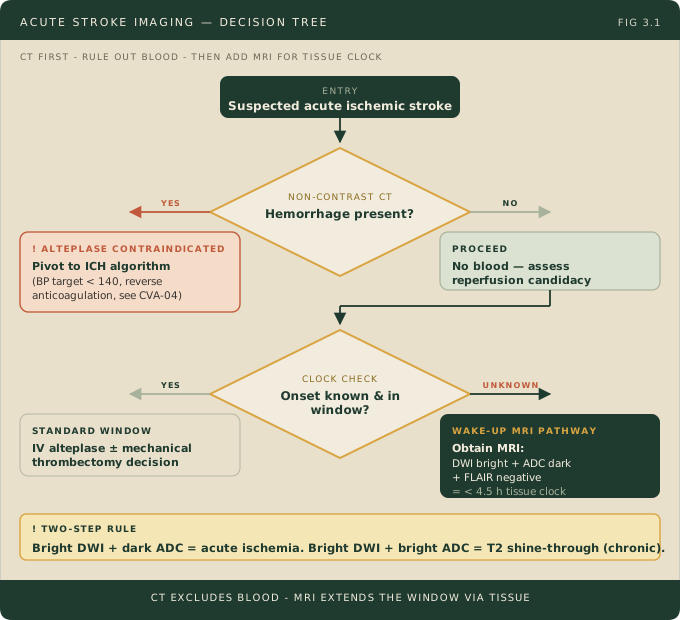
Bottom line: non-contrast CT first excludes hemorrhage and assesses ischemic extent, and established ischemic hypodensity usually takes 24 to 48 hours to appear on it. DWI can turn positive within 3 to 30 minutes; bright DWI plus dark ADC supports acute infarction in the appropriate clinical setting. DWI–FLAIR mismatch points to onset under 4.5 hours and can help select eligible unknown-onset patients for thrombolysis; sensitivity and specificity are imperfect, so it is selection evidence rather than a timestamp.
The non-contrast head CT is usually the first imaging study in suspected acute stroke. Its immediate priority is excluding intracranial hemorrhage, which precludes IV alteplase for the presenting event. CT also evaluates early ischemic change, extensive established injury, mass effect and alternative diagnoses. Established hypodensity from acute ischemia usually takes 24 to 48 hours to appear, so a normal early scan does not exclude ischemic stroke, and absence of hemorrhage alone does not establish reperfusion eligibility. Acute blood usually appears hyperdense.
When subtle early ischemic changes are present on non-contrast CT, an experienced reader can sometimes identify them. Loss of gray-white matter differentiation occurs because cytotoxic edema in the cortex blurs the normally distinct boundary between gray and white matter, classically appearing in the insular cortex as the insular ribbon sign or along the lateral margin of the lentiform nucleus. Sulcal effacement reflects swollen tissue compressing the cerebrospinal-fluid-filled sulci. The hyperdense MCA sign is a bright dense focus within the middle cerebral artery itself, representing acute thrombus packed with red cells and fibrin within the vessel lumen. The presence of these signs supports the clinical diagnosis, but their absence does not change the algorithm. The CT was obtained to rule out blood, and if blood is absent, the team proceeds to determine reperfusion candidacy.
Magnetic resonance imaging (MRI) with diffusion-weighted imaging (DWI) is far more sensitive to early ischemia than CT and can turn positive within 3 to 30 minutes of symptom onset. The mechanism is the cellular link boards test directly: when a neuron becomes ischemic the sodium-potassium ATPase pump fails, sodium and water pour into the cell, and cytotoxic edema swells it. Water that normally diffuses freely through the extracellular space is now trapped inside the swollen cell, and DWI is tuned to detect exactly that restricted motion, which is why the lesion lights up bright. Sensitivity in the first minutes is not perfect, so a negative early study does not exclude stroke.
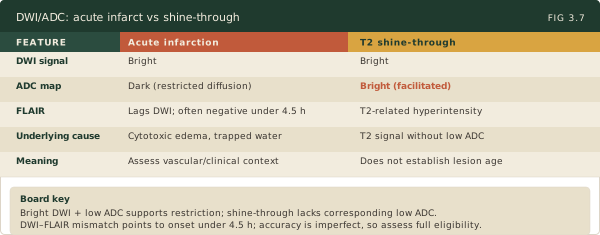
A bright DWI signal alone does not establish acute infarction, and this is where the ADC map earns its place. DWI sequences sit on top of T2-weighted contrast, so any fluid-filled lesion that is bright on the underlying T2 can shine through into the DWI image and read as a false positive. That artifact is T2 shine-through. The apparent diffusion coefficient (ADC) map removes the T2 contribution mathematically and displays diffusion alone. True restricted diffusion is dark on ADC, so the conventional acute vascular pattern is bright DWI plus dark ADC, while shine-through is bright on both. Read the pattern with the symptoms, the lesion distribution and the other sequences: shine-through tells you there is no true restriction, not that the lesion is old or that nothing urgent is happening.
The DWI–FLAIR mismatch means a DWI lesion without corresponding marked FLAIR hyperintensity. FLAIR suppresses free cerebrospinal fluid signal and picks up tissue water that accumulates extracellularly as the blood-brain barrier breaks down, and that breakdown takes hours: cytokines, vascular endothelial growth factor and matrix metalloproteinases have to degrade the endothelial tight junctions first. DWI lights up in minutes; FLAIR lags. So a bright DWI lesion with a still-dark FLAIR points to a stroke under 4.5 hours old, which is the tissue clock WAKE-UP used to select patients with unknown onset for IV alteplase. The finding is not governed by an exact switch and its sensitivity and specificity for that window are imperfect, so apply the complete clinical and imaging eligibility criteria rather than reading the mismatch as a timestamp.
High Yield — Imaging in the First Hour
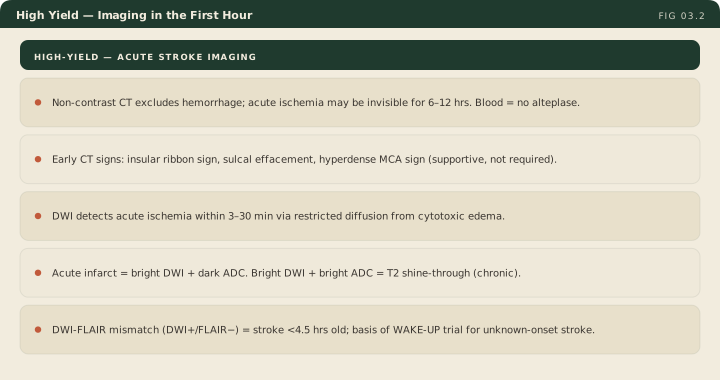
- CT first excludes hemorrhage and assesses ischemic extent; established ischemic hypodensity usually takes 24 to 48 hours to appear, so a normal early scan does not exclude stroke.
- Subtle early CT signs: insular ribbon sign, sulcal effacement, hyperdense MCA sign (supportive but not required).
- CT hypodensity from acute ischemia is usually established by 24 to 48 hours; subtle early ischemic signs can appear sooner.
- DWI can turn positive within 3 to 30 minutes, detecting water trapped by cytotoxic edema; sensitivity is not perfect.
- Bright DWI + dark ADC supports acute infarction in a vascular context; T2 shine-through lacks corresponding low ADC.
- DWI–FLAIR mismatch (positive DWI, negative FLAIR) points to onset under 4.5 hours; WAKE-UP used it with full eligibility criteria, not as an exact clock.
A mismatch between a positive DWI and a negative FLAIR indicates that the patient qualifies for intravenous alteplase, regardless of what the clock on the wall says or what time they went to sleep. You are treating the tissue timeline.
— CVA-03 podcast, ~17:04
Wallenberg syndrome is a lateral medullary infarction, usually due to an occlusion of the posterior inferior cerebellar artery or the vertebral artery. The corticospinal tract runs medially in the brainstem. So because the lesion is lateral and the motor tract is medial, the weakness is spared.
— CVA-03 podcast, ~8:32
If you are evaluating a patient with profound language deficits and unilateral weakness, you are in the hemisphere, likely the MCA. If you see crossed findings or a complex constellation of neurological deficits with preserved motor strength, your localization must shift down to the brainstem.
— CVA-03 podcast, ~8:48