Before You Listen
- Prerequisites: the Monro-Kellie doctrine and basic intracranial pressure (ICP) physiology; vascular anatomy of the lenticulostriate, thalamoperforating, and posterior cerebral artery branches; the inverted blood pressure logic from CVA-03 (permissive hypertension in ischemic stroke); the four direct oral anticoagulants (DOACs) and warfarin from CVA-03.
- Runtime: 59 minutes.
- Topic in one line: the disproportionate mortality of intracerebral hemorrhage (ICH) with 32 to 52% 30-day mortality (half of the deaths within 48 hours), the deep-vs-lobar location-to-etiology rule (deep suggests hypertensive small-vessel disease; lobar in the elderly suggests cerebral amyloid angiopathy [CAA] by Boston v2.0 criteria; lobar or deep in the young without hypertension raises a vascular malformation), the four classic syndromes (putaminal contralateral hemiplegia, thalamic eyes-down-and-in with hydrocephalus, cerebellar surgical emergency on deterioration, brainstem compression, hydrocephalus or volume ≥15 mL, pontine pinpoint reactive pupils with quadriplegia), the ICH Score and its original-cohort mortality rates, the ABC/2 volume calculation, the spot sign predictor of hematoma expansion, the INTERACT-2 and ATACH-2 blood-pressure trials read against the dated 2022 and 2025 guideline targets, the warfarin/dabigatran/factor-Xa reversal trio (four-factor PCC plus vitamin K, idarucizumab, and the andexanet alfa withdrawal from the US market), the PATCH harm signal against platelet transfusion in medically managed antiplatelet-associated ICH, and the ENRICH trial for selected early minimally invasive lobar evacuation.
Vignette. A 72-year-old woman with poorly controlled hypertension is brought to the emergency department after collapsing at dinner. She is now obtunded with a Glasgow Coma Scale (GCS) of 9, dense left hemiplegia, and a blood pressure of 218/118. Non-contrast head CT shows a 38 mL right putaminal hemorrhage extending into the lateral ventricle with 4 mm of midline shift. CT angiography shows a single small focus of contrast extravasation within the hematoma. She takes apixaban for atrial fibrillation. Her husband reports she has been on a stable warfarin-equivalent regimen for years and that she has never had a prior stroke.
Calculate her ICH Score and predicted 30-day mortality, name the radiographic predictor of hematoma expansion seen on her CT angiography, state the systolic blood pressure target and how the trial evidence and the dated guidelines differ, name the current US reversal approach for her anticoagulant, and explain why platelet transfusion would be the wrong move if she were on aspirin instead.
(Answer at the end of this chapter)
Section 1: Epidemiology, the 48-Hour Cliff, and the Self-Fulfilling Prophecy
Bottom line: intracerebral hemorrhage (ICH) is 10 to 15% of all strokes in US-anchored teaching, a range that contains the 10% US surveillance figure CVA-02 gives and sits well below the roughly 28.8% global share, but carries 32 to 52% 30-day mortality (3 to 4 times deadlier than ischemic stroke), with half of the deaths, not half of all admissions, occurring in the first 48 hours; a 2007 AHA statement put functional independence at 6 months at about 20% of all ICH patients, a dated cohort figure rather than a current individual probability; absent previously documented treatment limitations, give aggressive care and defer new DNAR or withdrawal decisions until at least the second full hospital day, because premature withdrawal of care is itself a mechanism of mortality, DNAR limits resuscitation and not other treatment, and the ICH Score alone must never determine care limits.
Intracerebral hemorrhage (ICH) is bleeding directly into the brain parenchyma. It is fundamentally distinct from subarachnoid hemorrhage (SAH), which bleeds into the cerebrospinal-fluid-filled spaces around the brain. The pathophysiology, management, and prognosis diverge entirely. ICH accounts for approximately 10 to 15% of all strokes, far behind ischemic stroke in incidence. That range needs its denominator, because the share of strokes that is ICH is population dependent. It is US-anchored teaching, and it contains rather than contradicts the 10% ICH share in the conventional US partition CVA-02 gives (87% ischemic, 10% ICH, 3% SAH), which the American Heart Association statistical update attributes to 1999 surveillance data compiled in an unpublished national tabulation rather than to a separate peer-reviewed series. Outside high-income settings the share is far larger: GBD 2021 put ICH at 28.8% of incident strokes globally, 17.8% in high-income countries and 31.1% across low- and middle-income countries. A stem asking for the US share wants 10%; a stem asking for the global share wants roughly 29%. However, ICH carries a devastatingly disproportionate share of stroke mortality and is the deadliest stroke subtype by a wide margin.
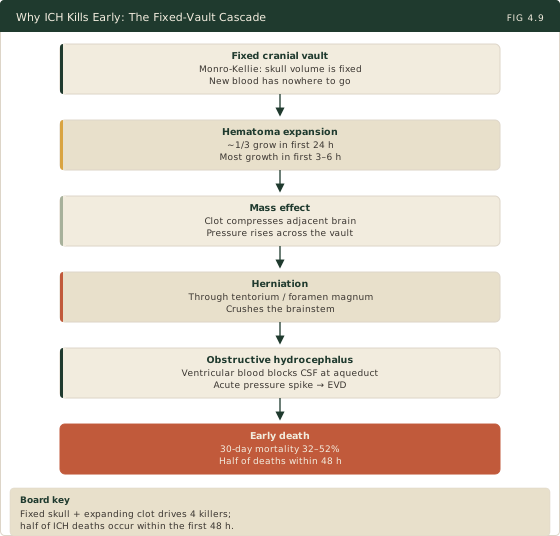
The 30-day mortality for ICH ranges from 32 to 52%, compared with 10 to 15% for ischemic stroke, making ICH roughly 3 to 4 times more lethal. Even more sobering is the temporal distribution: half of all ICH deaths occur within the first 48 hours. That is half of the deaths, not half of all newly admitted patients: a patient admitted tonight does not have a one-in-two chance of dying by Thursday. This early mortality is driven by the four-mechanism cascade described by the Monro-Kellie doctrine: ongoing hematoma expansion, mass effect compressing adjacent brain, herniation through the tentorium or foramen magnum (which crushes the brainstem), and ventricular extension causing acute obstructive hydrocephalus when blood blocks cerebrospinal fluid (CSF) flow through the cerebral aqueduct.
Functional outcomes are generally poor. A 2007 AHA statement cited approximately 20% of all ICH patients functionally independent at 6 months; that is a dated all-patient estimate, and later reports use different populations and denominators. This creates a clinical phenomenon that board examiners reference directly: the self-fulfilling prophecy of early withdrawal of care. A clinician sees a comatose patient with a catastrophic-appearing scan, assumes the situation is futile, places an early do-not-resuscitate (DNR) order, withholds aggressive blood pressure management, and the patient dies. The death certificate lists ICH as the cause, artificially reinforcing the disease’s lethality statistics. The reality is that some of those patients possessed the physiologic reserve to survive and recover meaningfully.
Current guidance is explicit: absent previously documented treatment limitations, provide aggressive care and defer new DNAR or withdrawal-of-care decisions until at least the second full hospital day. Prognostic models are unreliable in the hyperacute window. The swelling has not peaked, the blood pressure has not stabilized, and the patient has not had a chance to declare a trajectory. Respect prior wishes and shared decisions, keep DNAR separate from withdrawal of other treatment, and never limit care on an admission ICH Score alone. The physiatrist should be a consistent voice for continued rehabilitation and recovery-oriented care even in patients with severe initial deficits, because the rehabilitation trajectory after ICH can be paradoxically more favorable than after ischemic stroke of similar initial severity. As the hematoma is reabsorbed and surrounding edema resolves over weeks, brain tissue that was displaced and rendered dysfunctional by compression (rather than destroyed by ischemia) can resume function. Patients may show delayed but ultimately more substantial recovery than initially expected.
High Yield — ICH Epidemiology
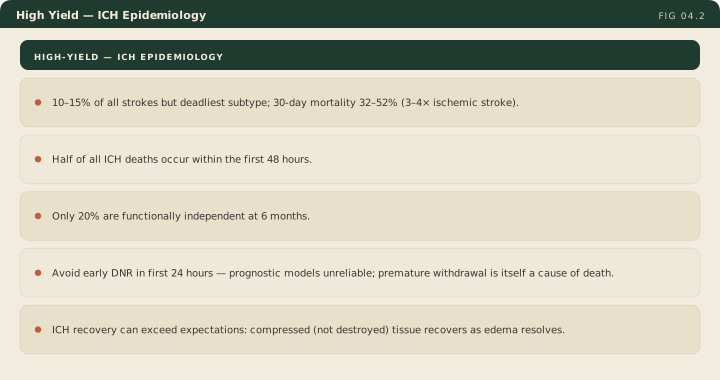
- 10 to 15% of all strokes but the deadliest subtype. That range is US-anchored and contains the 10% ICH share of the US partition in CVA-02; the share is population dependent, and GBD 2021 put ICH at 28.8% of incident strokes globally and 17.8% in high-income countries.
- 30-day mortality 32 to 52% (3 to 4 times ischemic stroke mortality).
- Half of all deaths in the first 48 hours.
- 20% functionally independent at 6 months in a dated 2007 all-patient AHA estimate; outcomes vary by cohort and by the care delivered.
- Defer new DNAR or withdrawal decisions until at least the second full hospital day absent previously documented limitations. Prognostic models are unreliable that early, premature withdrawal is itself a mechanism of death, DNAR does not limit other treatment, and an ICH Score alone must not determine care limits.
- ICH recovery can be more substantial than expected because compressed (not destroyed) tissue can recover as edema resolves.
Now, on paper, the death certificate says the intracerebral hemorrhage killed them. But the physiological reality is that some fraction of those patients actually possessed the underlying reserve to survive that initial insult and make a meaningful recovery.
— CVA-04 podcast, ~6:32