Before You Listen
- Prerequisites: Circle of Willis anatomy and the territories of the anterior, middle, and posterior cerebral arteries (CVA-01); the cranial nerve (CN) III oculomotor pathway including parasympathetic outflow; intracerebral hemorrhage management and the closed-skull pressure dynamics from CVA-04; non-contrast computed tomography (CT) interpretation for blood density.
- Runtime: 1 hour 4 minutes.
- Topic in one line: the saccular (“berry”) aneurysm at Circle-of-Willis bifurcations as the cause of 80-85% of spontaneous subarachnoid hemorrhages (SAH); the three highest-frequency sites (anterior communicating artery 30%, posterior communicating artery 25%, middle cerebral artery bifurcation 20%); the painful pupil-involving cranial nerve III palsy of a posterior communicating artery aneurysm, which a spared pupil does not exclude; the sentinel headache in roughly 30% of cases driving the CT-then-lumbar-puncture (LP) algorithm; the Hunt-Hess clinical grade and the original Fisher radiographic grade (original Fisher 3, not 4, carries the classic vasospasm association); the vasospasm window from day 3-5 through day 14, subsiding by about day 21; transcranial Doppler (TCD) middle cerebral artery (MCA) mean velocity ≥120 cm/s with a Lindegaard ratio ≥3 supporting focal spasm; enteral nimodipine 60 mg every 4 hours for 21 days, never injected; the International Subarachnoid Aneurysm Trial (ISAT) ~7% absolute risk reduction favoring coiling in lesions suitable for either repair; the syndrome of inappropriate antidiuretic hormone (SIADH) versus cerebral salt wasting (CSW) trap; the Spetzler-Martin grading system for arteriovenous malformations (AVMs); the cavernous malformation as the angiographically occult “popcorn lesion” that presents with seizures; and the dural arteriovenous fistula (dAVF), in which cortical venous drainage turns a low-risk lesion into a dangerous one.
Vignette. A 47-year-old woman with autosomal dominant polycystic kidney disease arrives in the emergency department after sudden onset of “the worst headache of my life” while gardening 4 hours ago. She had a brief loss of consciousness at onset, vomited twice, and now has neck stiffness and photophobia. Examination shows a drowsy but arousable patient (Glasgow Coma Scale 13), no focal motor deficit, but a fixed, dilated right pupil with ptosis and the right eye deviated down and out. Non-contrast head CT shows hyperdense blood layered in the basal cisterns and the interhemispheric fissure with mild ventricular enlargement.
State the Hunt-Hess grade, name the most likely aneurysm location and explain the cranial nerve finding, list the next two diagnostic-and-management steps, predict the highest-risk delayed complication and the day it is most likely to begin, and explain why phenytoin should be avoided if seizure prophylaxis is selected.
(Answer at the end of this chapter)
Section 1: Berry Aneurysms, Aneurysm Locations, and the PCOM-CN III Trap
Bottom line: 80-85% of spontaneous SAH comes from a saccular aneurysm at a Circle-of-Willis bifurcation; ACOM 30%, PCOM 25%, MCA 20%; a painful pupil-involving CN III palsy is a PCOM aneurysm pressing the parasympathetic surface fibers until proven otherwise.
Subarachnoid hemorrhage accounts for roughly 3% of all strokes. Roughly 80-85% of spontaneous SAH follows rupture of a saccular (berry) aneurysm. It can affect younger adults and cause substantial disability or death.
Saccular aneurysms develop at susceptible arterial branch points through wall remodeling and hemodynamic stress. Inherited susceptibility can contribute, but the lesion is not simply a universally congenital absence of the tunica media and internal elastic lamina. Rupture releases arterial blood into the CSF spaces around the brain.
Three locations dominate. The anterior communicating artery (ACOM) sits at the midline bridge between the two anterior cerebral arteries and accounts for approximately 30% of ruptured aneurysms, the single most common site. Blood concentrated in the interhemispheric fissure on CT suggests an ACOM source. The posterior communicating artery (PCOM) accounts for approximately 25% and connects the internal carotid to the posterior cerebral artery. The middle cerebral artery bifurcation accounts for approximately 20%; blood pooled in the Sylvian fissure on CT suggests an MCA aneurysm. Other anterior and posterior circulation sites, including the basilar tip, make up the remainder.
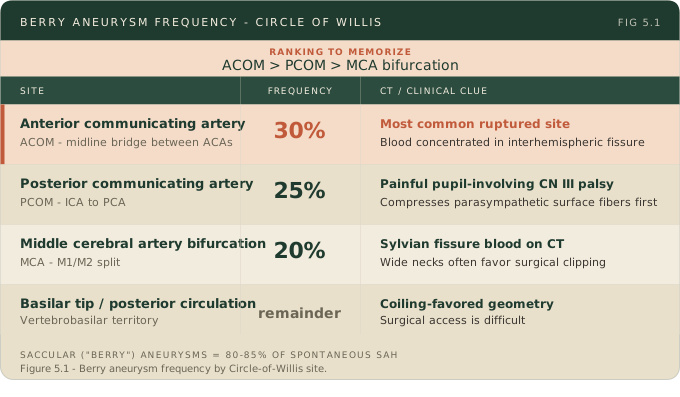
The PCOM aneurysm is an important localization association because it lies close to CN III (oculomotor nerve). An expanding aneurysm can compress the nerve and produce pupil and extraocular-motor abnormalities.
The parasympathetic fibers controlling pupil constriction run superficially in CN III, helping explain frequent mydriasis with external compression. Somatic motor dysfunction can produce ptosis and a down-and-out eye: the lateral rectus (CN VI) and superior oblique (CN IV) act relatively unopposed. Pupil and motor findings may develop together or in different sequences; there is no obligatory pupil-first progression.
A new painful, pupil-involving CN III palsy is an emergency: urgently investigate a PCOM aneurysm. The classic comparison is microvascular, often diabetic, palsy with relative pupil sparing. Pupil sparing does not exclude an aneurysm, especially in an incomplete palsy; diabetes and pain do not provide a safe imaging gate. Acute acquired isolated III palsy warrants prompt vascular imaging and specialist assessment. Clinical evidence
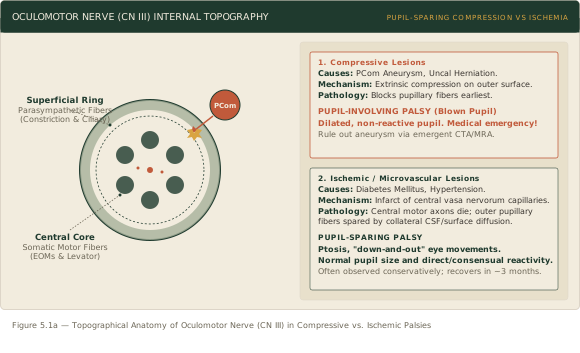
Original teaching schematic; fiber positions are simplified and do not establish a diagnostic rule or fixed symptom sequence.
High Yield — Berry aneurysms and CN III
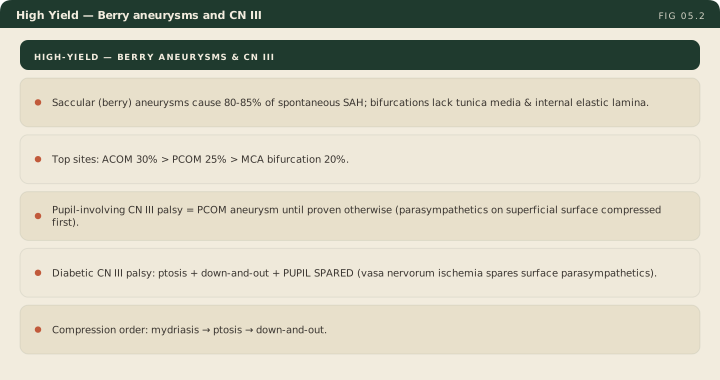
- Saccular (berry) aneurysms account for approximately 80-85% of spontaneous SAH; wall susceptibility and hemodynamic remodeling contribute.
- Top three sites: ACOM 30% > PCOM 25% > MCA bifurcation 20%.
- Painful pupil-involving CN III palsy: urgently investigate PCOM aneurysm. Superficial parasympathetic fibers explain the classic association.
- Microvascular, often diabetic, CN III palsy typically spares the pupil; this is an association, not an exclusion test for aneurysm.
- No fixed order of mydriasis, ptosis and eye deviation; obtain prompt vascular imaging for an acute acquired isolated III palsy.
Board Trap — Pupil sparing does not exclude aneurysm
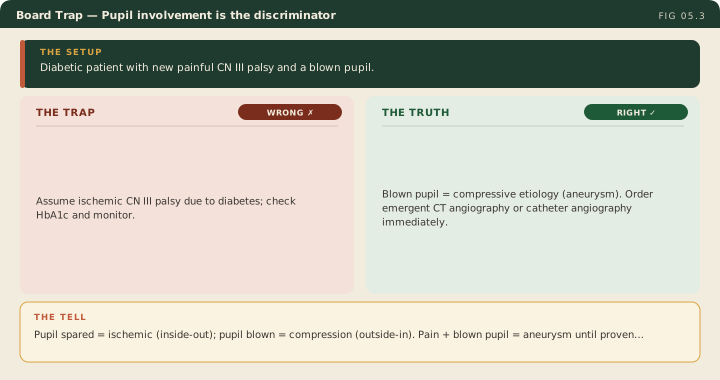
A new acquired isolated third-nerve palsy in an adult gets prompt vascular imaging, CTA or MRA, whether the pupil is blown, partly involved or fully spared, and whether or not the patient has diabetes. A painful pupil-involving palsy is a PCOM aneurysm until imaging says otherwise, because the superficial parasympathetic fibers sit where compression reaches them first. Mydriasis, ptosis and eye deviation appear in no fixed order, and aneurysmal palsies that spare the pupil are documented, so the examination localizes the lesion and imaging names the cause.
The very first sign, the absolute canary in the coal mine is the pupil blowing open. It becomes fixed and dilated.
— CVA-05 podcast, ~7:52