Before You Listen
- Prerequisites: middle cerebral artery (MCA) and anterior cerebral artery (ACA) territories and the motor homunculus (CVA-01); upper vs lower motor neuron lesion patterns.
- Runtime: 49 minutes.
- Topic in one line: the seven Brunnstrom stages, the four synergy patterns, the four classic neurorehabilitation techniques, the constraint-induced movement therapy (CIMT) inclusion criteria, and the prognostic markers that decide who recovers.
Vignette. A 62-year-old right-handed woman, 6 months post left-MCA infarct, has voluntary movement of the right upper extremity but every reach produces scapular retraction and elevation, shoulder external rotation with the arm flaring outward, forceful elbow flexion, palm turning upward, wrist and finger flexion. She cannot extend the elbow with fingers flexed. Active wrist extension 30°, active finger extension 15°. She uses the right arm for nothing.
What is the Brunnstrom stage, the named synergy pattern, the CIMT candidacy decision, and the behavioral phenomenon at play?
Section 1 — Brunnstrom Stages 1 through 7
Bottom line: recovery moves flaccid → spastic synergies → out-of-synergy emergence → selective control, in that order; spasticity peaks at stage 3 and many patients plateau there.
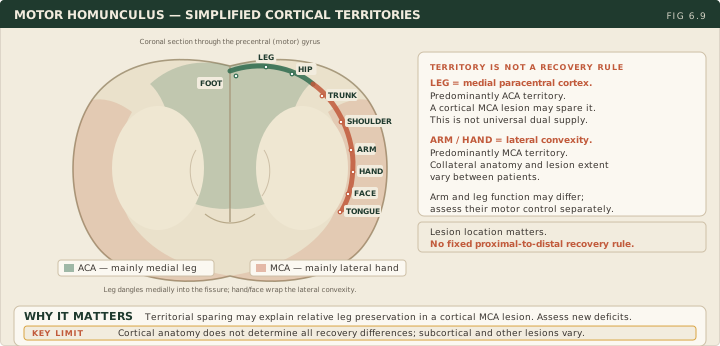
Signe Brunnstrom, a Swedish-American physical therapist, mapped a remarkably consistent post-stroke recovery sequence in the 1960s. The seven stages describe order of recovery, not speed or ceiling. Sources present the scale either way: six stages ending at near-normal function, or seven with a normal endpoint. This chapter uses the seven-stage convention, with stage 7 denoting normal function, so a six-stage table is a presentation difference, not a contradiction. Patients can plateau at any stage, and the upper and lower extremities frequently progress at different rates in the same patient: the leg representation is medial and mainly in ACA territory while the hand representation is lateral and MCA-dependent, so an MCA stroke often spares the leg more than the hand. That is a simplified cortical map, not a dual blood supply for the leg, and lesion location and extent decide the actual pattern. The downstream picture is a stage-5 leg walking around independently while the same patient’s stage-3 arm remains locked against the chest. Recovery classically follows a proximal-to-distal gradient within each limb (shoulder and hip lead, hand and foot trail), which is the order Twitchell described and Brunnstrom built her stages from, but early-stroke observation has not found that gradient in every patient. Examine arm, hand and leg separately rather than inferring one from another.
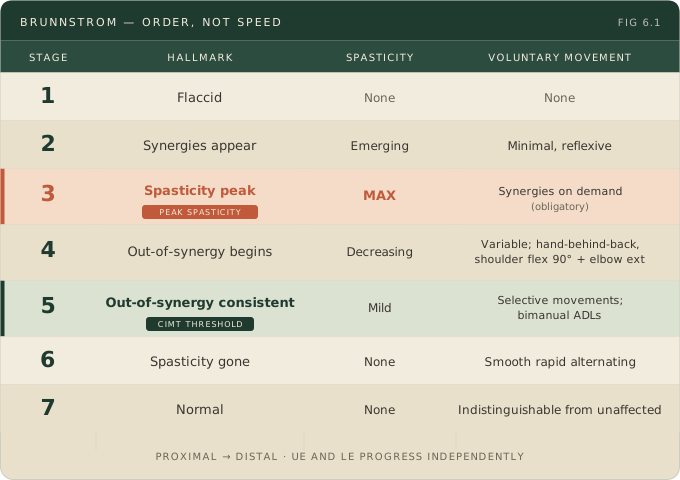
- Stage 1: Flaccidity. No tone, no voluntary movement, no reflex. Hemiplegic shoulder is at peak risk for inferior glenohumeral subluxation because the supraspinatus and rotator cuff are silent and the bony glenoid is too shallow to hold the humeral head against gravity. The dropped humeral head produces a palpable finger-width gap below the acromion; the stretched capsule triggers durable secondary pain syndromes once sensation returns. Protect the arm from traction and support it with positioning, lap trays and, where the individual assessment supports it, a sling; slings are advised particularly to avoid traction during ambulation and are not automatic for every patient. Flaccidity persisting past 3 weeks means severe weakness and a guarded prognosis, and it should prompt reassessment; it does not diagnose destruction of the corticospinal tract or fix a recovery ceiling.
- Stage 2: Spasticity appears; basic synergies are involuntary. Mass-pattern responses triggered reflexively by attempted movement, yawning, or startle. This is a descriptive stage in the classical sequence. It is not a prognostic sign: tone and selective motor recovery are different constructs, and a population cohort found self-reported spasticity at three months associated with worse adjusted outcome.
- Stage 3: Peak spasticity; synergies are voluntary but obligatory. Patient can fire flexor or extensor synergy on command but cannot move outside the template. Reaching to grasp is impossible because reach uses extensor components (elbow extension, scapular protraction) and grasp uses flexor components (finger flexion). The two macros cannot be combined. A common plateau. Rehabilitation adds compensatory one-handed strategies, adapted equipment and contracture prevention, alongside continued goal-directed restorative practice; stage 3 alone is not a reason to abandon recovery goals.
- Stage 4: Out-of-synergy movements begin; spasticity declines. Hand-behind-back (shoulder extension + internal rotation + elbow flexion) and shoulder flexion to 90° with elbow extended are the classic milestones, both require combinations that don’t belong to either pure synergy. Movements are fragile: the patient performs them in a quiet therapy room then reverts to synergy under fatigue, cognitive load, or stressful task demands. Stage the limb on the tested movements themselves; day-to-day variability is a common accompaniment, not the criterion.
- Stage 5: Independence from synergy templates. Reliable selective joint control: elbow flexes without shoulder activation, palm turns up with elbow extended, individual fingers move with reasonable precision. Spasticity persists only with rapid movement or stress. Bimanual ADLs become possible, stabilizing a fork while the intact hand cuts, holding paper while writing, assisting with dressing. Lower extremity gains independent knee flexion during swing phase, replacing the obligatory hip-hike circumduction. Hand and leg capacity are assessed separately, and stage 5 is not a CIMT eligibility threshold: CIMT candidacy is measured, not staged.
- Stage 6: Near-normal; spasticity essentially gone. Smooth isolated joint movements; subtle deficits on rapid-alternating fine motor testing only.
- Stage 7: Normal. No detectable difference between affected and unaffected sides on careful examination. Achieved by a minority of stroke patients, typically those with small infarcts and minimal initial impairment.
The classical explanation for the synergies is the hierarchical model of motor control: cortical damage releases older brainstem circuits (reticulospinal, vestibulospinal) from inhibition, and they dominate the motor output as crude bundled patterns. Hold it as a teaching model. It does not show that the cortex only inhibits movement, and the appearance of spasticity does not prove that descending pathways have reconnected.
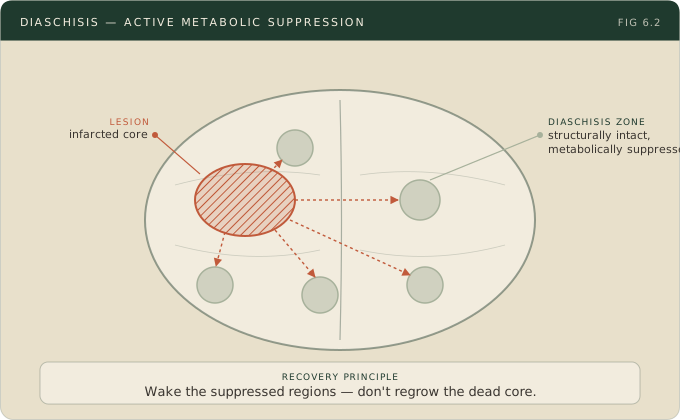
Stage 1 is not pure structural damage. Diaschisis is reduced function in regions remote from, but connected to, a focal lesion, and it is distinct from the ischemic penumbra, which is underperfused tissue at the lesion itself. Small imaging series show clinical improvement accompanying recovery of remote cortical perfusion, so resolution of diaschisis can contribute to early gains. It does not define flaccidity, rest on a proven glutamate hibernation mechanism, or schedule the transition to stage 2.
Clinical Pearl — Bobath vs Brunnstrom philosophy
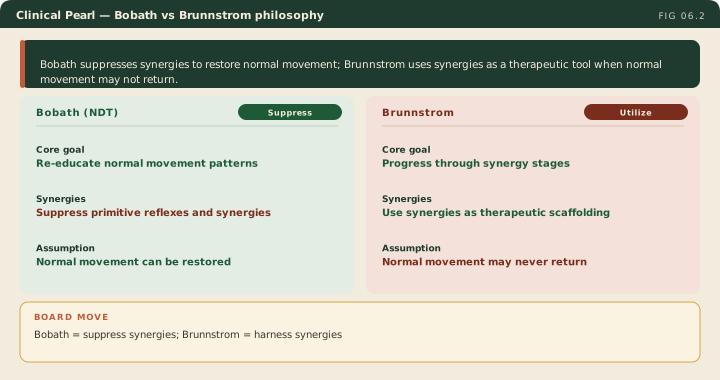
Bobath (NDT) seeks to suppress primitive reflexes and synergies and re-educate normal movement; Brunnstrom uses the synergies as scaffolding, then works to dissociate them. The two approaches were direct competitors in the 1960s, and the contrast is a standard board-review comparison.
Board Trap — “Spasticity worsening = recovery worsening”
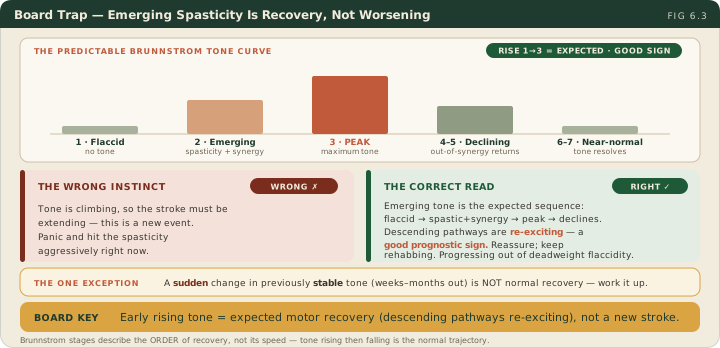
Half wrong, and the correction cuts the other way too. Increasing spasticity in stage 2 is the expected classical sequence, so it is not evidence that the patient is deteriorating. It is also not evidence of neural repair or a better prognosis: tone and selective motor recovery are separate findings, and more tone is not more useful movement. Judge recovery by selective movement, function, pain and care needs, and assess any abrupt change clinically.
High Yield — Brunnstrom in 7 lines
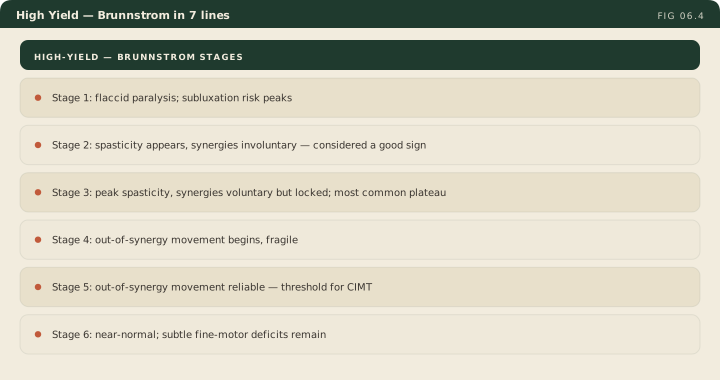
- Stage 1 flaccid, subluxation risk peaks here.
- Stage 2 spasticity appears, synergies involuntary; expected in the sequence, not a prognostic sign.
- Stage 3 peak spasticity, synergies voluntary but locked, common plateau.
- Stage 4 out-of-synergy begins, fragile.
- Stage 5 out-of-synergy reliable; CIMT candidacy is measured, not staged.
- Stage 6 near-normal, subtle fine-motor deficits.
- Stage 7 normal: minority of patients.
Because the rotator cuff muscles are totally silent, there’s nothing holding the heavy head of the humerus up inside the glenoid fossa. And the glenoid itself is a very shallow socket, so gravity just ruthlessly pulls the arm down, resulting in inferior glenohumeral subluxation.
— CVA-06 podcast, ~6:21