Before You Listen
- Prerequisites: Brunnstrom synergy patterns, the obligatory upper-extremity flexor template and lower-extremity extensor template, and the constraint-induced movement therapy (CIMT) inclusion criteria from CVA-06; the basic structure of the gait cycle (stance and swing phases) and normal swing-phase requirements (~60° knee flexion, ankle dorsiflexion, hip flexion); upper- vs lower-motor-neuron physiology and the corollary that surface electrical stimulation needs enough excitable peripheral motor axons to produce useful movement; the ankle-foot orthosis (AFO) categories (solid, hinged, posterior leaf spring) introduced in earlier MSK and SCI material.
- Runtime: 51 minutes.
- Topic in one line: mirror therapy as a visual-feedback adjunct usable at Brunnstrom stage 1-2 and in post-stroke complex regional pain syndrome; functional electrical stimulation (FES) of the common peroneal nerve for foot drop and the excitable-motor-axon requirement; body-weight-supported treadmill training and the Locomotor Experience Applied Post-Stroke (LEAPS) trial, which found no superiority over a progressive home exercise program at one year; vagus nerve stimulation (VNS) paired with rehabilitation, FDA-approved in 2021 for chronic ischemic stroke with moderate-to-severe arm impairment (VNS-REHAB primary Fugl-Meyer gain 5.0 vs 2.4, 90-day secondary 5.8 vs 2.8); the hemiplegic gait pattern (circumduction, hip hike, stiff knee, equinovarus) with an energy cost roughly 50-100% above normal; AFO selection by examination; the Functional Independence Measure (FIM) (18 items, 7-point ordinal scale, max 126, motor 91, cognitive 35) and FIM efficiency; the Barthel Index (10 items, 0-100); the Fugl-Meyer Assessment (UE max 66, LE max 34); the Berg Balance Scale (≤45 flags fall risk); the 10-meter walk test boundaries (0.4 and 0.8 m/s); the Montreal Cognitive Assessment (MoCA) (≥26 normal, +1 if ≤12 years of education); and the World Health Organization (WHO) impairment-vs-activity-vs-participation framework.
Vignette. A 64-year-old right-handed man is admitted to inpatient rehabilitation 11 days after a left middle cerebral artery (MCA) infarct. On admission his FIM total is 56 (motor 32, cognitive 24). He has hemiplegic gait with circumduction, a stiff right knee that does not flex during swing, equinovarus foot positioning, and active right wrist extension of 12° with active right thumb extension of 11° and 10° of active extension in two additional digits. Berg Balance Scale is 38; 10-meter walk test is 0.32 m/s; MoCA is 23. After a 14-day length of stay he is discharged with a FIM total of 91. He has 8 years of formal education.
Calculate his FIM efficiency and say what it does and does not establish; identify the dominant gait deviation and the quadriceps muscle most appropriate for botulinum toxin injection while preserving stance-phase stability; give his walking-speed category from the 10-meter walk test; classify the Berg score for fall risk; say whether he meets the CIMT motor screen and what else candidacy requires; and adjust his MoCA for education and interpret the result.
(Answer at the end of this chapter)
Section 1: Mirror Therapy, Functional Electrical Stimulation, and Vagus Nerve Stimulation
Bottom line: mirror therapy is a visual-feedback adjunct usable at Brunnstrom stage 1-2 and in post-stroke complex regional pain syndrome; functional electrical stimulation of the common peroneal nerve fires the tibialis anterior in foot drop and needs enough excitable motor axons to produce useful movement, so complete denervation sends you to an AFO; vagus nerve stimulation paired with rehabilitation improved chronic upper-extremity recovery in VNS-REHAB (primary Fugl-Meyer gain 5.0 vs 2.4), and the noradrenergic and cholinergic plasticity mechanism is the proposed explanation rather than a demonstrated one.
Mirror therapy is a simple intervention that uses the brain’s visual processing system to support motor recovery and reduce pain after stroke. The patient sits at a table with a vertical mirror placed along the midline. The affected limb is hidden behind the mirror; the unaffected limb is positioned in front of the mirror. When the patient moves the unaffected hand, the reflection appears in the position of the affected hand, and the brain receives a visual illusion that the affected hand is moving normally. The setup feeds the visual-motor loop with apparently normal movement even when the affected limb produces no motor output at all.
The proposed neurophysiological basis is the mirror neuron system, a network in premotor and parietal cortices that fires both when a person performs an action and when they observe the same action. Watching the reflection of the unaffected hand is thought to recruit motor circuits associated with the affected hand. Small functional-neuroimaging studies during mirror practice report increased activation in the ipsilesional primary motor cortex (the damaged hemisphere) and premotor cortex. That is an imaging association with the practice, and it does not prove that the visual illusion alone drives clinical recovery.
The evidence base supports mirror therapy in two settings. First, systematic reviews and randomized studies report improvement in upper-extremity motor function, and in some trials sensory and attentional measures, when mirror therapy is added to standard rehabilitation; the size of the effect varies with the endpoint and the follow-up. Second, mirror therapy improved pain and arm function in a randomized trial of post-stroke complex regional pain syndrome (CRPS-I). The mechanism proposed there is sensory-motor incongruence: the brain repeatedly sends a motor command without confirming visual or proprioceptive feedback, and the resulting error signal is interpreted as pain. Restoring visual congruence with the mirror is thought to reduce that mismatch. Mirror therapy is inexpensive, requires no equipment beyond a mirror, and can be performed independently at home; no intervention should be presented as universally effective or free of adverse effects. It is appropriate even for patients with severe hemiplegia who cannot produce any voluntary movement of the affected hand, making it one of the few active recovery interventions available to patients at Brunnstrom stage 1 or 2, well below the active distal movement conventional CIMT eligibility requires.
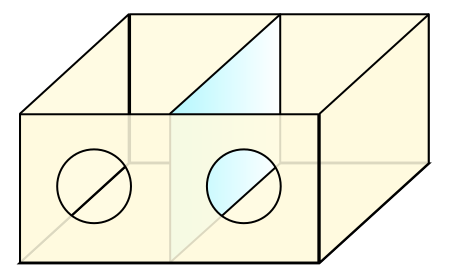
Source: Phidauex, “Ramachandran-mirrorbox”, via Wikimedia Commons, Public Domain. https://commons.wikimedia.org/wiki/File:Ramachandran-mirrorbox.svg
Functional electrical stimulation (FES) uses electrical current through surface or implanted electrodes to activate paralyzed or paretic muscles and produce functional movement. In stroke rehabilitation FES has two roles: a therapeutic modality during sessions to strengthen muscles and bombard the somatosensory cortex with afferent input, and an orthotic device worn throughout the day as an assistive substitute for damaged cortical drive.
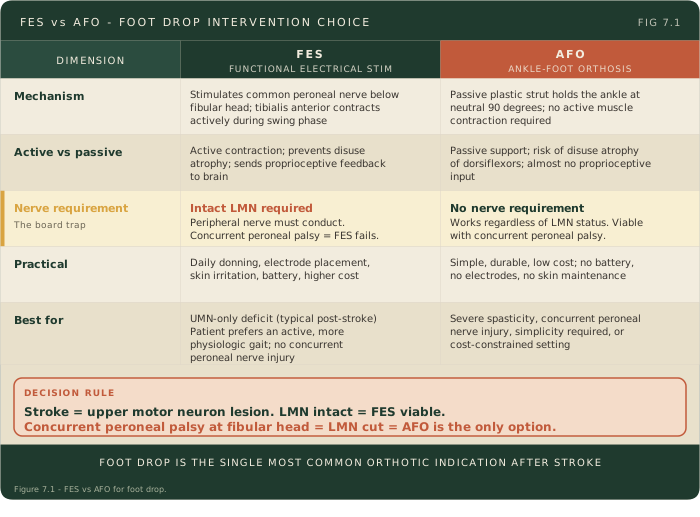
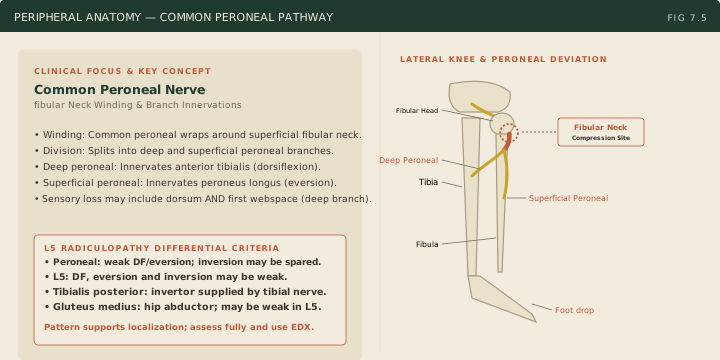
The most-tested application is FES for foot drop, the single most common indication for orthotic intervention after stroke. Weakness of the ankle dorsiflexors (primarily the tibialis anterior, innervated by the deep peroneal nerve) prevents foot lift during swing phase; the foot drags and creates a tripping hazard. The traditional solution is an ankle-foot orthosis (AFO) that holds the ankle at neutral. FES offers an alternative: a surface electrode is placed over the common peroneal nerve just below the fibular head, a sensor in the shoe detects swing-phase onset, and the stimulator delivers a burst of current that fires the tibialis anterior. Stimulation timing is synchronized to the gait cycle so that dorsiflexion occurs only during swing.
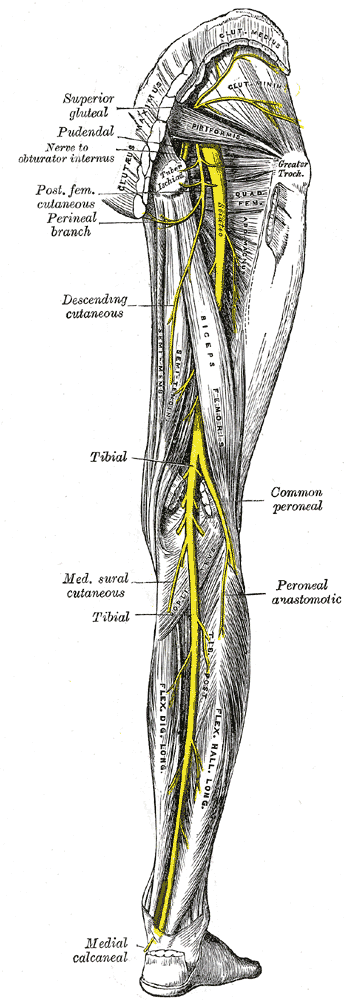
Source: Henry Vandyke Carter, Gray’s Anatomy of the Human Body (1918), Plate 832, via Wikimedia Commons, Public Domain. https://commons.wikimedia.org/wiki/File:Gray832.png
FES advantages include gait-timed active dorsiflexion, potential dorsiflexor strengthening, and afferent input from an active contraction. Disadvantages include cost, daily donning and skin irritation. The head-to-head evidence is narrower than the enthusiasm: a large chronic-stroke randomized trial found peroneal FES non-inferior to an AFO on its primary outcomes, which does not make FES superior. Both devices remain reasonable, and the choice turns on the fitted response, gait needs, cost, donning and skin tolerance.
The requirement that decides the exam question is peripheral: conventional nerve-targeted FES needs enough excitable motor axons to produce useful movement. Stroke produces an upper motor neuron lesion and leaves the lower motor neuron intact, which is why FES works after stroke. A concurrent peroneal nerve palsy at the fibular head (for example from prolonged ICU bed rest) damages the lower motor neuron, and complete motor denervation prevents any FES response; an AFO then supplies the clearance and stability mechanically. A partial palsy is not complete denervation, and a poor first fitting is not a failed nerve: check the fitting and the stimulated response, and use electrodiagnostic testing when the answer is not clinically obvious. Common peroneal injury can also affect first-webspace sensation. Beyond foot drop, FES can target the wrist and finger extensors for grasp and release, or the shoulder muscles to reduce subluxation.
Vagus nerve stimulation (VNS) paired with rehabilitation is the newest intervention in the stroke armamentarium and represents a fundamentally different approach: rather than targeting the limb directly, VNS targets the brain’s neuromodulatory systems. The proposed mechanism, supported by preclinical work rather than by the human trial, is release of norepinephrine from the locus coeruleus and acetylcholine from the basal forebrain, both of which promote synaptic plasticity and motor learning. Pairing is with the practiced movement: the stimulator delivers brief trains during movement repetitions in therapy, not only at the instant of a successful task completion. The human trial measured arm function; it did not demonstrate that neurotransmitter release mediated the benefit.
The pivotal randomized trial, VNS-REHAB, published in 2021, enrolled 108 adults with moderate-to-severe upper-extremity motor impairment 9 months to 10 years after ischemic stroke, well into the chronic phase when spontaneous recovery has plateaued. Patients underwent surgical implantation of a vagus nerve stimulator and were randomized to active VNS plus upper-extremity rehabilitation versus sham plus the same rehabilitation. Know both endpoints, because a stem can ask for either: the primary outcome, Fugl-Meyer upper-extremity change immediately after in-clinic therapy, was 5.0 points active versus 2.4 sham; the 90-day secondary outcome was 5.8 versus 2.8. Trial stimulation used 0.8 mA, 100-microsecond pulses at 30 Hz, in 0.5-second trains. The Food and Drug Administration approved the device in 2021 for use with rehabilitation in chronic ischemic stroke with moderate-to-severe arm impairment; the 9-month figure describes trial enrollment rather than the label. Implantation carries surgical risk, including a case of serious vocal-cord paresis in the trial. The conceptual significance is that VNS works at the level of the brain’s plasticity machinery rather than at the muscle or peripheral nerve. VNS-REHAB.
High Yield — Mirror, FES, and VNS
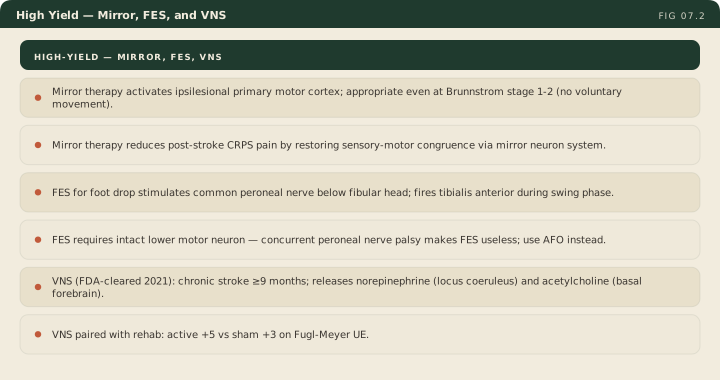
- Mirror therapy: visual-feedback adjunct; mirror-network recruitment in premotor and parietal cortex is the proposed mechanism, with imaging showing ipsilesional motor-cortex change. Appropriate even at Brunnstrom stage 1-2 (no voluntary movement); also improves pain in post-stroke CRPS.
- FES for foot drop stimulates the common peroneal nerve below the fibular head to fire the tibialis anterior during swing phase. Needs enough excitable motor axons — complete peroneal denervation means no FES response, and the answer becomes an AFO. Non-inferior to an AFO in a large chronic-stroke trial, not superior.
- Stroke = upper motor neuron lesion; LMN intact = FES viable. Confirm a useful fitted response; a partial palsy is not complete denervation.
- VNS paired with rehab (FDA-approved, 2021): chronic ischemic stroke with moderate-to-severe arm impairment; trial entry was 9 months to 10 years. Norepinephrine (locus coeruleus) and acetylcholine (basal forebrain) are the proposed mediators; trains are paired with practiced movements. Fugl-Meyer UE: primary +5.0 vs +2.4, 90-day secondary +5.8 vs +2.8.
Board Trap — FES failure with concurrent peroneal palsy
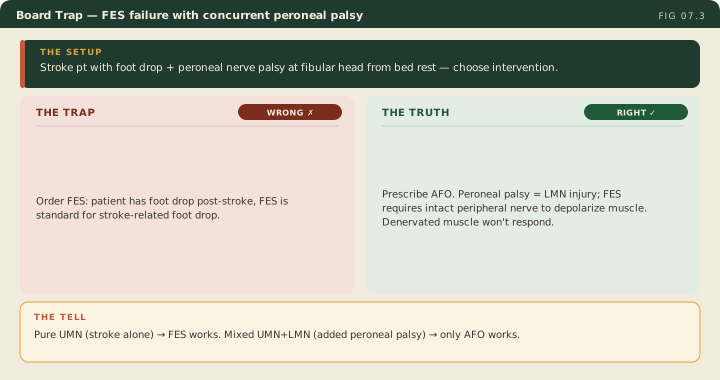
A patient with stroke-related foot drop plus complete peroneal motor denervation at the fibular head from bed rest is not a candidate for FES. FES stimulates the peripheral nerve to fire the muscle; a denervated muscle cannot respond. The right answer in that stem is an AFO, not FES. The discriminator is whether the lesion is purely upper motor neuron (typical post-stroke; FES works) or mixed UMN plus a denervating LMN lesion (only the AFO delivers clearance). Read the stem for what it actually establishes: a partial palsy, or one unsuccessful fitting, does not prove that FES must fail. Assess the stimulated response and use electrodiagnostic testing when it is unclear.
If you place an FES unit over a denervated nerve, the electrical current has nowhere to go. It cannot traverse a damaged peripheral axon to reach the motor end plate. The stimulation will completely fail.
— CVA-07 podcast, ~10:13
In the parietal cortex, that unresolvable error signal gets translated into a pain signal. The brain essentially decides, if I told the arm to move and it didn’t, the tissue must be catastrophically damaged.
— CVA-07 podcast, ~6:08