Before You Listen
Aphasia affects 15% to 38% of patients who suffer an ischemic stroke and is consistently ranked by patients and families as the most devastating consequence of stroke after physical paralysis. This chapter locks down the three-variable matrix (fluency, comprehension, repetition) that classifies every aphasia, walks through the four classic perisylvian aphasias with impaired repetition (Broca, Wernicke, global, conduction) and the four with preserved repetition (the three transcortical subtypes plus anomic), frames prognosis and treatment-intensity evidence, and finishes with the six dysarthrias that boards expect a candidate to match to specific lesion patterns. Memorize them cold.
- Prerequisites: vascular anatomy of the middle cerebral artery (MCA) including superior and inferior division territories; the dominant-hemisphere language model; cortical versus subcortical strokes; upper motor neuron (UMN) versus lower motor neuron (LMN) signs.
- Runtime: 1 hour 4 minutes.
- Topic in one line: the fluency-comprehension-repetition matrix, the four classic perisylvian aphasias with impaired repetition (Broca, Wernicke, global, conduction), the four with preserved repetition (anomic plus the three transcortical subtypes — motor, sensory, mixed — from watershed lesions), the multifocal embolic mechanism for global aphasia without hemiparesis, the conduite d’approche fingerprint of conduction aphasia, the global-to-Broca-to-anomic recovery course, individualized speech-therapy dosing, constraint-induced language therapy (CILT), melodic intonation therapy (MIT), the six dysarthrias (flaccid, spastic, ataxic, hypokinetic, hyperkinetic, mixed) with their lesion patterns, and the writing test that separates aphasia from dysarthria.
Vignette. A 62-year-old right-handed man presents to the emergency department with sudden onset of difficulty speaking. He has a right facial droop and right arm weakness with leg sparing. When asked “What happened to you?” he strains for several seconds and produces “arm… no good… fell… morning.” When asked to raise his left arm, he does so immediately. When asked to repeat “no ifs, ands, or buts,” he cannot reproduce the phrase and weeps with frustration. The motor exam shows 0/5 strength in the right upper extremity and 4/5 in the right lower extremity. Computed tomography (CT) angiography is pending.
What aphasia subtype does this patient have, which middle cerebral artery (MCA) division is occluded, why does the right face and arm weakness fit the vascular anatomy, and which language therapy uses melody and rhythm for selected patients with this syndrome?
(Answer at the end of this chapter)
Section 1: The Three-Variable Matrix and the Repetition Divide
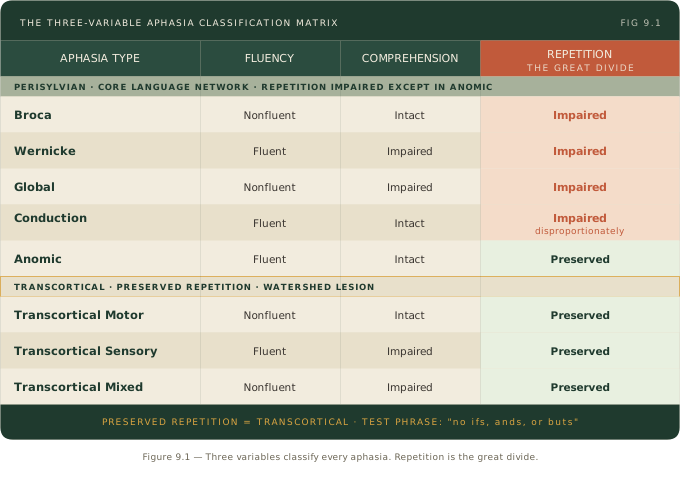
Bottom line: three clinical variables classify the classic aphasias (fluency, comprehension, repetition), and naming, reading and writing complete the language examination; fluency points anterior versus posterior; repetition is the great divide that separates the perisylvian aphasias (repetition impaired, lesion in the core network) from the transcortical aphasias (repetition preserved, lesion outside it in a watershed zone).
The classification of the classic aphasias rests on three clinical variables: fluency, comprehension, and repetition. Add naming, reading and writing to complete the language examination; naming is what identifies anomic aphasia, and it is the one the three-variable matrix leaves out. Fluency is a mechanical assessment of spontaneous speech output, judged from a conversational sample of roughly 30 seconds. A fluent aphasia produces speech that flows at normal rate with normal phrase length and prosody (the musicality of speech), even if the content is meaningless. A nonfluent aphasia produces speech that is effortful, halting, and shortened to one or two words at a time, with flat telegraphic delivery and often visible facial straining. The first board shortcut: fluent aphasias point to posterior temporal and parietal lesions; nonfluent aphasias point to anterior frontal lesions. Anterior brain handles motor planning and execution; posterior brain handles sensory processing and meaning. Those are strong clinical tendencies inside a distributed network, not exact lesion tests.
Comprehension is the brain’s ability to decode and understand spoken language. Testing it accurately is harder than it appears because patients lean on facial expressions, gesture, and environmental context. A patient may nod and smile to a routine greeting without comprehending a single word. To isolate the auditory cortex and the semantic processing centers, hand the patient graded commands stripped of social and visual cues, and do not demonstrate the answer while you ask: “Take this paper in your hand, fold it in half, and place it on the floor.” Increasing complexity reveals the threshold where semantic understanding breaks down. Make the response physically possible: do not ask a patient with a paralyzed right arm to prove comprehension with that hand, and account for hearing loss, visual impairment, attention and limb apraxia before calling a failed command a comprehension deficit.
Repetition is the act of hearing a spoken phrase and reproducing it verbatim, and it is the linchpin of aphasia classification. Repetition requires the integrity of the dominant-hemisphere perisylvian network: Wernicke area in the posterior superior temporal gyrus (where sounds become meaning), Broca area in the inferior frontal gyrus (where concepts become motor programs), and the arcuate fasciculus (the white matter cable arching from Wernicke through the parietal lobe to Broca). The classic test phrase is “no ifs, ands, or buts.” Repetition is a closed-loop task that demands the acoustic signal travel intact from Wernicke through the arcuate fasciculus to Broca; if any segment of the loop is broken, repetition fails. That is the classification model, and lesion studies place repetition across a wider temporoparietal and frontal network, so a failed repetition test tells you the syndrome rather than proving that one tract has been cut.
The single most important dividing line in the classification system is repetition. The classic perisylvian aphasias impair repetition: Broca, Wernicke, global, and conduction, each damaging a component of the core perisylvian network. Transcortical aphasias preserve repetition, because the damage lies outside the core network in the watershed zones between major vascular territories. Anomic aphasia is the special case: classically temporoparietal (angular gyrus) but with preserved repetition, since neither the arcuate fasciculus nor Broca/Wernicke proper is interrupted; naming systems are distributed, so anomia does not localize to one site. When a board question presents any aphasia with preserved repetition plus impaired comprehension or fluency, immediately select a transcortical subtype; if repetition is preserved with intact comprehension and fluency but a prominent word-finding deficit, the answer is anomic.
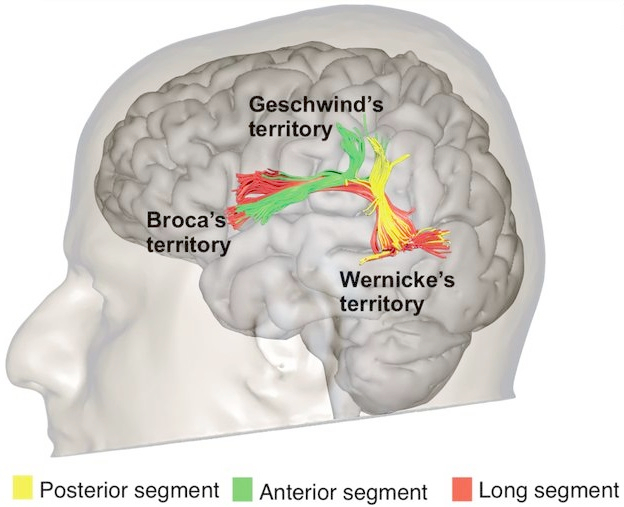
Source: Catani M, Dell’Acqua F, Budisavljevic S, et al., “Frontal networks in adults with autism spectrum disorder”, Brain 2016, via Wikimedia Commons, CC BY 4.0. https://commons.wikimedia.org/wiki/File:Three_segments_of_the_arcuate_fasciculus.jpg
High Yield — The repetition divide
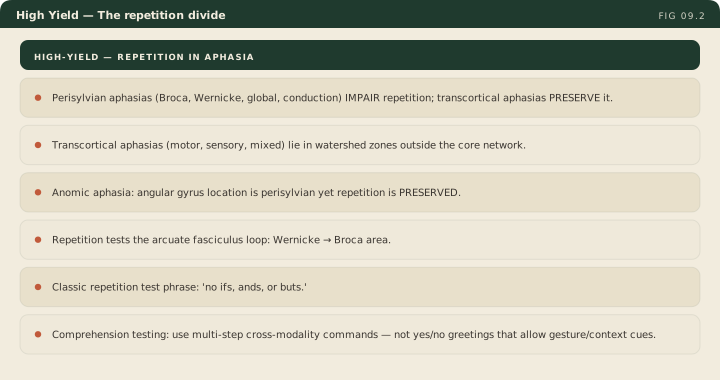
- Three classification variables: fluency (anterior vs posterior), comprehension (intact vs impaired), repetition (intact or impaired). Add naming, reading and writing.
- Perisylvian aphasias impair repetition = Broca, Wernicke, global, conduction (damage the core network). Anomic aphasia is classically temporoparietal (angular gyrus) but preserves repetition, and its lesions are variable.
- Transcortical aphasias (motor, sensory, mixed) lie outside the core network in watershed zones and preserve repetition.
- Repetition tests the arcuate fasciculus loop: Wernicke area to Broca area through the arcuate fasciculus. Modern lesion work spreads repetition across a temporoparietal and frontal network, so impaired repetition names the syndrome rather than proving a severed tract.
- Test phrase: “no ifs, ands, or buts.”
- Comprehension testing must strip away gesture and context: use graded multi-step commands, not yes/no greetings, without demonstrating the answer. Make the response physically possible and account for hearing, vision, attention and apraxia.
Because humans are incredibly social creatures with highly developed, deeply ingrained compensatory skills. A patient can nod, smile, and respond entirely appropriately to a greeting like, how are you doing today, using absolutely nothing but facial cues, your tone of voice, and the social context of a doctor walking into a hospital room.
— CVA-09 podcast, ~8:18