Before You Listen
This episode covers the cognitive syndromes that determine independence after stroke even when motor function looks intact. A patient can walk the hall, lift a hand weight, and converse warmly, yet still be unable to live alone because they cannot attend to the left side of space, recognize a spouse by sight, sequence the steps of a meal, or distinguish their right hand from their left. You will leave with hemispatial neglect mechanism through prognosis, the three apraxias and their localizations, the agnosias including anosognosia and prosopagnosia, the four-feature Gerstmann tetrad, the visual-neglect-versus-hemianopia distinction, the formal executive function tests, the cognitive rehabilitation strategies, and the split between pseudobulbar affect and depression.
Prerequisites:
- Cerebral vascular territories: right middle cerebral artery (MCA), posterior cerebral artery (PCA), and anterior cerebral artery (ACA) supply
- Functional cortical anatomy of parietal, temporal, occipital, and frontal lobes
- The eight aphasia syndromes from CVA-09
Runtime: 46 minutes.
Vignette. A 65-year-old right-handed man is admitted to acute inpatient rehabilitation 5 days after a right middle cerebral artery (MCA) infarct. The nursing team reports he eats only the food on the right half of his hospital tray and is “hungry again” the moment a nurse rotates the tray 180 degrees. Occupational therapy notes that he dresses only the right side of his body and shaves only the right side of his face. When the physical therapist stands on his left and calls his name, he turns his head to the right searching for the source of the voice. On confrontation testing each visual field is intact in isolation; on simultaneous bilateral finger wiggling, he reports only the right-sided stimulus. He has a dense left hemiparesis but insists his left arm “works fine” and tries to stand and transfer alone. He has fallen twice.
Where is the lesion, what specific bedside finding distinguishes this from a homonymous hemianopia, what cognitive deficit explains his repeated unsafe transfer attempts, and which therapy recalibrates the sensorimotor system and so depends least on his insight?
Section 1: Hemispatial Neglect, Mechanism, Localization, and the Hemispheric Asymmetry
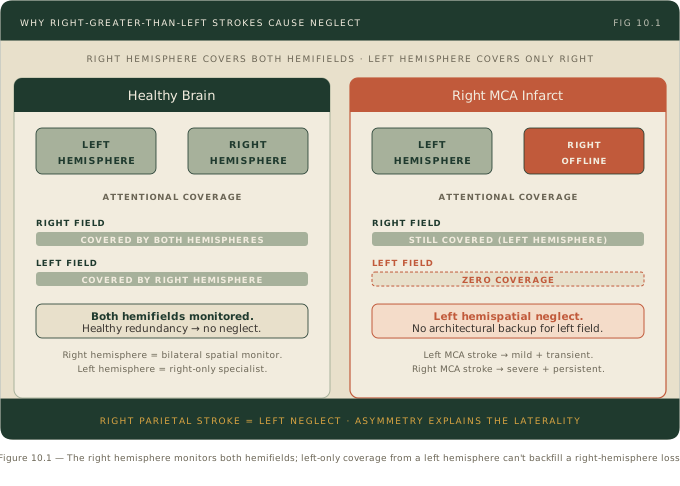
Bottom line: hemispatial neglect is a failure to attend to the contralesional half of space that primary sensory and motor loss does not explain. The lesion is the right parietal lobe in the right MCA territory and the neglected side is the left, because the right hemisphere attends to both hemifields while the left attends only to the right, leaving no redundancy when the right hemisphere goes offline.
Hemispatial neglect is a failure to attend to, respond to, or orient toward stimuli on the side of space contralateral to a brain lesion, and the definition requires that a primary sensory or motor deficit not explain it. The failure is in the attentional networks, not in the pathway that carries the signal: the patient can register a left-sided stimulus presented on its own and then fail to register it when the right side competes. That split between attentional failure and sensory failure is the foundation of every board question about neglect.
It is a definition of what neglect is not explained by, not a promise that the patient has nothing else. Hemianopia, hemisensory loss and hemiparesis frequently accompany neglect, so test primary vision, sensation and strength on their own before attributing any single finding to attention.
Neglect classically follows right parietal lobe lesions in the non-dominant hemisphere, in the right MCA territory. Left-sided neglect is more common and more severe than right-sided neglect. The asymmetry is not an accident: the left hemisphere attends primarily to the right side of space, while the right hemisphere attends to both sides. When the left hemisphere is damaged, the intact right hemisphere can compensate because it already monitors both hemifields. When the right hemisphere is damaged, the left hemisphere can only attend to the right and nothing covers the now-unmonitored left. The board examiner expects the candidate to articulate this redundancy. Neglect does also occur after left-hemisphere lesions, and the traditional bilateral-right / unilateral-left account is a simplified model of a distributed attention network.
Clinical manifestations are dramatic. The patient eats only the food on the right side of the tray and leaves the left untouched, not because they are not hungry but because food on the left does not register in conscious awareness. They begin reading sentences in the middle or skip left-sided words. They shave only the right side of the face, dress only the right arm, and collide with doorframes on the left when wheeling through halls. In severe cases the patient denies ownership of the left arm entirely. Determine the supervision a given patient needs by watching the actual task: assess transfers, wheelchair navigation and meals directly rather than assuming a level of assistance from the diagnosis.
Neglect is not monolithic. Sensory (perceptual) neglect is the failure to attend to contralesional stimuli that primary sensory loss does not explain, and it is the prototype most board questions address. Motor neglect (intentional neglect) is reduced spontaneous use of the contralesional limb beyond what weakness explains; directional hypokinesia, a bias against moving into contralesional space, is the related pattern rather than a synonym for every motor-neglect presentation. Personal neglect is neglect of the patient’s own body on the affected side. Spatial or extrapersonal neglect refers to neglect of the environment beyond the body and affects navigation, meal completion, and reading. The subtypes overlap, and primary sensory or motor deficits can sit on top of any of them.
High Yield: Hemispatial Neglect Core Facts
- Definition: failure to attend to or respond to the contralesional half of space that primary sensory or motor loss does not explain. Attentional failure, not sensory failure, and those deficits coexist with it.
- Localization: right parietal lobe in the non-dominant hemisphere, classically in the right MCA territory.
- Asymmetry: left-sided neglect is far more common and more severe because the right hemisphere normally monitors both hemifields and the left hemisphere monitors only the right.
- Subtypes: sensory (perceptual), motor (intentional), personal (own body), spatial (extrapersonal). Boards most commonly test sensory and personal; the subtypes overlap.
- Functional impact: independent negative predictor of functional outcome, longer rehab stay, higher fall risk, supervised discharge.
Board Trap: Neglect Is Not Stubbornness
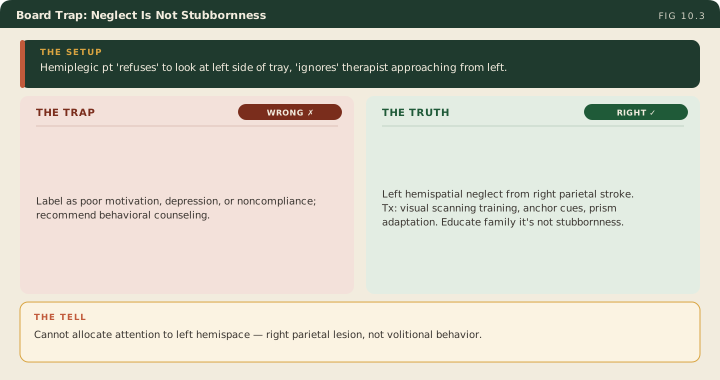
A vignette describes a hemiplegic patient who “refuses” to look at the food on the left side of the tray and “ignores” the therapist who approaches from the left. The trap is to label this as poor motivation, depression, or noncompliance and recommend behavioral counseling. The correct answer is left hemispatial neglect from a right parietal stroke, and the appropriate intervention is visual scanning training, anchor cues, and prism adaptation. The patient cannot allocate attention to the left half of space, and the family must be educated explicitly that this is not stubbornness.
It is like having a fully gassed up car. You know, the engine works perfectly, the transmission is fine, the tires are inflated, but the driver simply refuses to put the key in the ignition when they need to turn left. The execution hardware is totally intact, but the initiation software is corrupted.
— CVA-10 podcast, ~7:46
The analogy is about motor intention, and it holds for motor neglect specifically. Real patients often carry weakness and apraxia alongside it, so confirm that the limb has the movement the task requires before calling a failure to use it neglect.