Before You Listen
Hemiplegic shoulder pain is the single most common pain complaint in stroke rehabilitation, affecting 30% to 70% of survivors and independently linked to longer hospital stays and worse functional outcomes. The etiology is almost always multifactorial. This episode covers the glenohumeral anatomy and the mechanism of subluxation, positioning and sling use, functional electrical stimulation, brachial plexus traction injury, ranging technique, the full hemiplegic-shoulder differential, adhesive capsulitis and rotator cuff pathology, the spasticity ladder with the Modified Ashworth and Tardieu scales, complex regional pain syndrome with the Budapest criteria and the historical stage vocabulary, central post-stroke pain, and heterotopic ossification.
Prerequisites:
- Glenohumeral and rotator cuff anatomy: supraspinatus, infraspinatus, teres minor, subscapularis, deltoid
- Upper motor neuron syndrome and the Brunnstrom flaccid-to-spastic transition (CVA-06)
- Neuropathic pain pharmacology basics: gabapentinoids, tricyclics, sympathetic blockade
Runtime: 42 minutes.
Vignette. A 68-year-old right-handed man is 3 weeks out from a left middle cerebral artery (MCA) infarct with dense right hemiplegia. He is now in acute inpatient rehabilitation. The right arm was flaccid from admission, with biceps tone beginning to return in the days before the transfer incident. On bedside examination there is a palpable two-finger-breadth gap between the acromion and the humeral head, and he reports aching pain rated 7 out of 10 across the lateral shoulder, worse in the upright position and during transfers. Two days ago a nursing aide pulled on his right wrist during a sit-to-stand transfer; since then he has new burning pain radiating down the lateral arm, and his developing biceps tone has suddenly disappeared. Vital signs are normal. There is no edema, no temperature asymmetry, and no skin color change in the right hand.
What is the mechanism of his original shoulder pain, what new complication has the iatrogenic transfer most likely produced, what single bedside maneuver could have prevented the original injury, and what diagnostic study should you order to confirm the new diagnosis (and when)?
Section 1: Glenohumeral Anatomy, Subluxation Mechanism, and Positioning
Bottom line: shoulder subluxation is common in hemiplegic patients during the flaccid stage of recovery and is caused by loss of dynamic muscular stabilization (supraspinatus and posterior deltoid) during the flaccid stage, not by spasticity. Prevention rests on continuous arm support: lap tray or arm trough in the wheelchair, pillow positioning in bed, and a sling during upright mobility only.
The shoulder is the most mobile joint in the body, and it achieves that range of motion by sacrificing bony stability. The glenoid fossa covers only about one-third of the humeral head at any given time. In a healthy shoulder the humeral head is held in place not by bony constraint but by the dynamic stabilizers: the rotator cuff (supraspinatus, infraspinatus, teres minor, subscapularis) and the deltoid. The supraspinatus and posterior deltoid are the muscles that prevent inferior displacement of the humeral head against gravity when the arm hangs at the side.
After a stroke, the upper motor neuron lesion initially produces flaccid paralysis on the affected side. During this flaccid stage, the rotator cuff and deltoid have no tone and cannot generate the tonic contraction that normally holds the humeral head in the glenoid. Gravity pulls the weight of the arm straight down, and the humeral head slides inferiorly, creating a palpable gap between the acromion and the humeral head. The gap is measured in finger breadths: one finger breadth is mild subluxation; two to three finger breadths is severe and places the patient at significant risk for traction injury to the brachial plexus and the axillary nerve as those structures stretch over the inferior aspect of the joint capsule.
A board pearl is the relationship between subluxation and spasticity. Subluxation in the hemiplegic shoulder is caused by loss of dynamic muscular stabilization due to flaccid paralysis of the rotator cuff and deltoid. It is not caused by spasticity. Spasticity, when it later develops, can paradoxically reduce the subluxation because increased tone in the adductors and internal rotators pulls the humeral head back toward the glenoid. The trade-off is that spasticity creates its own problems: contracture and pain from the characteristic posture of shoulder adduction, internal rotation, elbow flexion, forearm pronation, and wrist flexion. When a vignette presents a flaccid-stage patient with a subluxated shoulder, the mechanism is loss of dynamic stabilization, not spasticity.
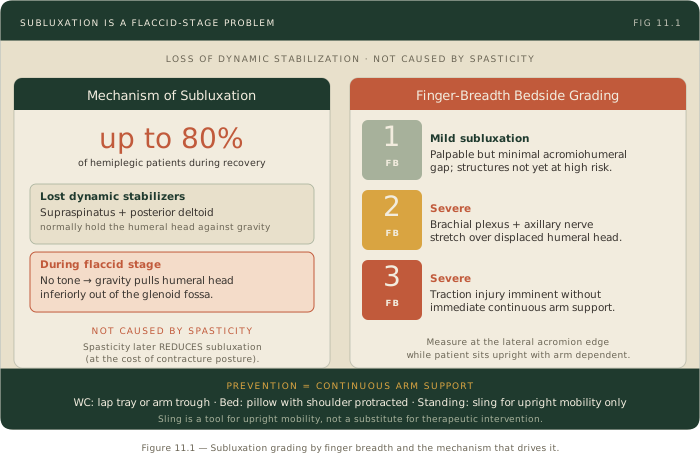
Prevention and management center on continuous arm support. Every team member must consistently implement positioning. A single lapse during a transfer can cause a brachial plexus traction injury that permanently worsens the prognosis. Wheelchair: the affected arm must be supported on a lap tray or arm trough; the arm must never dangle over the side. A dangling flaccid arm adds a lever-arm of torque to the gravity already pulling the humeral head out of the joint. Bed: the affected arm rests on a pillow with the shoulder slightly forward (protracted) and the arm in neutral or slight external rotation. When lying on the unaffected side, the hemiplegic shoulder should be protracted on a pillow in front of the body. Standing or transferring: a hemiplegic arm sling reduces gravitational pull during upright mobility. The sling is removed during seated activities and therapy when the arm can be supported on a surface. A patient kept in a sling 24 hours a day will develop shoulder adduction and elbow flexion contractures and progressive disuse of the affected extremity. The sling is a tool for upright mobility, not a substitute for therapeutic intervention.
High Yield: Subluxation and Positioning Core Facts
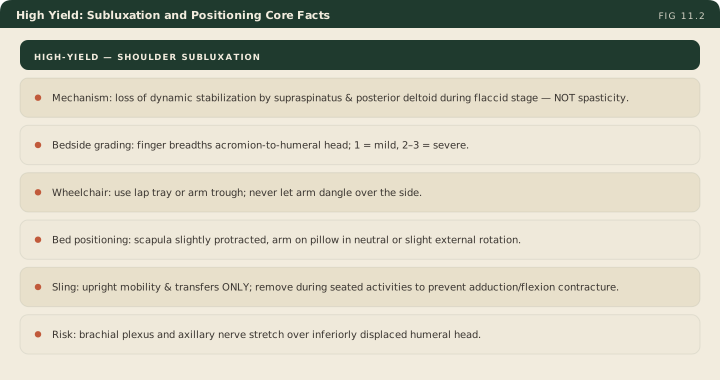
- Mechanism: loss of dynamic stabilization by the supraspinatus and posterior deltoid during the flaccid stage; not caused by spasticity.
- Bedside grading: finger breadths between acromion and humeral head: 1 = mild, 2 to 3 = severe.
- Wheelchair: lap tray or arm trough; never let the arm dangle over the side.
- Bed: scapula slightly protracted, arm on a pillow in neutral or slight external rotation.
- Sling: during upright mobility and transfers only; remove during seated activities to prevent adduction or flexion contracture.
- Risk: brachial plexus and axillary nerve stretch over the inferiorly displaced humeral head.
The subluxation is caused entirely by the loss of dynamic stabilization during the initial flaccid stage. It is never caused by spasticity.
— CVA-11 podcast, ~3:46