Before You Listen
- Prerequisites: stroke severity bands and the National Institutes of Health Stroke Scale (NIHSS) from CVA-01; the acute thrombolysis and thrombectomy framework with the tissue plasminogen activator (tPA) bleed window from CVA-02 and CVA-03; intracerebral hemorrhage (ICH) and antithrombotic management from CVA-04; the Modified Ashworth Scale (MAS) and spasticity ladder from CVA-11.
- Runtime: 59 minutes.
- Topic in one line: DVT diagnosis and prevention; individualized anticoagulation after AF-related stroke; depression screening and fluoxetine trial evidence; seizures and drug interactions; pseudobulbar affect; swallowing and bladder complications; falls, bone loss, fatigue and sleep apnea; and the evaluation of hyponatremia.
Vignette. A 71-year-old woman is in inpatient rehabilitation on stroke day 9 after a right MCA ischemic stroke treated with intravenous tPA. She has chronic atrial fibrillation; warfarin was resumed on stroke day 9 after follow-up brain imaging showed no hemorrhagic transformation. She has dense left hemiplegia, dysphagia managed with an individually prescribed texture-modified diet, and a PHQ-9 score of 14 awaiting clinical assessment. Overnight she develops a swollen, warm left calf. Serum sodium is 128 mmol/L, serum osmolality 264 mOsm/kg, urine osmolality 410 mOsm/kg, and urine sodium 62 mmol/L. She is alert, without new neurologic symptoms. Blood pressure is 138/82 without orthostasis, weight is stable, and there is no edema or jugular venous distension. Renal, thyroid and adrenal evaluation is unrevealing; she is not taking a diuretic or an SSRI. She had one self-limited generalized seizure on stroke day 2.
How should the swollen calf be evaluated, what did the CLOTS trials actually compare, what additional information supports the sodium diagnosis and treatment, and why does phenytoin complicate warfarin management?
(Answer at the end of this chapter)
Section 1: DVT in the Paretic Limb, the CLOTS Trials, and the 1-3-6-12 Rule
Bottom line: deep vein thrombosis (DVT) and pulmonary embolism (PE) lead preventable post-stroke deaths; risk peaks in the first 2 weeks and is dramatically higher in the paretic leg because the calf venous pump is offline; compression ultrasonography is the diagnostic study of choice for a high-suspicion swollen leg, and a hospital D-dimer loses specificity rather than sensitivity; intermittent pneumatic compression (IPC) works (CLOTS 3: 8.5% versus 12.1%) and elastic stockings do not (CLOTS 1); prophylactic UFH or LMWH is individualized after bleeding-risk assessment, with 24-hour post-thrombolysis imaging first and 24 to 48 hours from onset in nonambulatory spontaneous ICH; therapeutic anticoagulation for atrial fibrillation is a separate decision, and the 1-3-6-12 rule (1 day for TIA, 3 for a small infarct, 6 for a moderate one, 12 or more for a large one) is a historical consensus framework rather than a current schedule.
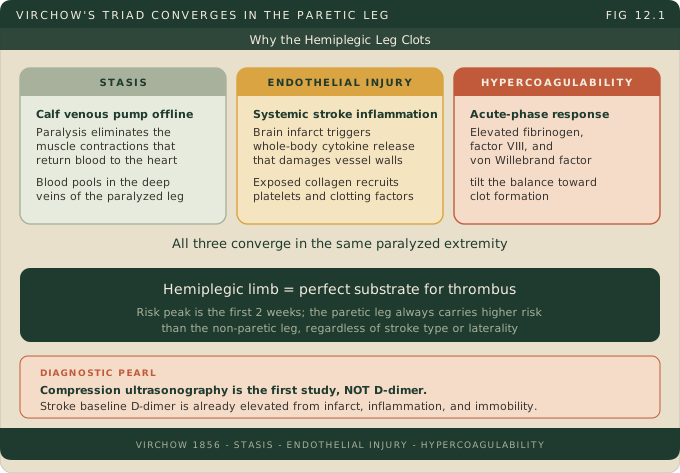
DVT and PE remain leading causes of preventable death in hospitalized stroke patients. Risk peaks during the first 2 weeks after stroke onset, when immobility is greatest and the prothrombotic acute-phase response is most intense. The hemiplegic leg carries substantially higher risk than the non-paretic side because loss of voluntary calf contraction eliminates the venous pump that normally returns blood to the heart. Blood stagnates in the deep veins of the paralyzed leg and activates the coagulation cascade. When a vignette asks which leg is at higher risk after stroke, the answer is the hemiplegic leg. Laterality raises the prior probability; it does not by itself diagnose or exclude a clot.
Venous stasis from immobility is the operative limb of Virchow’s triad here. Virchow’s triad remains the general framework for thrombosis, but do not read it as proof that a stroke directly injures the endothelium of the paretic leg.
When DVT is suspected in a patient with a swollen, warm leg and substantial clinical risk, obtain compression ultrasonography. A thrombosed proximal vein may fail to compress. D-dimer has limited utility in hospitalized patients because positive results are common for reasons other than new DVT. This lowers specificity; it does not mean stroke automatically abolishes the value of a negative sensitive assay. A negative D-dimer is used only within an appropriate low-pretest-probability diagnostic pathway, not as the sole exclusion test in this high-suspicion vignette. Persistent suspicion after a negative study requires reassessment and, when indicated, repeat imaging.
Treatment of confirmed DVT is therapeutic anticoagulation, typically LMWH at full therapeutic doses transitioned to an oral anticoagulant for a duration of 3 months when the provoking factor has resolved. An inferior vena cava (IVC) filter is reserved for venous thromboembolism plus an absolute anticoagulation contraindication, classically a recent large hemorrhagic transformation. The filter does not treat the thrombus; it catches propagating clot before it reaches the pulmonary vasculature. When anticoagulation becomes safe, it is initiated and a retrievable filter removed.
For immobile patients with acute ischemic stroke, prophylactic-dose UFH or LMWH is reasonable after individualized bleeding-risk assessment. There is no universal requirement to start LMWH within 48 hours. After intravenous thrombolysis, obtain follow-up CT or MRI at 24 hours before starting antithrombotics; elapsed time alone is not clearance. In nonambulatory spontaneous ICH, low-dose UFH or LMWH at 24–48 hours from hemorrhage onset may be reasonable after assessing hematoma stability and bleeding risk. Renal function guides drug and dose selection: severe renal impairment requires enoxaparin dose adjustment and often favors unfractionated heparin, 5,000 units subcutaneously every 8 to 12 hours, which is also the usual choice when bleeding risk argues for a shorter-acting drug. Severe renal impairment calls for LMWH dose adjustment, not a blanket prohibition.
The CLOTS trials addressed different comparisons. CLOTS 1 found no significant DVT reduction with thigh-length stockings versus no stockings, with more skin injury. CLOTS 2 found fewer proximal DVTs with thigh-length than below-knee stockings (6.3% versus 8.8%); it had no no-stockings control. CLOTS 3 found that IPC reduced the primary DVT outcome compared with no IPC (8.5% versus 12.1%). Current guidance recommends IPC for impaired mobility without contraindications and advises against elastic stockings. Begin appropriate mechanical prevention promptly; new signs of DVT require clinical reassessment rather than an automatic instruction to continue compression.
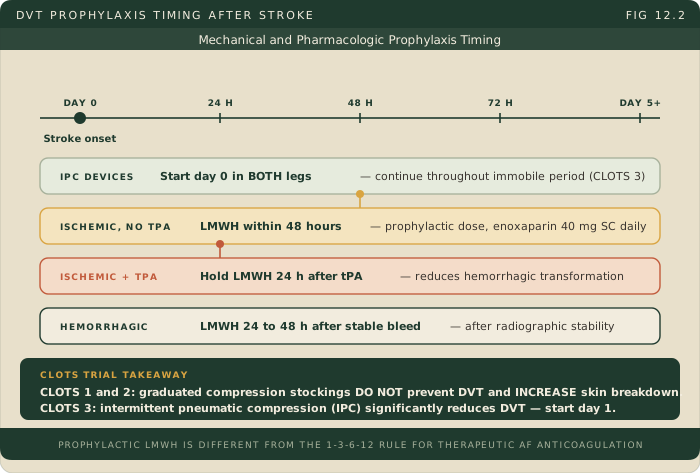
Timing of therapeutic anticoagulation after AF-related ischemic stroke balances recurrent embolism against intracranial bleeding, and the rule to know by name is the 1-3-6-12 rule: 1 day for a TIA, 3 days for a small infarct, 6 days for a moderate infarct, and 12 or more days for a large one, the logic being that a larger infarct has more tissue available to bleed. Know it as the board answer and as a historical consensus framework; the trials since have supported earlier starts in selected patients. ELAN started a DOAC within 48 hours for minor and moderate infarcts and on day 6 or 7 for major infarcts, compared with later initiation on days 3 to 4, 6 to 7, and 12 to 14 respectively; the composite reduction did not reach statistical significance. OPTIMAS (within 4 days versus 7 to 14) and TIMING (within 4 days versus 5 to 10) were both noninferior. The 2026 AHA/ASA guideline accordingly makes early oral anticoagulation a Class 2a option in carefully selected, generally milder AF-related strokes, while noting that prevention of early recurrence is not established. So decide from infarct size, clinical severity, follow-up imaging and hemorrhagic transformation rather than the calendar, and do not extend DOAC evidence to warfarin, heparin, mechanical valves, ICH or active bleeding. This decision is separate from low-dose VTE prophylaxis.
High Yield — DVT and Anticoagulation Timing
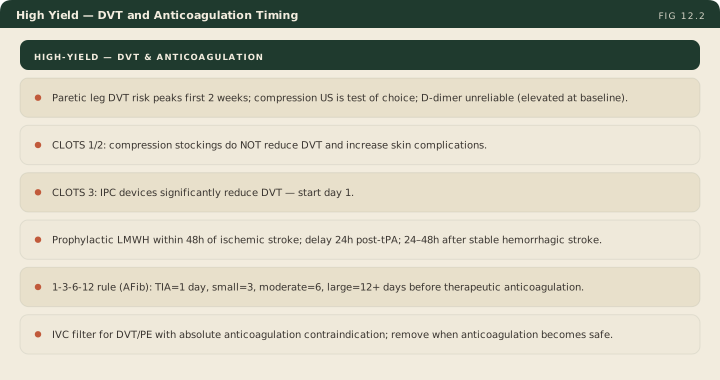
- Paretic leg carries dramatically higher DVT risk; risk peak is the first 2 weeks.
- Compression ultrasound for high clinical suspicion; D-dimer positivity is nonspecific in hospital.
- CLOTS 1: thigh stockings versus none, no DVT benefit and 5% versus 1% skin injury. CLOTS 2: thigh-length beat below-knee (6.3% versus 8.8% proximal DVT); no untreated control.
- CLOTS 3: IPC reduced DVT 8.5% versus 12.1%; use promptly for impaired mobility when appropriate.
- Individualize UFH/LMWH prophylaxis (UFH 5,000 units SC q8-12h when renal function or bleeding risk favors it); obtain 24-hour post-IVT brain imaging. ICH timing is 24 to 48 hours from onset with stability assessment.
- 1-3-6-12 (TIA 1 day, small 3, moderate 6, large 12+) is a historical framework; ELAN, OPTIMAS and TIMING support earlier DOAC start in selected patients, and the 2026 guideline makes it Class 2a.
- IVC filter when DVT/PE plus absolute anticoagulation contraindication; remove when anticoagulation is safe.
Board Trap — D-dimer in the post-stroke patient
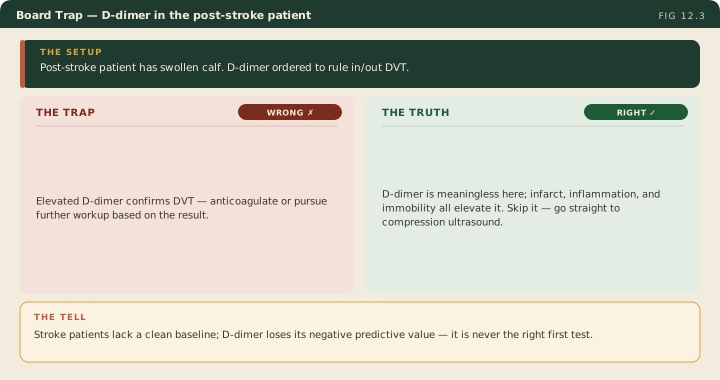
A positive D-dimer does not diagnose DVT. In this hospitalized patient with a swollen calf, compression ultrasound is the appropriate initial study. Do not generalize this to claim that every stroke patient has an elevated D-dimer or that a negative sensitive assay has no role in any validated low-risk pathway.
So checking a D-dimer in a stroke patient is basically like checking a fire alarm when you are already standing inside a burning building.
— CVA-12 podcast, ~5:54