Before You Listen
- Prerequisites: Modified Ashworth Scale (MAS) and the spasticity ladder from CVA-11; post-stroke depression and the SSRI evidence (FOCUS-AFFINITY-EFFECTS) from CVA-12; the noxious-stimulus loop from CVA-12; basic familiarity with hemispatial neglect, anosognosia, and homonymous hemianopia from CVA-10.
- Runtime: 37 minutes.
- Topic in one line: the social return after stroke. Sexual dysfunction in 50 to 75% with the 3 to 5 metabolic equivalent (MET) cardiovascular counseling and the PLISSIT model, the SSRI–PDE5 inhibitor problem and the absolute nitrate contraindication, driving evaluation with homonymous hemianopia and the state field and acuity standards, the on-road assessment by a Certified Driver Rehabilitation Specialist (CDRS) as the reference standard, adaptive equipment (spinner knob, left-foot accelerator, hand controls), state reporting duties and the seizure-free interval, the World Health Organization International Classification of Functioning (ICF) framework, vocational rehabilitation under the Americans with Disabilities Act (ADA), the Zarit Burden Interview and respite care for caregivers, and the secondary prevention package (hypertension control, the SPARCL statin, antiplatelet vs anticoagulant for atrial fibrillation, CRYSTAL-AF and EMBRACE rhythm monitoring, smoking cessation).
Vignette. A 60-year-old man is 4 months out from a left middle cerebral artery (MCA) ischemic stroke with mild residual right arm weakness at 4 out of 5 strength. His post-stroke depression has improved on sertraline 100 mg daily and his PHQ-9 is 6. He returns to clinic asking three things: he wants to know whether sex is safe; he reports new erectile dysfunction since starting sertraline; and he wants to know when he can drive again. His past medical history includes coronary artery disease for which he takes daily isosorbide mononitrate, hypertension on metoprolol and lisinopril, and atrial fibrillation on apixaban. On bedside exam, his Trail Making Test B time is 78 seconds, formal automated perimetry shows a full visual field, and there is no hemispatial neglect.
What metabolic equivalent (MET) reassurance addresses his cardiovascular safety question, what is the safest pharmacologic strategy for his sertraline-induced erectile dysfunction given his nitrate use, what office-based screen plus what gold-standard step gates his return to driving, and how should his cardiac medication indications affect review of sexual adverse effects?
(Answer at the end of this chapter)
Section 1: Sexual Dysfunction After Stroke and the PLISSIT Model
Bottom line: sexual dysfunction affects 50 to 75% of stroke survivors and fewer than 10% receive any counseling; the cardiovascular demand of intercourse is 3 to 5 METs, about the demand of climbing 2 flights of stairs; contributors are physical (motor, sensory, hip-adductor tightness, fatigue), psychological (depression, fear of incontinence, role reversal, fear of recurrent stroke), and pharmacologic; the PLISSIT model gives every clinician a graded counseling framework: Permission, Limited Information, Specific Suggestions, Intensive Therapy.
Sexual dysfunction after stroke is remarkably common, affecting 50 to 75% of survivors, yet fewer than 10% receive any counseling. The gap is one of the most striking failures in stroke rehabilitation, and boards test it because it sits at the intersection of medical knowledge, patient counseling, and pharmacology.
The etiology is multifactorial. Physical contributors include motor deficits that limit positioning and endurance, sensory changes that alter touch and pleasure, hemiplegia that restricts positions, fatigue, and hip-adductor tightness that physically impedes positioning (a particularly significant barrier for women). Psychological contributors are at least as significant. Depression (about 30% prevalence) reduces libido. Fear of triggering a recurrent stroke during sexual activity is one of the most common barriers, and it is the one the MET counseling exists to defuse. Fear of incontinence drives withdrawal. Changes in self-image erode confidence. Role reversal, when the partner becomes the caregiver, alters the relationship dynamic and creates a psychological barrier to viewing the survivor as a sexual partner.
The cardiovascular reassurance is concrete and tested. The metabolic demand of intercourse is 3 to 5 metabolic equivalents (METs), comparable to climbing 2 flights of stairs or walking briskly, and the 2012 AHA statement considers sexual activity reasonable for patients who can sustain that level of exertion without cardiac symptoms. The stair comparison is an approximation drawn from small exercise studies, so use it to frame the conversation and then check the patient’s actual cardiovascular stability, symptoms and functional capacity. Two things follow for management. If the patient has unstable or worsening cardiac symptoms, defer sexual activity and arrange cardiovascular evaluation first. If functional capacity is genuinely uncertain, order exercise testing rather than inferring safety from the fact that he tolerated three hours of inpatient therapy.
The PLISSIT model provides a graded framework for sexual counseling that every member of the rehabilitation team can apply at the appropriate level. It defines four levels of intervention.
At the Permission level, the clinician simply opens the door by raising the topic in a normalizing way. Most patients will not bring up sexual concerns spontaneously because of embarrassment, cultural factors, or the assumption that the physician is not interested. By stating that sexual concerns are common after stroke and that the topic is appropriate to discuss, the clinician grants permission. This is the most basic level and every physiatrist should be comfortable providing it from the outset of rehabilitation.
At the Limited Information level, the clinician provides basic education about the effects of stroke on sexual function and reassures the patient about safety. The 3 to 5 MET data point and the 2-flights-of-stairs analogy belong here.
At the Specific Suggestions level, the clinician offers practical advice tailored to the patient’s deficits: adaptive positioning (the affected side supported and not bearing weight; pillows for stability; a comfortable side-lying position when appropriate), timing of activity to coincide with peak energy and best-controlled spasticity (after antispasticity medication peak effect), pre-activity stretching, bladder emptying immediately before activity, and partner communication strategies.
At the Intensive Therapy level, patients with complex psychosexual issues are referred to a specialist in sexual medicine or a psychologist with expertise in sexuality and disability. Detailed counseling is typically most productive in the later stages of inpatient rehabilitation and during outpatient follow-up, when medical condition has stabilized. Permission-level intervention, however, is appropriate from the outset.
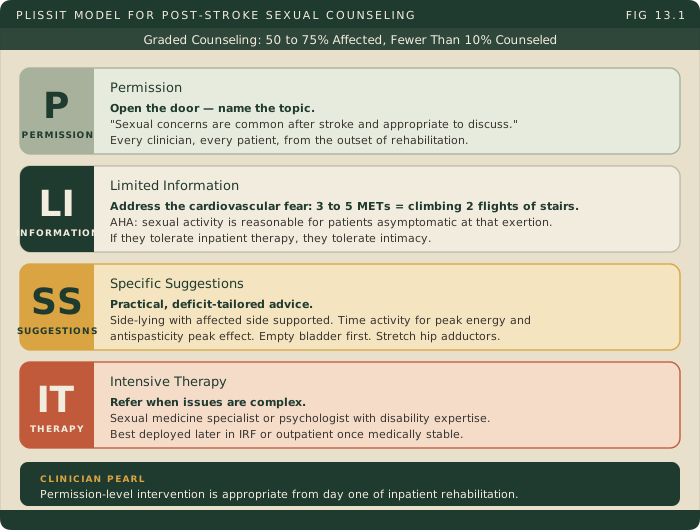
High Yield — Sexual Dysfunction and PLISSIT
- 50 to 75% of stroke survivors have sexual dysfunction; fewer than 10% receive counseling.
- 3 to 5 METs for intercourse, about 2 flights of stairs; the AHA considers activity reasonable at that exertion without cardiac symptoms. Unstable symptoms mean evaluate first.
- Hip-adductor tightness is a physically limiting issue, especially for women.
- Specific Suggestions include timing intimacy with antispasticity medication peak effect.
- Role reversal when partner becomes caregiver is a major psychological barrier; intentional separation of caregiver and partner roles is a target for counseling.
- PLISSIT levels: Permission → Limited Information → Specific Suggestions → Intensive Therapy.
- Permission-level intervention is appropriate from the outset of rehabilitation.
Patients will almost never bring this up themselves. They are waiting for a signal that it is medically relevant.
— CVA-13 podcast, ~8:11