Before You Listen
Episode Setup
- Topic in one line: the technical machinery between the patient and the waveform on the screen — Ohm’s law for the electrodiagnostic (EDX) circuit, the difference between monopolar and concentric needles, supramaximal stimulation and the constant-current rule, the differential amplifier and the common mode rejection ratio (CMRR), filter settings by study type and what altering them does to a waveform, the temperature effects on nerve conduction studies (NCS), and the safety rules for pacemakers, anticoagulation, and infection control.
- Prerequisites: EDX-01 (action potentials, motor units, the safety factor, the dorsal root ganglion (DRG) localization rule) and the basic algebra of Ohm’s law.
- Runtime: 53 minutes.
Vignette. A 56-year-old woman is referred for evaluation of bilateral hand numbness, worse on the right, with nocturnal awakening and pain radiating up the forearm. The electromyographer brings her into the laboratory on a cool February morning. Hand temperature is measured at 28.5 degrees C. Without warming, the median sensory peak latency to digit 2 is recorded at 4.1 ms (laboratory upper limit 3.5 ms), the median motor distal latency to abductor pollicis brevis (APB) at 4.8 ms (upper limit 4.4 ms), and the median compound muscle action potential (CMAP) amplitude at 7.0 mV. Comparison studies are not yet done. The technologist asks whether the prolonged latencies confirm carpal tunnel syndrome (CTS) or whether further work is needed before interpretation.
What is the minimum acceptable hand temperature for upper extremity NCS, what specific effects does cooling have on conduction velocity, distal latency, sensory nerve action potential (SNAP) amplitude, and CMAP amplitude, why does the amplitude behavior matter, and what does an arithmetic temperature correction give you that a repeat measurement does not? Also, what would the same cool-limb scenario do to a possible diagnosis of demyelinating neuropathy or to a side-to-side H-reflex comparison?
(Answer at the end of this chapter)
Section 1: Ohm’s Law, Electrodes, and Stimulating the Nerve
Bottom line: every EDX study is governed by Ohm’s law (V = I × R), with impedance replacing resistance for AC biological signals; the surface workhorse is the silver-silver chloride disc, and target electrode impedance is under 5-10 kOhms with E1 and E2 closely matched; monopolar needles have a wider recording field and record larger-amplitude MUAPs than concentric needles, so each needle type carries its own reference values; the dedicated single-fiber electrode has a 25-micrometer recording surface and a 500 Hz high-pass filter and measures jitter and fiber density, which concentric-needle jitter recording cannot; the cathode is the negative pole, it depolarizes the nerve, and it sits closer to the recording electrodes in the standard distal-recording arrangement, with anodal block the trap when polarity is reversed; supramaximal stimulation is 20 to 25 percent above the intensity at which the CMAP plateaus, and a constant-current stimulator holds its selected current only within its compliance voltage.
Every electrodiagnostic study is governed by Ohm’s law: V = I × R. In the laboratory, voltage represents the bioelectric signals being recorded (millivolts for CMAPs and microvolts for SNAPs and MUAPs); current represents the charge delivered by the stimulator; and resistance, or more precisely impedance (Z) for AC biological signals, opposes current flow. Tissue impedance, electrode impedance, and amplifier input impedance all influence signal quality. For AC signals, impedance includes resistive and reactive components: Z = sqrt(R² + X²), where the reactance X arises from capacitive and inductive elements. Capacitance is relevant throughout the laboratory: the skin-electrode interface acts as a capacitor, stray capacitance between nearby cables introduces noise, and capacitive coupling between the stimulator and recording electrodes can prolong stimulus artifact. Power dissipation, P = V × I, underlies electrical safety, though modern EMG machines operate at power levels inherently safe for routine use.
Surface electrodes are placed on the skin for recording CMAPs and SNAPs during nerve conduction studies. The standard is the silver-silver chloride (Ag/AgCl) disc, which provides a stable potential and low noise. Ring electrodes (metal bands around a finger) are convenient for digital sensory studies. Bar electrodes (two metal contacts at a fixed interelectrode distance) provide reproducible spacing. Adhesive pre-gelled disposable electrodes are convenient for single use but carry higher impedance when the gel layer is thin. Skin preparation is essential: clean with alcohol or abrasive prep to reduce impedance. The target impedance is below 5-10 kOhms at each electrode. Dead skin cells, oils, and lotions all increase impedance. E1 placement: for motor studies, E1 is placed directly over the motor point (the muscle surface closest to the terminal zone of the motor nerve), producing the largest CMAP with an initial negative deflection. For sensory studies, E1 is placed over the nerve trunk. E2 placement: E2 goes at the reference site the recording protocol specifies, conventionally 3-4 cm distal to E1 over the tendon for motor studies and at a defined fixed spacing for sensory studies. E2 is not electrically silent, and moving it changes the recorded amplitude and onset latency, which is why the protocol’s spacing has to be reproduced rather than approximated. Impedance matching between E1 and E2 must be as close as possible; impedance mismatch is the single most common cause of degraded common mode rejection (Section 3).
Display convention: a negative potential at E1 relative to E2 is displayed upward, and a positive potential downward. Negative up, positive down, the reverse of almost every other graph a physician reads, which is why it has to be stated rather than assumed. The convention explains the two initial deflections that matter most on needle exam. A source sitting directly under the recording electrode, such as an endplate spike, deflects negative and therefore upward. A wavefront traveling toward the electrode from a distance, such as a fibrillation potential, presents its leading positivity first and deflects downward. Needle position moves the electrode relative to the source, so polarity can change with it. Read initial polarity alongside morphology, firing pattern and recording site rather than calling a muscle denervated on polarity alone.
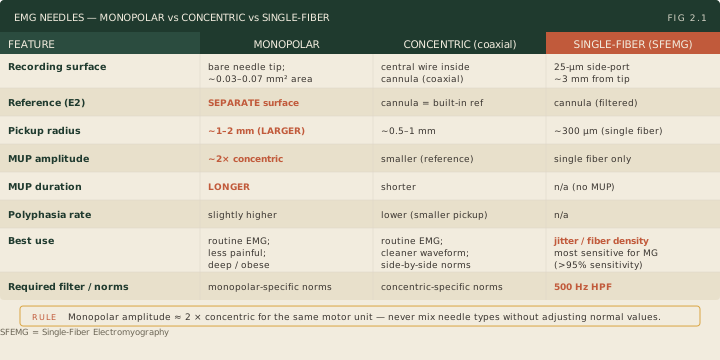
Two needle types dominate routine EMG. Monopolar needles are solid, Teflon-coated stainless steel needles with only the bare tip exposed as the recording surface, typically 0.03-0.07 mm², and a separate surface electrode serves as the reference. Concentric (coaxial) needles carry a fine insulated wire down the center of a hollow cannula: the central wire is E1 and the cannula is E2, so the reference sits millimeters away instead of on the skin. That geometry sets the recording field. A concentric needle’s main MUAP spike comes from fibers within roughly 0.5-1 mm; the monopolar needle, with its distant reference, draws from roughly 1-2 mm, and more distant fibers still contribute to the later components of both. A recording radius describes where most of the signal comes from, not a wall the rest of the muscle cannot cross.
The consequence is that the two needles put different numbers on the same motor unit. Monopolar MUAP amplitudes are larger. How much larger depends on the method, and the two published comparisons disagree: Chan and Hsu recorded the same unit with both needles simultaneously in tibialis anterior and found monopolar amplitude 2.05 times concentric and duration 1.86 times, with no difference in phases or turns; Pease and Bowyer recorded sequentially in extensor digitorum and found no significant difference in either. Take the direction, not a conversion factor, and read every MUAP against reference values collected with the needle you are holding; mixing needle types without switching norms produces interpretive errors. Pain depends on technique as much as on needle: monopolar hurts less on large movements, but small movements reduce concentric pain enough to erase the difference. Neither type detects abnormality better than the other.
A dedicated single-fiber EMG electrode has a 25-micrometer recording surface exposed at a side port behind the tip. It records individual muscle-fiber potentials from within roughly 300 micrometers of that surface, measures jitter and fiber density, and runs on a 500 Hz high-pass filter (typical bandpass 500 Hz to 10 kHz) to strip the slow components that would otherwise merge single fibers together. Concentric-needle jitter recording is a different technique, with its own signal-selection criteria and its own reference values, and it cannot measure fiber density at all. Jitter is highly sensitive to impaired neuromuscular transmission, with the sensitivity depending on the muscle, the method and the distribution of disease, and increased jitter is not specific for myasthenia gravis: reinnervation, some myopathies and botulinum toxin raise it too.
Surface stimulating electrodes consist of a cathode (negative pole) and an anode (positive pole) separated by 2-3 cm. Under the cathode, current flows outward across the nerve membrane and depolarizes it, and that is where the action potential starts. Under the anode, current flows inward and hyperpolarizes the membrane. In the standard distal-recording arrangement the cathode is placed closer to the recording electrodes and the anode proximally, so reversing the pair moves the activation site and changes the measured latency. Anodal block is what happens when hyperpolarization under the anode is enough to stop the action potentials generated under the cathode, producing a falsely reduced response. It is a real mechanism rather than an automatic consequence of every reversal, so when a response is unexpectedly small, check polarity, anatomy and stimulus adequacy rather than assuming any one of them. Constant-current stimulators are the clinical standard: they hold the selected current by raising voltage as impedance rises, and they do so up to their compliance voltage, beyond which excess circuit impedance simply prevents the requested current from being delivered. A constant-voltage stimulator delivers a fixed voltage, so the current reaching the nerve changes with skin thickness, subcutaneous fat, hydration and temperature, and stimulation is poorly reproducible from site to site. Total charge equals current × duration (Q = I × t). Standard NCS pulse duration is 0.1-0.2 ms; 0.5-1.0 ms reaches deep nerves and obese or edematous limbs, at the cost of discomfort, stimulus artifact and spread to neighboring nerves.
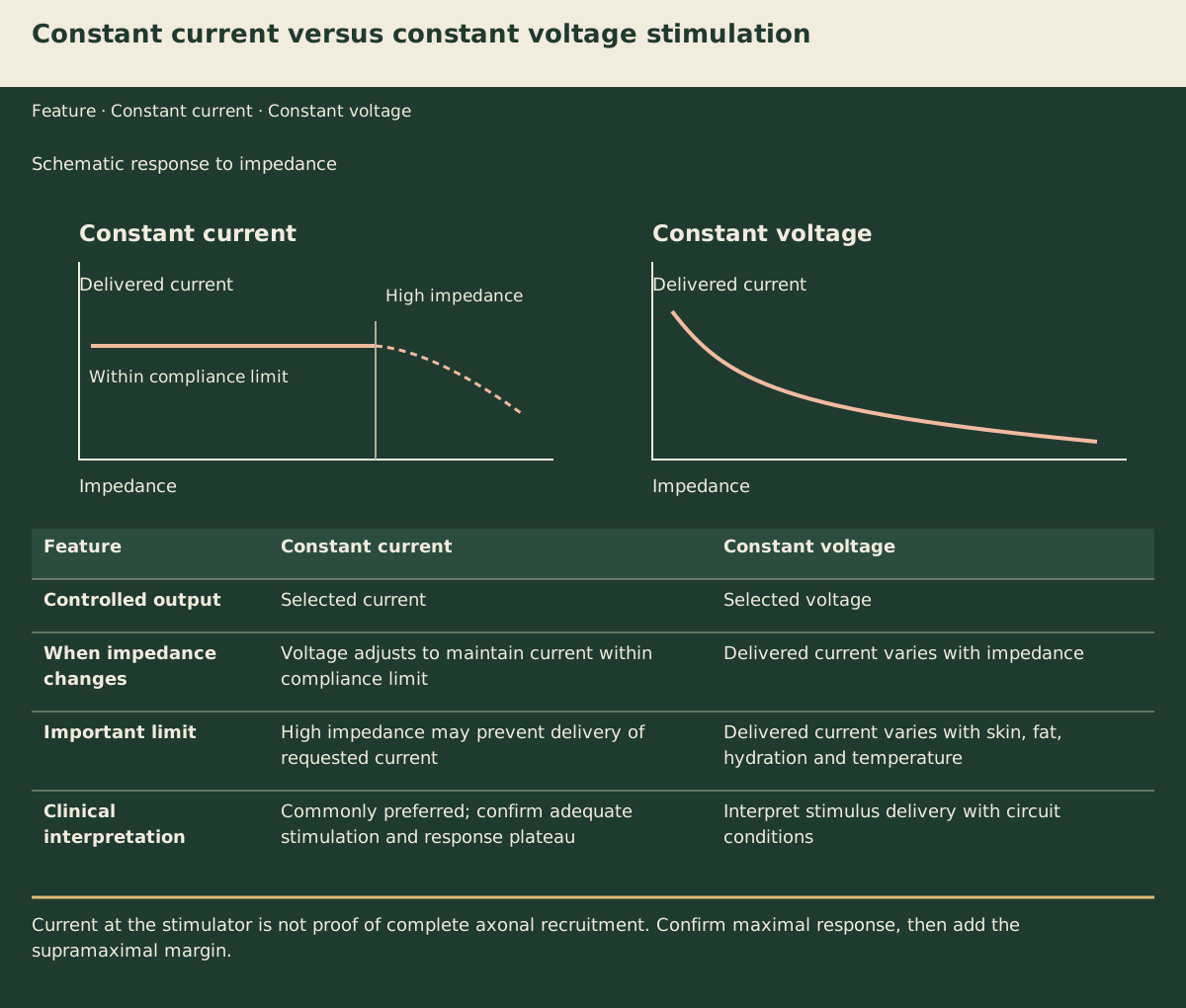
For motor NCS, the goal is to activate every axon in the nerve. Raise stimulus intensity until the CMAP amplitude reaches a reproducible plateau (maximal stimulation), then add 20-25% above that level (supramaximal stimulation). The test for submaximal stimulation is behavioral, not arithmetic: if amplitude still climbs when you raise the current, the earlier stimulus was submaximal. Reaching a plateau at a lower current than expected does not by itself mean the stimulus was inadequate. Inadequate stimulation is the classic technical error in motor NCS, because it produces a falsely low CMAP amplitude that reads as axonal loss or as conduction block at a proximal site. Confirm electrode placement, waveform reproducibility and adequate stimulation at every site, and note that patient discomfort does not prove the stimulus was adequate.
High Yield — Electrodes and stimulation
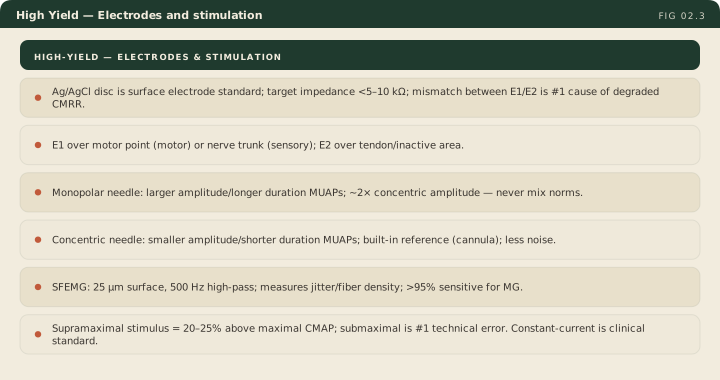
- V = I × R; impedance Z replaces R for AC biological signals.
- Surface electrode standard = Ag/AgCl disc; target impedance < 5-10 kOhms.
- E1 over motor point (motor) or nerve trunk (sensory); E2 3-4 cm distal over the tendon (motor) or at the protocol’s fixed spacing (sensory). E2 is not silent, so reproduce the spacing.
- Display convention, negative up and positive down: an endplate spike (source at the electrode) deflects negative/upward; a fibrillation potential (distant wavefront) deflects positive/downward. Needle position can change polarity, so read it with morphology and firing pattern.
- Impedance mismatch between E1 and E2 is the #1 cause of degraded CMRR.
- Monopolar needle: bare tip 0.03-0.07 mm², ~1-2 mm field, separate surface reference; LARGER-amplitude MUAPs; needs monopolar norms.
- Concentric needle: central active wire with cannula reference, ~0.5-1 mm field for the main spike; needs concentric norms.
- No fixed conversion factor: paired simultaneous recordings gave monopolar 2.05× amplitude and 1.86× duration (Chan and Hsu); sequential recordings found no significant difference (Pease and Bowyer). Keep the direction, drop the ratio, match the norms to the needle.
- Dedicated SFEMG: 25-micrometer surface, ~300-micrometer uptake, 500 Hz high-pass; measures jitter AND fiber density. Concentric jitter uses its own criteria and norms and cannot measure fiber density.
- Cathode (-) closer to the recording electrodes; depolarizes the nerve. Anodal block = anode-induced failure of propagation, one cause of an unexpectedly small response.
- Constant-current is the clinical standard, and it holds the selected current only within its compliance voltage.
- Stimulus duration 0.1-0.2 ms standard; 0.5-1 ms for deep/obese.
- Supramaximal = 20-25% above the current producing a reproducible maximal CMAP. Amplitude still rising with more current means the earlier stimulus was submaximal; submaximal stimulation falsely suggests axon loss or block.
Mnemonic — Cathode = Closer = Causes depolarization
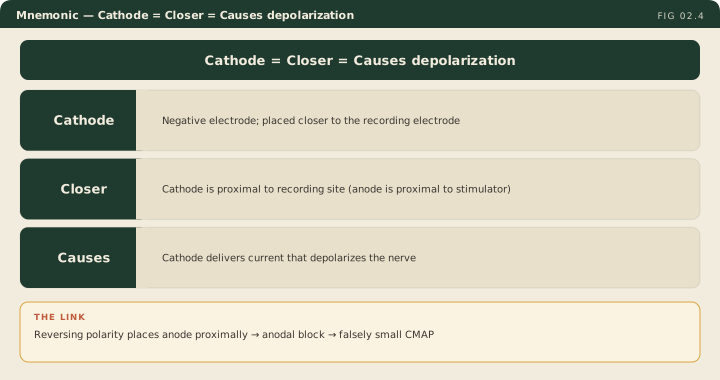
The Cathode (negative) is Closer to the recording electrodes and Causes depolarization. The anode is proximal. Reverse them and the activation site moves, the latency changes, and anodal block can cut the response down. If a CMAP is unexpectedly small, recheck polarity and stimulus adequacy; a response that improves when you flip the stimulator tells you the polarity was wrong, but a response that does not improve does not prove it was right.
That submaximal response perfectly mimics the physiological appearance of true axonal loss. You could misdiagnose a perfectly healthy nerve as severely diseased simply because you did not turn the dial high enough.
— EDX-02 podcast, ~22:16
Because the needle is picking up a positive charge first, and because positive is displayed downward, the initial deflection of a fibrillation potential on the screen dives downward.
— EDX-02 podcast, ~12:03
That downward first deflection is the typical fibrillation, and it is what the display convention predicts. Needle position moves the electrode relative to the source, so polarity is the opening evidence rather than the whole diagnosis.
So if the impedance at E1 is 2,000 ohms and E2 is 8,000 ohms, you have a serious problem. That mismatch is actually the single most common cause of a degraded common mode rejection ratio.
— EDX-02 podcast, ~7:54